题目内容

Many kids help out around the house with chores(家庭杂务) such as emptying the dishwasher, putting laundry away, and taking out the trash. In exchange, some kids get allowances(补贴) or other rewards such as extra computer time.

But some people do not think that kids should get rewards for doing chores. Susie Walton, a parenting educator and family coach, believes that by rewarding kids, parents are sending a message that work isn’t worth doing unless you get something in return. "Running any kind of household is a team effort," Susie said. "A home is a living space for everyone in the family. It’s important for kids to see that we all have responsibilities in the house, and that families decide together how they want their home to look, and how they are going to keep it looking like everyone wants it to look."

Other people believe that getting a cash allowance or other rewards motivates kids to do chores, and it also teaches them real world lessons about how we need to work to earn money. There are also new applications that give kids points and digital gifts that can be redeemed(兑取) either online or in the real world. With the ChoreMonster app, kids earn digital points by completing chores that they can turn in for real-life rewards such as extra Xbox time or a trip to the mall. "Our goal is to encourage kids to earn rewards," says Chris Bergman, founder of ChoreMonster. "Kids need positive reinforcement(强化) to help motivate them."

What do you think? Should kids be rewarded for doing chores? Or should kids help out around their homes without getting anything in return?

Write a 200-word response. Send it to tfkasks4you@timeforkids.com. Your response may be published in a future issue of Time For Kids. Please include your grade and contact information of your parent or teacher if you want your response to be published. The deadline for responding is February 18.

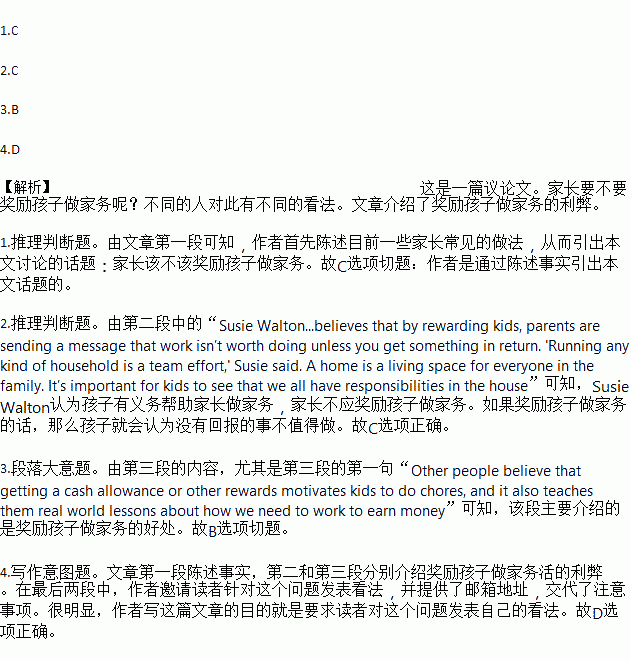
1.How does the author start the passage?

A. By comparing different views.

B. By listing some evidence.

C. By presenting some facts.

D. By stating his own experiences.

2.According to Susie Walton, _______.

A. kids should be rewarded for doing chores

B. parents decide what kids can do for the family

C. kids have the responsibility to share housework

D. kids can get extra computer time for doing chores

3.Paragraph 3 is mainly about ________.

A. Chris Bergman’s opinion on raising kids

B. the advantage of rewarding kids for doing chores

C. main reasons why kids need encouragement

D. how to motivate kids to try new applications

4.The purpose of writing the text is to __________.

A. inform readers of two different opinions

B. call on readers to reflect on their behavior

C. present the author’s viewpoint about parenting

D. invite readers to express their opinions
练习册系列答案
相关题目

Make the right choices

What is life’s gift? 1. Choice is the ability to select one course of action from a set of alternatives to achieve a goal. What is so great about choice? It transforms us from dumb animals into artists. Each of us becomes another Michelangelo. Choice becomes nothing other than the tool we use to sculpt (雕刻)our life. The tool doesn’t come free, however, for the price of choice is responsibility. 2. The reward is happiness.

Life is not still. It is a flow. 3. We constantly need to monitor where we are on our journey. We need to ask questions: Am I moving closer to my goals? If not, what corrective measures can I take? What action will I take now to readjust myself to my goals? Choice is power. Choice is at the heart of life. It is the creative power of life.

4. And your life becomes more convenient or comfortable because of them. For example, you decide which stores to shop at and which gas station to go to. But the decisions that we make to sculpt our lives are far more important than deciding where to shop. The more we appreciate the difference between minor and major decisions, the greater the probability that we will experience happiness and fulfillment.

All chess lovers realize that it isn’t necessary to win to enjoy the game. The pleasure is in the playing. Life is like a chess game. 5.

A.But when we accept ad carry it out, we get a great return.

B.Make the best moves you can under the circumstances.

C.Life is full of hard choices, and the bigger they are, the harder they get.

D.Every choice we make leads us closer to or farther from our goals.

E.Choose to carry out responsibilities not because you have to, but because you want to.

F.You have to make choices every day.

G..It is free will or choice.

Many of us know what it feels like to be an outside in high school. Some give in to the pressure to fit in; others remain “on the bottom of the social food chain”. However, Alexandra Robbins, the author of the book The Geeks Shall Inherit The Earth believes what makes people unpopular in high school, mainly an unwillingness to obey, tends to translate into success as an adult.

Robbins has spent the past decade analyzing the behavior of high school students. She found the things that make a student different make them a target. But in adulthood and outside of the school setting, the things “that make you different make you interesting, fun, and often successful,” she told the UK’s Daily Mail.

She researched the qualities that people found most valuable in adults. The top qualities are: creativity, free-thinking, vision, authenticity, self-awareness, honesty, curiosity, love of learning, and courage. “Those are qualities that are far more likely to be found in school outsiders than in the popular kids,” she said.

According to Robbins, when people are in with a popular crowd, they are more likely to hide aspects of their identity in order to fit into the group. As she put it to Yahoo.com, “You are more likely to have goals of social dominance(强势)rather than forming actual true friendships. You are more likely to let other people pressure you into doing things. None of those things is admirable or useful as adults.”

Meanwhile, in the eyes of Robbins, the outsiders are much more self-aware and much braver than the popular students. They are brave because they are sticking to being themselves in a challenging environment.

There are many celebrity examples of progress from unpopularity to later fame. Hollywood director Steven Spielberg was laughed at for being Jewish in high school. JK Rowling, author of hugely popular Harry Potter, was teased in school as a glasses-wearing child who lived mostly in books and daydreams.

Robbins encourages students to participate in out-of-class activities. “They will automatically meet people with similar tastes,” she told Daily Mail.

1.According to Robbins, what can make a student a target in high school?

A. Difference to others

B. Pressure to fit in

C. Unwillingness to obey

D. Behavior of high school students

2.Which quality is NOT considered to be valuable in adults?

A. Being creative

B. Being authentic

C. Being different

D. Being curious

3.Why do popular kids tend to be not as successful as outsiders?

A. They may have goals of forming actual true friendships

B. They may hide aspects of their identity to fit in

C. They may force others into doing things

D. They may stick to being themselves in the society

4.Which of the following statements is true?

A. Young people who are outside are successful as adults

B. JK Rowling is one of celebrities of unpopularity

C. Unpopular students develop skills while the popular don’t

D. Robbins encourages young people to be themselves

违法和不良信息举报电话:027-86699610 举报邮箱:58377363@163.com

精英家教网