题目内容

Mail lay scattered across the kitchen table. I couldn’t put off sorting through it any longer. I checked the envelopes, putting aside the ones addressed to my husband.

It had been over three years since Bob had died. To friends and family it looked like I had moved past the worst of my sorrow. I took care of my house, socialized and kept up with community. On the outside everything appeared to be normal. But inside I was anything but I worried I would never get better, never be myself again. They say sorrow has no set time limit, but I was so tired of feeling empty and hopeless. My sorrow was sharp and fresh as ever. It was like a wall of pressure in my chest, pressing my heart.

I picked up a piece of Bob’s mail and held it out to tear in half, but stopped myself from cutting up the envelope. The letter was from an organization that funded a Haitian orphanage called My Father’s House. Its founder, Carol Hawthorne, had given a presentation at our church. Bob and I had donated, and Bob ended up on the mailing list to receive the newsletter (通讯) with updates on the children.

I hadn’t read one since Bob died. But just three months before, in January 2012, the country had been hit by a terrible earthquake. In my depressed state, it hadn’t even occurred to me to wonder whether the orphanage had survived. I opened the newsletter and was surprised to find out that My Father’s House was still standing. Of course now it was more crowded than ever. At the bottom of the page was an announcement about an upcoming trip to visit the orphanage in person. “I should go.” The thought wouldn’t leave me. I contacted Carol Hawthorne.“What would I do if I go?” I asked.“Build houses?”

“The Haitian people there are eager to work and they know what they’re doing,” said Carol. “What they need are raw materials, and we provide them. We also visit with the children. We go to clinics and schools, pass out supplies. You’ll be very busy, I promise!” I reserved a seat but didn’t mention it to any of my friends. Just a few weeks later, I was at the airport with seven strangers, waiting to board a plane to Haiti. Even after takeoff I wasn’t really sure of what I was doing.

In Haiti we were met by Pastor Ronald Lefranc, the director of My Father’s House. We piled into an old school bus and drove over uneven roads full of stones and mud. We passed women shaking under the weight of huge water buckets balanced on their heads. Piles of rubbish scattered across the landscape, and the land was covered with broken tents. Finally we pulled up to the orphanage. A crowd of children—52 in all—rushed up to greet us. I couldn’t understand the words of the song they sang in Creole, but with the smiles on their faces I didn’t need to. Each child planted a big kiss on my cheek.

Carol and Pastor Ronald led us into the main building. “What are those over there?” I asked, pointing to a collection of thin tents. “Is there not enough room in the building for all the children?”

“We have the room,” said Pastor Ronald. “But many of these children came here after the earthquake. They still don’t feel safe sleeping under a roof.”

There was no sign of fear in the playroom inside. I played dolls and other games. Children I’d just met presented me with pictures they’d drawn and letters written in Creole. In the evening the children gathered in the dining room. They took turns reading aloud and then they all joined in song. The words were strange, but the tune sounded familiar.

They’d lost so much, yet were so joyful. In the evening the children gathered in the dining room. One of the older children stood up to speak and then they all joined in song. The words were strange, but the tune sounded familiar. The children settled down. In the silence, a quiet noise began.

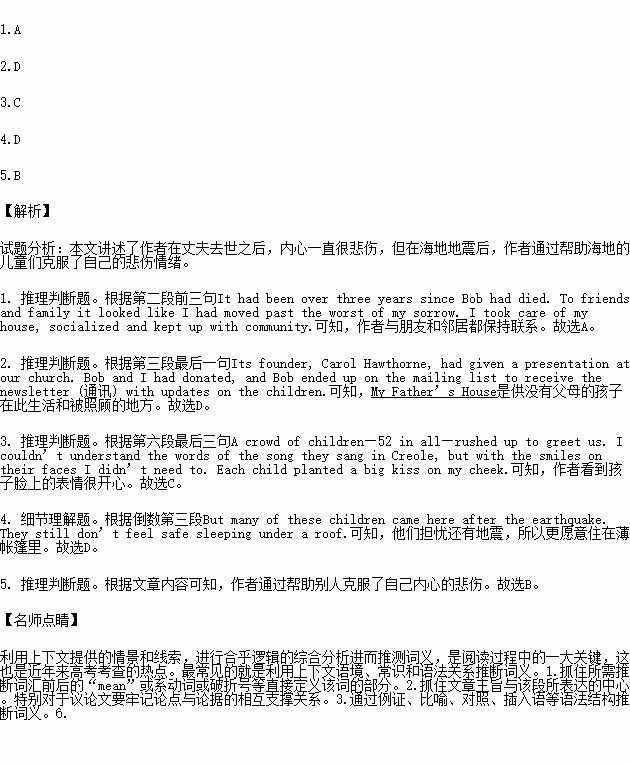
1.During the three years after her husband’s death, the writer ________.

A. kept in close touch with friends and neighbors

B. just stayed at her home to take care of her house

C. forgot her unhappiness completely with busy work

D. lived in emptiness and hopelessness due to hardships

2.What does the underlined part “My Father’s House” refer to?

A. An association that fund the research into earthquake in Haiti.

B. An institution where children without parents greet foreigners.

C. An organization that collect money for children without parents.

D. A place where children without parents live and are looked after.

3.The writer enjoyed herself at ________.

A. driving over the roads

B. viewing the landscape

C. seeing the expressions on children’s faces

D. observing water buckets on women’s heads

4.Why did the children love to live in the thin tents?

A. Because they had to make preparations for the newcomers.

B. Because the tents are convenient for drawing in the open.

C. Because the rooms in the building are used to house guests.

D. Because they worried there might be another earthquake.

5.What can we conclude from the passage?

A. The writer decided to settle down in Haiti at last.

B. The writer overcame her loss by helping others.

C. The writer taught the children to sing in English.

D. The writer picked up Creole during her stay there.
练习册系列答案
相关题目

When Luke went to university he thought he would be on a new journey in life and getting his own place. In the UK, it’s common to fly the nest at a fairly young age. Many choose a flat-share; others make plans to get on the property ladder.

But the current economic situation forced Luke back to his mum’s house at the age of 27. And he’s not alone: a quarter of young adults in the UK now live with their parents. The Office for National Statistics said more than 3.3 million adults between the ages of 20 and 34 were living with their parents in 2013.

Lack of jobs and the high cost of renting accommodation made Luke change his plans. He’s upset. "There’s something very difficult about being an adult living in an environment where you’re still a child," he says. "It limits me socially; sometimes I feel it limits me professionally."

Indeed, many young people have no choice but to stay at "the hotel of Mum and Dad".

Krissy had to return home after a year away and now lives in rather terrible conditions, sharing the family’s three-bedroom house with her sisters. She says they end up getting on each other’s nerves when it’s time to use the bathroom in the morning.

Of course, living with your parents is not unusual in some countries. Economic conditions, culture, or family traditions mean many young people stay at home until they get married. Even then, it can be too expensive to rent or buy a house and the married couples continue to live at one of their parents’ homes.

But some parents seem to enjoy having their kids back at home. Janice’s daughters are part of what’s being called "the boomerang generation". She says, "I get to share their lives with them, and I’ve got to know them all as adults. We have the sort of conversations that good friends do."

So for some it’s a win-win situation — spending time with your families, and saving money.

1.How is the passage developed?

A. By listing figures

B. By making comparisons

C. By analyzing causes

D. By giving examples

2.We can learn from the passage that.

A. living with parents is common in some countries

B. all the parents enjoy living with their children

C. the author approves of children’s living with parents

D. Janice belongs to a group called "the boomerang generation"

3.What does the underlined sentence mean in the fifth paragraph?

A. They get on very well with each other.

B. They shout at each other angrily.

C. They finally make each other annoyed.

D. They are unwilling to share with each other.

4.What is the purpose of the passage?

A. To persuade children into living on their own after getting married.

B. To show the present situation of young people living with their parents.

C. To compare the advantages and disadvantages of living with parents.

D. To present the problems young adults may face after going to university.

Dear John,

My name is Amber and I want to share my story with you because what you've shared about life and positive energy has changed my life. This past year has been one of the hardest for me. I felt I was stuck in a position that had nothing to do with what I wanted to do with my life. In January, after two years of being together, my boyfriend left me.

I read your blog every morning as I drink my coffee at work, but it wasn't until this March that I told myself "no more negativity" as you taught readers in your blog.

Since then I've got into new habits at work to keep my energy positive. When people walk in the front door, I'm the first face they see, so I smile big when I say "good morning" to them, especially on Mondays. Instead of waiting for someone to ask me for help, I offer it with an open mind. The CEO noticed my change and offered me the executive assistant position that I wanted.

One of the biggest things I've taken to heart from your blog is changing my opinions on my job. Yes, it was not an important position, but when I was passionate (热情的) about it, I could make my life fulfilling.

All in all, I have to thank you somehow for having the passion to help others because it truly is inspiring to me. So thank you so much, John. My life has changed because your words pointed me in the right direction, Take care!

Sincerely ,

Amber

1.Amber wrote the letter mainly to______

A. introduce herself to John

B. talk about her bad year

C. ask for some advice

D. express her thanks

2.We can infer from the passage that Amber______

A. didn't like her boyfriend

B. spent a lot of time online

C. wasn't satisfied with her job

D. received very good education

3.What is implied about John in the letter?

A. He is a very famous writer.

B. He used to live a very negative life.

C. He doesn't like sharing his life stories.

D. He likes helping others through writing positive blogs.

4.What does Amber's change tell us?

A. Practice makes perfect.

B. Bad luck doesn't exist long.

C. A positive attitude is rewarding.

D. A friend in need is a friend indeed.

Two of the saddest words in the English language are “if only”. I live my life with the goal of never having to say those words, because they convey regret, lost opportunities, mistakes, and disappointment.

My father is famous in our family for saying, “Take the extra minute to do it right.” I always try to live by the “extra minute” rule. When my children were young and likely to cause accidents, I always thought about what I could do to avoid an “if only” moment, whether it was something minor like moving a cup full of hot coffee away from the edge of a counter, or something that required a little more work such as taping padding (衬垫) onto the sharp corners of a glass coffee table.

I don’t only avoid those “if only” moments when it comes to safety. It’s equally important to avoid “if only” in our personal relationships. We all know people who lost a loved one and regretted that they had foregone an opportunity to say “I love you” or “I forgive you.” When my father announced he was going to the eye doctor across from my office on Good Friday, I told him that it was a holiday for my company and I wouldn’t be here. But then I thought about the fact that he’s 84 years old and I realized that I shouldn’t give up an opportunity to see him. I called him and told him I had decided to go to work on my day off after all.

I know there will still be occasions when I have to say “if only” about something, but my life is definitely better because of my policy of doing everything possible to avoid that eventuality. And even though it takes an extra minute to do something right, or it occasionally takes an hour or two in my busy schedule to make a personal connection, I know that I’m doing the right thing. I’m buying myself peace of mind and that’s the best kind of insurance for my emotional well-being.

1.Which of the following is an example of the “extra minute” rule?

A. Start the car the moment everyone is seated.

B. Leave the room for a minute with the iron working.

C. Wait for an extra minute so that the steak tastes better.

D. Move an object out of the way before it traps someone.

2.The author decided to go to her office on Good Friday to ________.

A. keep her appointment with the eye doctor

B. meet her father who was already an old man

C. join in the holiday celebration of the company

D. finish her work before the deadline approached

3.The underlined word “foregone” in Paragraph 3 is closest in meaning to ________.

A. avoidedB. lackedC. abandonedD. took

4.What is the best title for the passage?

A. The Emotional Well-being

B. The Two Saddest Words

C. The Most Useful Rule

D. The Peace of Mind

违法和不良信息举报电话:027-86699610 举报邮箱:58377363@163.com

精英家教网