There are about 22 million non-European Americans, mainly Black Americans, Red Indians, Latin Americans and other peoples.

  The Red Indians number about 600,000.They are the natives of America.They look somewhat like Tibetans.They are not red, but brown.They were called Indians by mistake.When Columbus landed in the New World in 1492, he thought he had landed in India and called the people Indians.

  The Black people had a sad history.Nearly all of them are descendants(后裔)of Africans brought from Africa to America sold as slaves in the 17th and 18th centuries.Today, they are about 21 million in number or 11 percent of total American population.Most of them lived in the South till the 1930s and since then more and more were leaving the South to look for work in the industrial North.Today, 60 percent of Black Americans live in New York, Chicago and other big cities.

  Mexicans who belong to Latin Americans are the 2nd biggest minority nationality.Most of them are immigrant(移民)farm workers.The Puerto Ricans, from the island of Puerto Rica off the coast of Florida, live mostly in the slums(贫民窟)of big cities like New York and Chicago.These two peoples like the Afro-Americans mostly live below the poverty line.

  There are Chinese people living in America, too-almost a quarter of million(the exact figure is 236,000).Many of them went to America about 100 years ago to build the railways there.They suffered a great deal.Today, most Chinese Americans live in California(a state facing the Pacific Ocean)and New York, and also in Hawaii, and archipelago(群岛)in the mid-Pacific, which is counted as the 50th state of the U.S.A.

(1)

Which of the following shows the right relationship among the population of American minorities?

[  ]

A.

American natives>Blacks>Mexicans>Chinese

B.

Red Indians>Afro-Americans>Chinese

C.

Blacks>Mexicans>European Americans>American Indians

D.

Black Americans>Mexicans>Indians>Chinese

(2)

Which of the following shows the right historical order?

a.The Afro-Americans were brought to American.

b.Lots of Chinese people built the railways in the U.S.A.

c.Columbus found the "New World".

d.Hawaii became one of the states of the U.S.A.

e.The Black Americans left the South for the North.

[  ]

A.

c-a-b-e-d

B.

c-b-e-d-a

C.

a-e-c-d-b

D.

d-c-b-a-e

(3)

According to the passage, which of the following statements is true?

[  ]

A.

Puerto Rica is among the 50 states of the U.S.A.

B.

Columbus was the first to call American Indians Red Indians.

C.

Most of the American minorities used to live a happy life.

D.

Black Americans and Puerto Ricans have begun to move from the countryside to big cities.

(4)

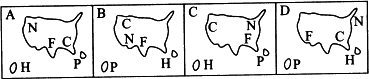
Which of the following maps gives the fight positions of the given places?(  )

(C-California;F-Florida;H-Hawaii;N-New York:P-Puerto Rica Island)

Mark Twain has been called the inventor of the American novel. And he surely deserves additional praise: the man who popularized the clever literary attack on racism.
I say clever because anti-slavery fiction had been the important part of the literature in the years before the Civil War. H. B. Stowe’s Uncle Tom’s Cabin is only the most famous example. These early stories dealt directly with slavery. With minor exceptions, Twain planted his attacks on slavery and prejudice into tales that were on the surface about something else entirely. He drew his readers into the argument by drawing them into the story.
Again and again, in the postwar years, Twain seemed forced to deal with the challenge of race. Consider the most controversial, at least today, of Twain’s novels, Adventures of Huckleberry Finn. Only a few books have been kicked off the shelves as often as Huckleberry Finn, Twain’s most widely read tale. Once upon a time, people hated the book because it struck them as rude. Twain himself wrote that those who banned the book considered the novel “trash and suitable only for the slums (贫民窟).” More recently the book has been attacked because of the character Jim, the escaped slave, and many occurences of the word nigger. (The term Nigger Jim, for which the novel is often severely criticized, never appears in it.)
But the attacks were and are silly—and miss the point. The novel is strongly anti-slavery. Jim’s search through the slave states for the family from whom he has been forcibly parted is heroic. As J. Chadwick has pointed out, the character of Jim was a first in American fiction—a recognition that the slave had two personalities, “the voice of survival within a white slave culture and the voice of the individual: Jim, the father and the man.”
There is much more. Twain’s mystery novel Pudd’nhead Wilson stood as a challenge to the racial beliefs of even many of the liberals of his day. Written at a time when the accepted wisdom held Negroes to be inferior (低等的) to whites, especially in intelligence, Twain’s tale centered in part around two babies switched at birth. A slave gave birth to her master’s baby and, for fear that the child should be sold South, switched him for the master’s baby by his wife. The slave’s lightskinned child was taken to be white and grew up with both the attitudes and the education of the slave-holding class. The master’s wife’s baby was taken for black and grew up with the attitudes and intonations of the slave.
The point was difficult to miss: nurture (养育), not nature, was the key to social status. The features of the black man that provided the stuff of prejudice—manner of speech, for example— were, to Twain, indicative of nothing other than the conditioning that slavery forced on its victims.
Twain’s racial tone was not perfect. One is left uneasy, for example, by the lengthy passage in his autobiography (自传) about how much he loved what were called “nigger shows” in his youth—mostly with white men performing in black-face—and his delight in getting his mother to laugh at them. Yet there is no reason to think Twain saw the shows as representing reality. His frequent attacks on slavery and prejudice suggest his keen awareness that they did not.
Was Twain a racist? Asking the question in the 21st century is as wise as asking the same of Lincoln. If we read the words and attitudes of the past through the “wisdom” of the considered moral judgments of the present, we will find nothing but error. Lincoln, who believed the black man the inferior of the white, fought and won a war to free him. And Twain, raised in a slave state, briefly a soldier, and inventor of Jim, may have done more to anger the nation over racial injustice and awaken its collective conscience than any other novelist in the past century.
【小题1】 How do Twain’s novels on slavery differ from Stowe’s?

A.Twain was more willing to deal with racism.
B.Twain’s attack on racism was much less open.
C.Twain’s themes seemed to agree with plots.
D.Twain was openly concerned with racism.
【小题2】Recent criticism of Adventures of Huckleberry Finn arose partly from its ______.
A.target readers at the bottom
B.anti-slavery attitude
C.rather impolite language
D.frequent use of “nigger”
【小题3】What best proves Twain’s anti-slavery stand according to the author?
A.Jim’s search for his family was described in detail.
B.The slave’s voice was first heard in American novels.
C.Jim grew up into a man and a father in the white culture.
D.Twain suspected that the slaves were less intelligent.
【小题4】The story of two babies switched mainly indicates that ______.
A.slaves were forced to give up their babies to their masters
B.slaves’ babies could pick up slave-holders’ way of speaking
C.blacks’ social position was shaped by how they were brought up
D.blacks were born with certain features of prejudice
【小题5】What does the underlined word “they” in Paragraph 7 refer to?
A.The attacks.B.Slavery and prejudice.
C.White men.D.The shows.
【小题6】What does the author mainly argue for?
A.Twain had done more than his contemporary writers to attack racism.
B.Twain was an admirable figure comparable to Abraham Lincoln.
C.Twain’s works had been banned on unreasonable grounds.
D.Twain’s works should be read from a historical point of view.

While we were riding the old German bus in Albania, a gypsy (吉普赛人) girl got on. She was about seven years old. Most gypsy children had a 36 look in their eyes.

     They were hardened by the world and by 37 they had experienced. The gypsies 38 in slums (贫民窟). The children begged on the streets or did other work so that their parents could 39 to buy wine. Every time we saw these 40 , we could always see the dead look in their eyes. But not this 41 . She was cheerful and had a beautiful smile on her face. As soon as she 42 , she started talking to us. Her name was Angela and she was on her 43 to visit her grandfather in a nearby slum village. I 44 my purse for something nice to give her. 45 , all I had with me was gum. She eagerly put a 46 in her mouth, and then squinted (眯着眼睛看) her eyes because the 47 was mint-flavored (薄荷味). It seemed like she had 48 tasted it before. She 49 in a funny way and the other people on the bus were all amused by what she did. When the bus 50 , she picked up the big bag she was carrying, 51 and jumped out of the bus.

    She is out of my life, but not out of my 52 . This girl deserved so much more than her 53 surroundings, yet she didn’t let any of them get herself 54 . I pray I will 55 her again someday, so that I can give her that hug which I should have given her that day on the bus!

1.                A.worried        B.happy          C.dead D.curious


2.                A.which          B.this            C.that  D.what


3.                A.lived           B.played          C.worked   D.studied


4.                A.manage        B.try             C.have D.afford


5.                A.children        B.adults          C.beggars   D.passers-by


6.                A.day            B.girl            C.place D.story


7.                A.sat down        B.crowded in      C.moved off D.lied down


8.                A.bus            B.car            C.way  D.taxi


9.                A.searched       B.examined       C.touched  D.found


10.               A.Fortunately      B.Sadly           C.Surprisingly D.Clearly


11.               A.little           B.block          C.piece D.set


12.               A.smell          B.sweet          C.sugar D.gum


13.               A.ever           B.never          C.always D.often


14.               A.laughed        B.shouted        C.cried D.complained


15.               A.got on         B.got off         C.pulled in   D.pulled down


16.               A.sighed         B.bent           C.nodded   D.waved


17.               A.feeling         B.dream         C.mind D.eyesight


18.               A.poor           B.warm          C.comfortable    D.rich


19.               A.off            B.up            C.away D.down


20.               A.help           B.meet          C.invite D.thank


Soccer is played by millions of people all over the world, but there have only been few players who were truly great. How did these players get that way---was it through training and practice, or are great players “born, not made”? First, these players came from places that have had famous stars in the past---players that a young boy can look up to and try to imitate(模仿). In the history of soccer, only seven countries have ever won the World Cup---three from South America and four from western Europe. There has never been a great national team---or a really great player---from North America or from Asia. Second, these players have all had years of practice in the game. Alfredo Di Stefano was the son of a soccer player, as was Pele. Most players begin playing the game at the age of three or four.

Finally, many great players come from the same kind of neighbourhood---a poor, crowded area where a boy’s dream is not to be a doctor, lawyer, or businessman, but to become a rich, famous athlete or entertainer(艺人). For example, Liverpool, which produced the Beatles, had one of the best English soccer teams in recent years. Pele practiced in the street with a “ball” made of rags(破布). And George Best learned the skills that made him famous by bouncing the ball off a wall(对着墙壁踢球) in the slums(贫民窟) of Belfast.

All great players have a lot in common, but that doesn’t explain why they are great. Hundreds of boys played in those Brazilian streets, but only one became Pele. The greatest players are born with some unique quality that sets them apart from all the others.

1.According to the writer, which of the following statements is true?

A. Soccer is popular all over the world, but truly great players are few.

B. Millions of people all over the world are playing soccer, but only seven countries have ever had famous stars.

C. Soccer is played by millions of people all over the world, but only seven countries from South America and western Europe have ever had great national teams.

D. Soccer is one of the most popular games all over the world, but it seems the least popular in North America and Asia.

2.The Brazilian streets are mentioned to illustrate that ______.

A. famous soccer players live in slum areas

B. people in poor areas are born with some unique quality

C. children in poor areas start playing football at the age of three or four

D. a great soccer player may be born in a slum area

3.In the last paragraph the statement “…but only one became Pele” indicates that ______.

A. Pele is the greatest soccer player

B. the greatest players are born with some unique quality

C. Pele’s birthplace sets him apart from all the others

D. the success of a soccer player has everything to do with the family background

4.. The writer mentions all the factors that may affect a soccer player’s success except ______.

A. his family background     B. his neighbourhood    C. his character    D. his practice


违法和不良信息举报电话:027-86699610 举报邮箱:58377363@163.com

精英家教网