题目内容

阅读理解

A scientist turns out to be able to see the future by offering each of some four-year-olds a piece of candy and watching how he or she deals with it. Some children reach eagerly for the treat they see. Some last a few minutes before they give in. But others are determined to wait until the last moment.

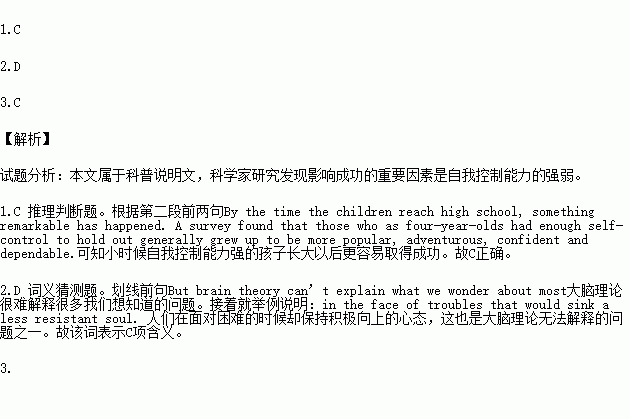
By the time the children reach high school, something remarkable has happened. A survey found that those who as four-year-olds had enough self-control to hold out generally grew up to be more popular, adventurous, confident and dependable. The children who gave in to temptation early on were more likely to be lonely, easily frustrated and inflexible .Actually, the ability to delay reward is a sign of emotional intelligence which doesn’t show up on an IQ test.

The hardware of the brain and the software of the mind have long been scientists’ concerns. But brain theory can’t explain what we wonder about most, like the question why some people remain upbeat in the face of troubles that would sink a less resistant soul.

Here comes the theory of Daniel Goleman, writer of Emotional Intelligence: when it comes to predicting people’s success, brain ability as measured by IQ may actually matter less than the qualities of mind once thought of as “character”.

EQ is not the opposite of IQ. What researchers have been trying to understand is how they work together; how one’s ability to handle stress, for instance, affects the ability to concentrate and put intelligence to use. Among the elements for success, researchers now generally agree that IQ counts for about 20%; the rest depends on everything from social class to luck.

While many researchers in this relatively new field are glad to see emotional issues finally taken seriously, some few fear EQ invites misuse.

1.The experiment with the four-year-olds makes it clear that______ .

A. the age of 4 is a proper time for scientific experiment

B. emotional intelligence won’t show up until adolescence

C. the ability of self-control plays a role in personal success

D. candy can be used to measure a person’s emotional intelligence

2.The underlined word “upbeat” in Paragraph 4 probably means______ .

A. kind B. floating C. excited D. cheerful

3.Why does the author mention the experiment at the beginning of the text?

A. To amuse both the children and readers.

B. To prove the scientist’s wisdom.

C. To introduce the topic of the text.

D. To show us how to do an IQ test.
练习册系列答案
相关题目

People who are slightly overweight or mildly obese(肥胖的) have a lower risk of early death than normal weight individuals(个人;个体), according to a new analysis of nearly 100 international studies.

The studies, most conducted within the past decade, included about three million adults from around the world. The result of these studies by researchers at the National Center for Health Statistics in Maryland, part of the U.S. Centers for Disease Control and Prevention, shows that slightly overweight or obese people were six percent less likely to die from all causes compared to people of normal weight. But the researchers found that seriously obese individuals were still at a 30 percent greater risk of death compared to healthy-weight individuals.

Study lead author Katherine Flegal says she was not surprised that overweight people would not have a higher death risk. “Because we'd actually already read a lot of this literature and realized that death rates for overweight would be at least not higher than normal[weight," she said. “I guess l was a little bit surprised that it was definitely lower. And l was also surprised that the lower rates of obesity didn't seem to differ from normal weight."

But Flegal stresses the difference in death rates appear to be small between normal-weight people and overweight and mildly obese individuals.

The finding by Flegal and colleagues have raised new questions about the reliability(可靠性)of the so-called "body mass index" or BMI, a measurement of body fat as a ratio(比例,比率)of height to weight, that has become popular in recent years among public health experts to measure potential health risks.

But Heymsfield warns that individuals should not conclude that it's okay to put on extra kilograms, since being at a healthy weight lowers the risk for heart disease and diabetes.

1.Katherine Flegal feels surprised at the fact that____.

A. obese people have higher death rates

B. slightly obese people have lower death rates

C. obese people tend to die early

D. death rates have nothing to do with body weight

2.What do we learn from the fifth paragraph?

A. BMI may not be so reliable.

B. The study provides further evidence for BMI.

C. BMI tells nothing about potential health risks.

D. BMI has been much questioned recently.

3.What can we conclude from the passage'?

A. It's OK to put on extra weight.

B. It doesn't matter if you are slightly obese.

C. Obese people are much healthier.

D. Body weight has nothing to do with death rates.

4.What topic does the passage mainly deal with?

A. Technology. B. Dieting. C. Health. D. Death.

阅读理解

Christmas Eve was tomorrow. I hoped one of the packages that held a camera had already been placed under the Christmas tree. It was the only thing I wanted. I had been dropping hints to my parents. I love taking photos. My bedroom walls are covered with photos I had taken with my mom’s old camera. I’m always trying to capture (捕捉) those perfect moments in which you can hear the laughter or touch the beautiful scene, but my camera has always seemed to fall short.

I knew Mom had put a few presents under the tree this morning, so I went on a hunt in my mom’s room. I opened the door and found my Christmas present was lying unwrapped on the floor — a big pink cat. I felt so disappointed.

Mom seemed to notice that, and she tried to cheer me up. “Stacy, I got your present today. I am so excited to surprise you!” “I can’t wait,” I said. The next day I couldn’t wait any longer. I needed to tell her.

“Mom, may I talk to you for a second?”

“Sure, dear. What do you need to talk about?” she asked.

And so it came — how upset I was that I was getting a cat.

“Stacy, that cat is for your sister Julia!” she said with a smile.

“Then what am I getting?” I asked.

She just smiled. “You’ll have to wait and see.”

The next morning, I happily got into the living room and sat next to the tree. I pulled out the box with my name on it and opened the wrapping paper to find ...

My camera! “Thank you!” I said to both Dad and Mom.

Dad picked up the camera and took a picture of Julia, Mom and me. It has become one of my favorite pictures. Just on that Christmas morning, I took lots of photos with my camera — my little sister making a face, my parents giving me a soft smile — and all of these photos have come to mean one thing to me: love.

1.The underlined phrase “dropping hints” in Paragraph 1 means _____.

A. talking often B. suggesting indirectly

C. sending presents D. taking pictures

2.Why did Stacy feel disappointed at first?

A. Her mother couldn’t understand her at all.

B. Her mother didn’t buy her any Christmas gift.

C. She didn’t find her present in her mom’s room.

D. She mistook her sister’s Christmas gift for hers.

3.We can infer from the passage that _____.

A. her mother bought Stacy a camera after discovering her disappointment

B. Stacy finally got her gift on Christmas Eve

C. Stacy thought it’s OK to have an old camera

D. her mother knew what gift Stacy wanted for Christmas

4.What would be the best title for the passage?

A. A Christmas gift as wished.

B. Love is more important than gifts.

C. A wonderful Christmas.

D. Love can not be bought.

Clearly if we are to participate in the society in which we live, we must communicate with other people. A great deal of communicating is performed on a person-to-person basis by the simple means of speech. If we travel in buses, buy things in shops, or eat in restaurants, we are likely to have conversations where we give information or opinions, receive news or comment, and very likely to have our views challenged by other members of society.

Face-to-face contact is by no means the only form of communication and during the last two hundred years the art of mass communication has become one of the dominating factors of contemporary society. Two things, above others, have caused the enormous growth of the communication industry. Firstly, inventiveness has led to advanced imprinting, telecommunications photography, radio and television. Secondly, speed has revolutionized the transmission(传输) and reception of communications so that local news often takes a back seat to national news, which itself is often almost eclipsed(侵蚀) by international news.

No longer is the possession of information confined to(只限于) a privileged minority. In the last century the wealthy man with his own library was indeed fortunate, but today there are public libraries. For years ago people used to flock to the cinema, but now far more people sit at home and turn on the TV to watch a programme that is being channeled into millions of homes.

Communication is no longer merely concerned with the transmission of information. The modern communication industry influences the way people live in society and broadens their horizons by allowing access to information, education and entertainment. The printing, broadcasting and advertising industries are all involved with informing, educating and entertaining.

Although a great deal of the material communicated by the mass media is very valuable to the individual and to the society of which he is part, the vast modern network of communications is open to abuse(滥用). However, the mass media are with us for better, for worse, and there is no turning back.

1.In the first paragraph, the writer emphasizes the ___________ of face-to-face contact in social setting.

A. nature B. limitation C. creativity D. usefulness

2.It is implied in the passage that ______.

A. local news used to be the only source of information

B. local news still takes a significant place

C. national news is becoming more popular

D. international news is the fastest transmitted news

3.Which of the following statements is NOT true?

A. Possessing information used to be a privilege.

B. Public libraries have replaced the private completely.

C. Communication means more than transmission of information.

D. Information influences ways of life and thinking.

4.From the last paragraph we can infer that the writer is _________.

A. indifferent to the harmful influence of the mass media

B. happy about the flexible changes in the mass media

C. pessimistic about the future of the mass media

D. concerned about the wrong use of the mass media

违法和不良信息举报电话:027-86699610 举报邮箱:58377363@163.com

精英家教网