题目内容
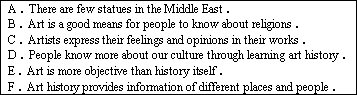
下面文章有5处需要添加小标题。请从以下选项(A、B、C、D、E和F)中选出符合各段意思的小标题。选项中有一项是多余选项。
1
A study of art history might be a good way to learn more about a culture than is possible to learn in general history classes.Most typical history courses concentrate on politics, economics and war.But art history focuses on much more than this because art reflects not only the political values of a people, but also religious beliefs, emotions, and psychology.
2
In addition, information about the daily acivities of our ancestors-or of people very different from our own-can be provided by art.In short, art expresses the essential qualities of a thme and a place, and a study of it clearly offers us a deeper understanding than can be found in most history books.
3
In history books, objective information about the political life of a country is presented; that is, facts about politics are given, but opinions are not expressed.Art, on the other hand, is subjective: it reflects emotions and opinions.The great Spanish painter Francisco Goya was perhaps the first truly “political” artist.In his well-known painting The Third of May 1808, he criticized the Spanish government for its misuse of power over people.Over a hundred years later, symbolic images were used in Pablo Picasso's Guernica to express the horror of war.Meanwhile, on another continent, the powerful paintings of Diego Rivera, Jose Clemente Orozco, and David Alfaro Siqueiros-as well as the works of Alfredo Ramos Martins-depicted these Mexican artists’ deep anger and sadness about social problems.
4
In the same way, art can reflect a culture's religious beliefs.For hundreds of years in Europe, religious art was almost the only type of art that existed.Churches and other religious buildings were filled with paintings that depicted people and stories from the Bible.Although most people couldn't read, they could still understand biblical stories in the pictures on church walls.
4
By contrast, one of the main characteristics of art in the Middle East was(and still is)its absence of human and animal images.This reflects the Islamic belief that statues are unholy.That's why no figures can be found in or around places of interest in these regions.

 新思维寒假作业系列答案
下面文章有5处需要添加小标题。请从以下选项(A、B、C、D、E和F)中选出符合各段意思的小标题,并填写在答题纸上将相应位置。选项中有一项是多余选项。
| A. Classroom participation B. Differences in American university education C. Examination system D. Competition among students E. Honest policy in students' school work F. Students' responsibility for learning |
【小题2】Participation in the classroom is not only accepted but also expected of the student in many courses. Some professors base part of the final grade on the student's oral participation. Although there are formal lectures during which the student has a passive role (i.e., listening and taking notes), many courses are organized around classroom discussions, student questions, and informal lectures.
【小题3】Many teachers believe that the responsibility for learning lies with the student. (Courses are not designed merely for students to pass exams.) The ideal student is considered to be one who is motivated to learn for the sake of learning, not the one interested only in getting high grades.
【小题4】Ideally, the teacher-student relationship at universities is characterized by trust. Thus, cheating on tests, Plagiarizing (抄袭) in written work, presenting other's ideas as original, and turning in homework completed by someone else are all prohibited (禁止).
【小题5】Relationships between students in the classroom can be cooperative or competitive. International students should not hesitate to ask for help if it is needed. in classes where such a grading curve is used, students may be reluctant to share lecture notes or information for fear that their own grades will suffer.
下面文章有5处需要添加小标题。请从以下选项(A、B、C、D、E和F)中选出符合各段意思的小标题,并填写在答题纸上将相应位置。选项中有一项是多余选项。
|
A. Classroom participation B. Differences in American university education C. Examination system D. Competition among students E. Honest policy in students' school work F. Students' responsibility for learning |
1.There is considerable variety in university classrooms in the United States. Because of diverse teaching methods and non-standardized curricula (课程), no two courses are the same. Undergraduate courses are considerable different from graduate courses. The classroom atmosphere in expensive, private universities may differ from that in community colleges, which are free and open to everyone.
2.Participation in the classroom is not only accepted but also expected of the student in many courses. Some professors base part of the final grade on the student's oral participation. Although there are formal lectures during which the student has a passive role (i.e., listening and taking notes), many courses are organized around classroom discussions, student questions, and informal lectures.
3.Many teachers believe that the responsibility for learning lies with the student. (Courses are not designed merely for students to pass exams.) The ideal student is considered to be one who is motivated to learn for the sake of learning, not the one interested only in getting high grades.
4.Ideally, the teacher-student relationship at universities is characterized by trust. Thus, cheating on tests, Plagiarizing (抄袭) in written work, presenting other's ideas as original, and turning in homework completed by someone else are all prohibited (禁止).
5.Relationships between students in the classroom can be cooperative or competitive. International students should not hesitate to ask for help if it is needed. in classes where such a grading curve is used, students may be reluctant to share lecture notes or information for fear that their own grades will suffer.