题目内容
任务型读写
There are two basic ways to see growth:one as a product, the other as a process. People have
generally viewed personal growth as an external(外在的)result or a product that can easily be identified
and measured. The worker who gets a rise, the student whose grades improve, the foreigner who learns
a new language-all these examples of people who have measurable results to show for their efforts.
By contrast(对照), the process of personal growth is much more difficult to determine, since it is a
journey and not the specific signposts or landmarks along the way. The process is not the road itself, but
the attitudes, feelings people have, and their caution or courage, as they meet with new experiences and
unexpected difficulties. In this process, the journey never really ends;there are always new ways to
experience the world, new ideas to try, new challenges to accept.
In order to grow, to travel new roads, people need to have a willingness to take risks, to face the
unknown, and to accept the possibility that they may "fail" at first. How we see ourselves as we try a
new way of being is necessary for our ability togrow. Do we see ourselves as quick and curious? If so,
we tend to take more chances and be more open to unfamiliar experiences. Do we think we're shy and
indecisive? Then our sense of fear can cause us to hesitate, to move slowly, and we think we are slow to
adapt?(适应)change or that we're not smart enough to deal with a new challenge. Then we are likely to
take a more passive role or not try at all.
These feelings of insecurity(不安全)and self?doubt are both unavoidable and necessary if we are to
change and grow. If we protect ourselves too much, then we stop growing. We become trapped inside a
shell of our own making.
generally viewed personal growth as an external(外在的)result or a product that can easily be identified
and measured. The worker who gets a rise, the student whose grades improve, the foreigner who learns
a new language-all these examples of people who have measurable results to show for their efforts.
By contrast(对照), the process of personal growth is much more difficult to determine, since it is a
journey and not the specific signposts or landmarks along the way. The process is not the road itself, but
the attitudes, feelings people have, and their caution or courage, as they meet with new experiences and
unexpected difficulties. In this process, the journey never really ends;there are always new ways to
experience the world, new ideas to try, new challenges to accept.
In order to grow, to travel new roads, people need to have a willingness to take risks, to face the
unknown, and to accept the possibility that they may "fail" at first. How we see ourselves as we try a
new way of being is necessary for our ability togrow. Do we see ourselves as quick and curious? If so,
we tend to take more chances and be more open to unfamiliar experiences. Do we think we're shy and
indecisive? Then our sense of fear can cause us to hesitate, to move slowly, and we think we are slow to
adapt?(适应)change or that we're not smart enough to deal with a new challenge. Then we are likely to
take a more passive role or not try at all.
These feelings of insecurity(不安全)and self?doubt are both unavoidable and necessary if we are to
change and grow. If we protect ourselves too much, then we stop growing. We become trapped inside a
shell of our own making.
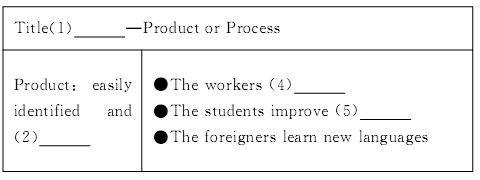
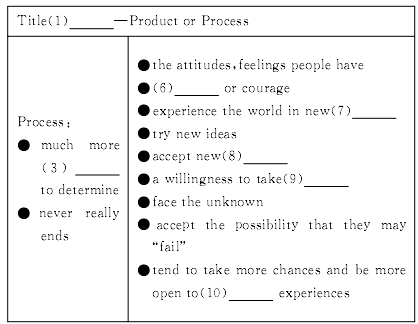
1. Growth 2. measured 3. difficult 4. get a rise 5. their grades
6. caution7. ways 8. challenges 9. risks 10. unfamiliar

练习册系列答案
相关题目
| 完形填空。 | |||
| But 1 a few of them are very 2 . English is one of these. Many, many people use it, not only in England and the U. S. A, but in other parts of the world. About 200, 000, 000 speak it as their own language. It is difficult to say how many  people are learning it as a 3 language. Many millions people are learning it as a 3 language. Many millions are 4 to do so. Is it easy or difficult to learn English? Different people may have different 5 . Have you ever 6 the ads of this kind in the newspapers or magazines? 'Learn English in six month, or your 7 back ...' 'Easy and funny? Our records and tapes 8 you master your English in a month. 9 the first day your 10 will be excellent. Just send ..." Of course, it never 11 quite like this. The only language that seems easy to learn is the mother tongue. We should 12 that we all learned our own language well when we were 13 . If we could learn English in the same way, it would not seem so difficult. 14 what a small child does. He listens to what people say. He tries what he hears. When he is using the language, talking in it, and 15 i  n it all n it all the time, just imagine the time, just imagine how much 16 that gets! So it is 17 to say that learning English is easy, because a good command of English 18 upon a lot of practice. And practice needs great effort and 19 much time. Good teachers, records, tapes, books, and dictionaries will 20 . But they cannot do the student's work for him. | |||
| ( )1. A. not ( )2. A. difficult ( )3. A. native ( )4. A. learning ( )5. A. questions ( )6. A. found ( )7. A. knowledge ( )8. A. make ( )9. A. From ( )10. A. spelling ( )11. A. happened ( )12. A. know ( )13. A. students ( )14. A. Imagine ( )15. A. using ( )16. A. time ( )17. A. hard ( )18. A. depends ( )19. A. uses ( )20. A. do |
B. quite B. important B. foreign B. enjoying B. problems B. watched B. time B. help B. On B. grammar B. know B. remember B. children B. Mind B. thinking B. money B. easy B. tries B. takes B. work |
C. only C. necessary C. useful C. trying C. ideas C. noticed C. money C. let C. Since C. English C. seemed C. understand C. babies C. Do C. trying C. language C. funny C. has C. gets C. help |
D. very D. easy D. mother D. liking D. answers D. known D. English D. allow D. After D. pronunciation D. felt D. think D. grown-ups D. Think of D. practicing D. practice D. silly D. takes D. costs D. master |
1. Daylight Saving Time was introduced in Tasmania _____.
A. to stop the drought in 1967
B. to support government officials
C. to pass a special law in the state
D. to save water and electricity
B. to support government officials
C. to pass a special law in the state
D. to save water and electricity
2. According to the text, which state was the last to use DST?
A. Victoria.
B. Queensland.
C. South Australia.
D. New South Wales.
B. Queensland.
C. South Australia.
D. New South Wales.
3. What can we learn about DST in some Australian states?
A. It doesn't have fixed dates.
B. It is not used in festivals.
C. Its plan was changed in 2000.
D. It lasts for two weeks.
B. It is not used in festivals.
C. Its plan was changed in 2000.
D. It lasts for two weeks.
4. What do we know about the use of DST from the last paragraph?
A. There exist some undesirable effects.
B. It helps little to save energy.
C. It brings about longer working days.
D. Radio and TV programs become different.
B. It helps little to save energy.
C. It brings about longer working days.
D. Radio and TV programs become different.