题目内容

LIPITOR

ABOUT LIPITOR

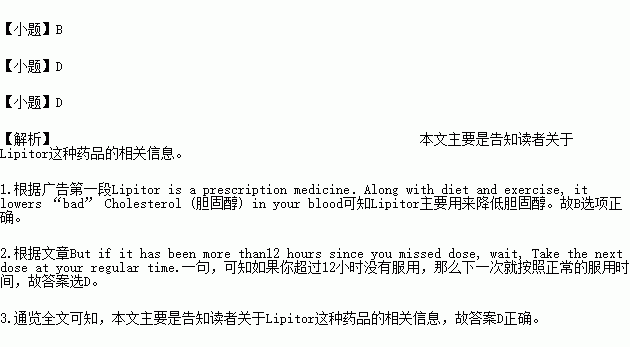
Lipitor is a prescription medicine.Along with diet and exercise, it lowers “bad” Cholesterol (胆固醇) in your blood. It can also raise “good ”cholesterol.

Lipitor can lower the risk of heart attack in patients with several common risk factors, including family history of early heart disease, high blood pressure, age and smoking.

WHO IS LIPITOR FOR?

Who can take LIPITOR:

· People who cannot lower their cholesterol enough with diet and exercise.

· Adults and children over l0.

Who should NOT take LIPITOR:

· Women who are pregnant, may be pregnant, or may become pregnant.Lipitor may harm your unborn baby.

· Women who are breast-feeding.Lipitor can pass into your breast milk and may harm your baby.

· People with liver(肝脏)problems.

POSSIBLE SIDE EFFECTS OF LIPITOR

Serious side effects in a small number of people:

· Muscle(肌肉)problems that can lead to kidney(肾脏)problems, including kidney failure.

· Liver problems.Your doctor may do blood tests to check your liver before you start Lipitor and while you are taking it.

Call your doctor right away if you have:

· Unexplained muscle pain or weakness, especially if you have a fever or feel very tired.

· Swelling of the face, lips, tongue, or throat that may cause difficulty in breathing or Swallowing.

· Stomach pain.

Some common side effects of LIPITOR are:

· Muscle pain.

· Upset stomach.

· Changes in some blood tests.

HOW TO TAKE LIPITOR

Do:

· Take Lipitor as prescribed by your doctor.

· Try to eat heart-healthy foods while you take Lipitor.

· Take Lipitor at any time of day, with or without food.

· If you miss a dose (一剂), take it as soon as you remember. But if it has been more than

12 hours since you missed dose, wait, Take the next dose at your regular time.

Don’t:

· Do not change or stop your dose before talking to your doctor.

· Do not start new medicines before talking to your doctor.

1.What is the major function of Lipitor?

A. To help quit smoking.

B. To lower "bad" cholesterol.

C. To improve unhealthy diet.

D. To control blood pressure.

2.If it has been over 12 hours since you missed a dose, you should .

A. change the amount of your next dose

B. eat more when taking your next dose

C. have a dose as soon as you remember

D. take the next dose at your regular time

3.What is the main purpose of the passage?

A. To teach patients ways for quick recovery.

B. To present a report on a scientific research.

C. To show the importance of a good lifestyle.

D. To give information about a kind of medicine.
练习册系列答案
相关题目

In 1693 the philosopher John Locke warned that children should not be given too much “unhealthy fruit” to eat.Three centuries later, misguided ideas about child-raising are still popular.Many parents fear that their children will die unless ceaselessly watched.In America the law can be equally paranoid (偏执的).In South Carolina this month Debra Harrell was jailed for letting her 9-year-old daughter play in a park unsupervised (无人监督的).

Her severe punishment reflects the rich world’s worry about parenting.By most objective measures, modern parents are far more conscientious (认真的) than previous generations.Dads are more hands-on than their fathers were, and working mothers spend more time nurturing their children than the housewives of the 1960s did.However, there are two problems in this picture, connected to class.One is at the lower end.Even if poor parents spend more time with their children than they once did, they spend less than rich parents do.America is a laggard here: its government spends abundantly on school-age kids but much less than other rich countries on the first two or three years of life.If America did more to help poor parents with young children, it would have huge returns.

The second one, occurs at the other end of the income scale, and may even apply to otherwise rational (理性的) Economist readers: well-educated, rich parents try to do too much.Safety is part of it—they fear that if they are not constantly watching their children may break their necks, which is the least rational.Despite the impression you get from watching crime dramas, children in rich countries are safe, so long as they look both ways before crossing the road.The other popular parental fear—that your children might not get into an Ivy League college—is more rational.Academic success matters more than ever before.But beyond a certain point, parenting makes less difference than many parents imagine.Studies in Minnesota and Sweden, for example, found that identical twins grew up equally intelligent whether they were raised together or apart.A study in Colorado found that children that adopted and raised by brainy parents ended up no brainier than those adopted by average parents.

This doesn’t mean that parenting is irrelevant.The families who adopt children are carefully screened, so they tend to be warm, capable and middle-class.But the twin and adoption studies indicate that any child given a loving home and adequate stimulation is likely to fulfill her potential.Put another way, better-off parents can afford to relax a bit.And if you are less stressed, your children will appreciate it, even if you still make them eat their fruit and vegetables.

1.Which of the following statements is NOT a misguided idea of parenting mentioned in the passage?

A. Children should be protected from any dangers by their parents

B. The more conscientious parents are, the more children will surely benefit from parenting

C. Children will die unless ceaselessly watched

D. Children are likely to fulfill their potential with a loving home and adequate stimulation

2.The underlined word “laggard” in Paragraph 2 probably means a country that __________.

A. is ahead in development

B. falls slow behind others

C. is free from physical or mental disorder

D. moves to a higher position

3.Which of the following can we learn from the passage?

A. Only warm, capable and middle-class people can adopt a child.

B. When it comes to child-raising, Economist readers will become more rational.

C. Children in rich countries are in greater danger due to the bad influence of crime dramas.

D. Although poor parents spend more time with their kids than they once did, they spend less than rich parents do.

4.This passage is mainly written to __________.

A. urge American laws concerning parenting to be changed

B. advise modern parents to learn from their previous generations

C. persuade stressed parents to learn to relax and give more freedom to their children

D. call on the government to do more to help poor parents with school-age children

You may not pay much attention to your daily elevator ride.Many of us use a lift several times during the day without really thinking about it.But Lee Gray,PhD,of the University of North Carolina,US,has made it his business to examine this overlooked form of public transport.He is known as the “Elevator Guy”.

“The lift becomes this interesting social space where etiquette (礼仪) is sort of odd (奇怪的),” Gray told the BBC.“The elevators are socially very interesting but often very awkward places.”

We walk in and usually turn around to face the door.If someone else comes in,we may have to move.And here,according to Gray,liftusers unthinkingly go through a set pattern of movements.He told the BBC what he had observed.

He explained that when you are the only one inside a lift,you can do whatever you want – it’s your own little box.

If there are two of you,you go into different corners,standing diagonally (对角线地) across from each other to create distance.

When a third person enters,you will unconsciously form a triangle.And when there is a fourth person it becomes a square,with someone in every corner.A fifth person is probably going to have to stand in the middle.

New entrants to the lift will need to size up the situation when the doors slide open and then act decisively.Once in,for most people the rule is simple – look down,or look at your phone.

Why are we so awkward in lifts?

“You don’t have enough space,” Professor Babette Renneberg,a clinical psychologist at the Free University of Berlin,told the BBC.“Usually when we meet other people we have about an arm’s length of distance between us.And that’s not possible in most elevators.”

In such a small,enclosed space it becomes very important to act in a way that cannot be understood as threatening or odd.“The easiest way to do this is to avoid eye contact,” she said.

1.According to Gray,when people enter an elevator,they usually _____.

A. turn around and greet one another

B. look around or examine their phone

C. make eye contact with those in the elevator

D. try to keep a distance from other people

2.Which of the following describes how people usually stand when there are at least two people in an elevator?

A.

B.

C.

D.

3.According to the article,people feel awkward in lifts because of _____.

A. someone’s odd behaviors

B. a lack of space

C. their unfamiliarity with one another

D. their eye contact with one another

【小题】What’s the passage mainly about _____.

A. Bad manners in the elevator

B. Some unwritten rules of elevator etiquette

C. An interesting but awkward elevator ride

D. The strange behaviors in the elevator

违法和不良信息举报电话:027-86699610 举报邮箱:58377363@163.com

精英家教网