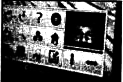
It's often said that the eye is the window to the soul.But in this case, the eye is the window to Windows.At least, that was the goal when EyeTech Digital Systems got the help of some BYU engineering students in creating an all-in-one eye-tracking system.
The idea behind the project was to create an inexpensive computer system that could be controlled completely with a person's eyes.The hope was that this system could be used by people with disabilities in parts of the world where they can't afford expensive eye-tracking systems.The students created the tablet(书写板)for their yearlong engineering project for their customer, EyeTech Digital Systems, an Arizona-based company that designs and develops eye-tracking software.
A separate BYU engineering team also worked with EyeTech last year to develop and improve the initial eye-tracking tephnology, but this year's focus was to put the eye tracking into a housing similar to a thick PC.The finished product runs Windows 7 and has the eye-tracking system built in.After a quick adjustment, the system can move the mouse to wherever the user is currently looking.All it takes is a blink(眨眼)to click.
Systems with similar abilities can cost upwards of $14, 000.But the students were able to find cheaper, readily available parts, pushing the cost down to under $1, 500.Jedediah Nieveen, the captain for this year's team, said the project was a challenge, but one that was rewarding on many levels."A lot of times in school you just work problems out of books, " he said."But this allowed us to take what we learned and apply it to something in real life, something that can help a lot of people, and that's really helped me."
Although the primary purpose of the product is to help people with disabilities, the technology could also have broader applications in the fields of research, advertising and even gaming.
(1)
According to the text, the eye-tracking system is ________.
[ ]
A.
a high-tech computer
B.
a computer system operated by eyes
C.
a way of protecting eyes
D.
a software against information theft
(2)
How long will the research of the eye-tracking project last in all?
[ ]
A.
About two years.
B.
Just one year.
C.
Over three years.
D.
Less than one year.
(3)
The eye-tracking system was created to ________.
[ ]
A.
help the poor students
B.
improve the computer system
C.
support the disabled people
D.
help to cure people's disabilities
(4)
What did the BYU engineering students value most during the project?
[ ]
A.
Earning money for their education.
B.
Putting their theory into practice.
C.
Showing their talents in technology.
D.
Increasing their job opportunities.
(5)
What can be inferred about the future of the eye-tracking system?
[ ]
A.
It may face a promising market.
B.
It is welcome only to the disabled people.
C.
It'll change the disabled people's social position.
D.
It can improve the disabled people's main way of life.