题目内容
even on the ground.
B. sitting
C. being sat
D. sitting

 开心快乐假期作业暑假作业西安出版社系列答案
[1] Look at the center circles of Diagram A and Diagram B. Which of the centre circles looks larger? 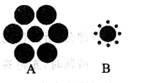
[2] Take a first look and you probably think that the centre circle in Diagram A is smaller than that in Diagram B. In fact, they are exactly the same size.
[3]Then look at the picture on the right. What do you see? A vase? Or two faces? Does the picture change quickly from one to the other again and again? Maybe or maybe not, but you can see them at the same time. 
[4]“What’s happening? Is something wrong with my eyes?” You may wonder at what you see. Don’t worry. Here is how it goes:
[5]When we look at things, our eyes send messages to our brains and then our brains interpret the information. However, sometimes our brains interpret the received information in a wrong way. It seems that our eyes are playing a joke on us. This often happens and we call it “Visual illusion(幻觉)”. 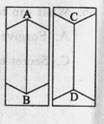
[6] Movie makers often make use of illusions. They make the objects around actors much smaller or bigger than usual. This makes us believe that the actors are much larger or smaller than they usually are. The movies Jurassic Park and Honey J shrunk the kids just make use of illusions.
【小题1】In which column of a magazine can you read the above text?
| A.Culture. | B.Science. | C.Humour. | D.Education. |
| A.something is wrong with our eyes |
| B.the two circles are not of the same size |
| C.our brains interpret the information wrongly |
| D.pictures change quickly from one to the other |
A. The second one. B. The third one. C. The sixth one.. D. The fifth one
【小题4】What’s the right order according to the text?
a. We look at things with our eyes. b. Our brains interpret the messages.
c. Our brains tell us what we have seen. d. Our eyes send messages to our brains.
A. a-d-b-c B c-a-b-d C a-c-d-b D. b-e-a-d
Charlie Chaplin was the first international star of the modern era(年代). He was especially beloved for his Little Tramp 32. He was the first screen artist to write, 33 and perform in his own films; in fact, 34 Charlie Chaplin even wrote the music for his movies. He was also the first artist to use his work to pass a 35of equality and justice for all —36for the "little guy". Charlie Chaplin's career and life made 37 the first global icon (偶像); his too-small hat, his too large shoes and his trademark moustache were instantly 38 by audiences from Chicago to China, from Iowa City to India. And they 39 are today. All of these make Charlie Chaplin the first citizen of our global village.
Chaplin, a native of London, was born in40 on April 16, 1889 to music hall performers. Chaplin only saw his 41twice until the age of seven. The man 42 him and his mother about a year after Chaplin was 43. During Chaplin's earliest years, his mother was a(n) 44and performer. Then her voice gave out, her stage career 45, and she began actively 46Church of England services. At the age of 47, Chaplin's mother was considered as the insane and sent to Cane Hill lunatic asylum (疯人院), and the 48 sent Charlie and his brother to live with his father, 49 had by then stopped all payments of child support.
Charlie Chaplin lived with his father only a short time 50 his mother was released from the lunatic asylum and then 51Charlie and his brother, to live with her once again.
| 【小题1】 |
|
| 【小题2】 |
|
| 【小题3】 |
|
| 【小题4】 |
|
| 【小题5】 |
|
| 【小题6】 |
|
| 【小题7】 |
|
| 【小题8】 |
|
| 【小题9】 |
|
| 【小题10】 |
|
| 【小题11】 |
|
| 【小题12】 |
|
| 【小题13】 |
|
| 【小题14】 |
|
| 【小题15】 |
|
| 【小题16】 |
|
| 【小题17】 |
|
| 【小题18】 |
|
| 【小题19】 |
|
| 【小题20】 |
|
Nowadays people are troubled by the violence that spreads throughout the media. Movies, television and video games are full of gunplay and bloodshed, and one might reasonably ask what’s wrong with a society that presents videos of violence as entertainment.
Viewing large amounts of violent television and video games may well contribute to violent behavior in certain individuals. The trouble comes when researchers downplay uncertainties in their studies or overstate the case for causality(因果关系). Skeptics were dismayed several years ago when a group of societies including the American Medical Association tried to end the debate by issuing a joint statement: “At this time, well over 1,000 studies… point to a causal connection between media violence and aggressive behavior in some children.”
Freedom-of-speech advocates accused the societies of catering to politicians, and even disputed the number of studies (most were review articles and essays, they said). When Jonathan Freedman, a social psychologist at the University of Toronto, reviewed the literature, he found only 200 or so studies of television-watching and aggression. And when he weeded out “the most doubtful measures of aggression”, only 28% supported a connection.
The critical point here is causality. The alarmists say they have proved that violent media cause aggression. But the assumptions behind their observations need to be examined. When labeling games as violent or non-violent, should a hero eating a ghost really be counted as a violent event? And when experimenters record the time it takes game players to read “aggressive” or “non-aggressive” words from a list, can we be sure what they are actually measuring? The intention of the new Harvard Center on Media and Child Health to collect and standardize studies of media violence in order to compare their methodologies, assumptions and conclusions is an important step in the right direction.
Another appropriate step would be to tone down the criticism until we know more. Several researchers write, speak and testify quite a lot on the threat posed by violence in the media. That is, of course, their privilege. But when doing so, they often come out with statements that the matter has now been settled, drawing criticism from colleagues. In response, the alarmists accuse critics and news reporters of being deceived by the entertainment industry. Such clashes help neither science nor society.
【小题1】Why is there so much violence shown in movies, TV and video games?
| A.Showing violence is thought to be entertaining. |
| B.Something has gone wrong with today’s society |
| C.Many people are fond of gunplay and bloodshed. |
| D.There is a lot of violence in the real world today. |
| A.Violence on television is fairly accurate reflection of real-world life. |
| B.Most studies exaggerate (夸大) the effect of media violence on the viewers. |
| C.A causal relationship exists between media and real-world violence. |
| D.The influence of media violence on children has been underestimated. |
| A.use standardized measurements in the studies of media violence |
| B.initiated the debate over the influence of violent media on reality |
| C.insist on a direct link between violent media and aggressive behavior |
| D.use appropriate methodology in examining aggressive behavior |
| A.got rid of things that are not good | B.removed unwanted parts from something |
| C.picked out things that are useful | D.took away unnecessary details of a report |
| A.He more than agrees with the views held by the alarmists. |
| B.It should come to an end since the matter has now been settled. |
| C.The past studies in this field have proved to be misleading. |
| D.More studies should be conducted before conclusions are drawn. |


