题目内容
任务型读写
阅读下面短文,根据所读内容在表格中的空白处填入恰当的单词。
注意:每个空格只填一个单词。
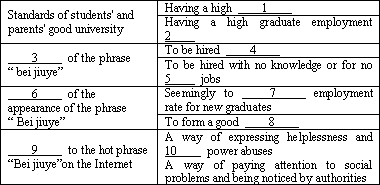
It's every student's dream to do well in the national college entrance examination and enter a good university.In the eyes of students and parents, a good university should have a high ranking, and the employment rate of its graduates should be high.But be careful! The employment rate they tell you might not always be true.
Recently, people created a Chinese phrase “bei jiuye”, which has become popular on the Internet almost overnight across China.The word “bei” has a grammatical use in Chinese:it has a function similar to the passive voice in English.But now people often use it to express their doubts about something.Here, the phrase “bei jiuye” has the literal meaning of “to be hired”, but people understand that it really means “to be hired without one's knowledge” or “be hired for jobs that may not exist at all”.
The story of “bei jiuye” goes like this.Zhao Dongdong, a graduate of a university in Shanxi province, was surprised to find that he got a job from a company he never applied to, which he wasn't even sure was a real place.On his last day of graduation ceremonies, he was surprised to come across the employment contract.
“God! At that time, I had not landed a job yet, but they gave me an employment contract! I wondered who on earth signed the contract with the company.” When Zhao made a phone call to the company to check it out, no one answered.He was not the only one in his college who was “hired” for a job that did not exist.One of his classmates signed a contract with a company called Xi'an Beilin Industrial Corporation, which could not be found on the Internet either.In the end, it turned out that the college had faked the contract to make it seem like the employment rate for new graduates was higher than that.By doing this, the college could build up a “good” reputation that could help it attract new students.“Bei jiuye” is just one of many hot “bei” words on the Internet.See some of them in “Bonus”.The use of “bei” is a satirical(讽刺的)way for the public to express its helplessness and criticize abuses of power, some people say.People also use “bei” words to bring attention to social problems, hoping they will be noticed by authorities.
解析:
|
1.ranking 2.rate 3.Definition/Meaning/Concept 4.literally 5.existent/existing 6.Causes/Purposes 7.improve/increase 8.reputation 9.Conclusion 10.criticizing |



阅读下面短文,根据所读内容在表格中的空白处填入恰当的单词。注意:每个空格只填一个单词。
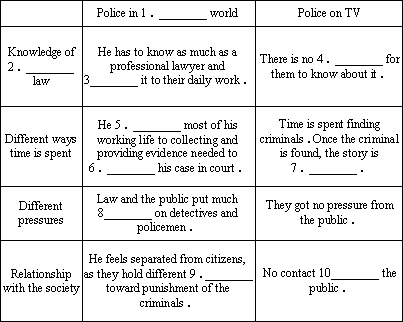
Real policemen hardly recognize any similarity between their lives and what they see on TV.
The first difference is that a policeman's real life revolved round(围绕;以…为目的)criminal law.He has to know exactly what actions are crimes and what evidence can be used to prove them in court.He has to know nearly as much law as a professional lawyer, and what is more, he has to apply it on his feet, in the dark and rain, running down a street after someone he wants to talk to.
Little of his time is spent in chatting.He will spend most of his working life typing millions of words on thousands of forms about hundreds of sad, unimportant people who are guilty of stupid crimes.
Most television crime drama is about finding the criminal:as soon as he's arrested, the story is over.In real life, finding criminal is seldom much of a problem.Except in very serious cases like murders and terrorist attacks, little effort is spent on searching.
Having made an arrest, a detective(侦探)really starts to work.He has to prove his case in court and to do that he often has to gather a lot of different evidence.
A third big difference between the drama detective and the real one is the unpleasant pressures:first, as members of a police force, they always have to behave absolutely in accordance with(依照)the law.Secondly, as expensive public servants, they have to get results.They can hardly ever do both.Most of the time some of them have to break the rules in small ways.
If the detective has to deceive(欺骗)the world, the world often deceives him.Hardly anyone he meets tells him the truth.And this separation the detective feels between himself and the rest of the world is deepened by the simple-minded-as he see it-of citizens, social workers, doctors, law-makers, and judges, who, instead of eliminating(消除)crime, punish the criminals less severely in the hope that this will make them reform.The result, detective feel, is that nine-tenths of their work is re-catching people who should have stayed behind bars.This makes them rather cynical(愤世嫉俗的).