题目内容

根据短文内容,从短文后的选项中选出能填入空白处的最佳选项。选项中有两项为多余选项。

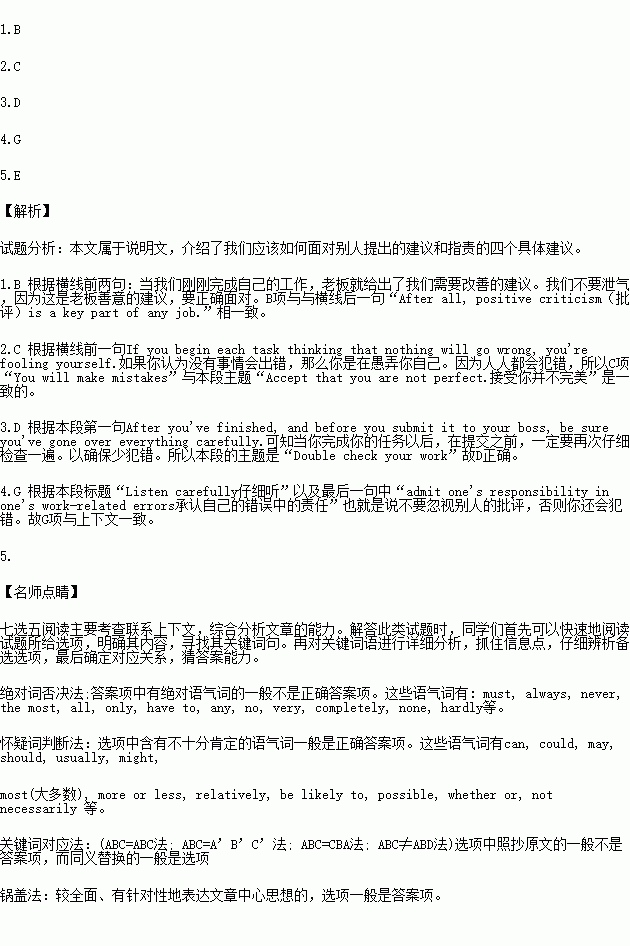
So, you just finished what you thought was a great project at work, and now your boss is listing all the things you need to improve upon. 1._____. After all, positive criticism(批评)is a key part of any job. Through this article, learn how to accept criticism and do your jobs well.

1. Accept that you are not perfect.

If you begin each task thinking that nothing will go wrong, you're fooling yourself. 2.______. The important thing is to learn from them.

2. 3.______.

After you've finished, and before you submit it to your boss, be sure you've gone over everything carefully. This can help you to avoid silly mistakes and ensure that your boss won't have to bother you about minor problems.

3. Listen carefully.

4.______. Take notes and remind yourself how to fix the problem. This step is the most difficult, as it can mean that one must put one's pride away and admit one's responsibility in one's work-related errors.

4. Agree with part of the criticism.

When faced with criticism, most people focus on the part of the negative feedback that may not be true and ignore the rest. This doesn't solve any problems, and you don't learn anything. When you agree with one part of the criticism, you become open to learning. 5.______. Even agreeing with one small aspect of the criticism will create an atmosphere of teamwork. The focus then can become how you'll work together to solve a problem, which will lessen your feeling of being attacked.

A. Don’t take it seriously.

B. Don’t get discouraged.

C. You will make mistakes.

D. Double check your work.

E. You don't have to agree with everything.

F. In fact you need time and courage to process the information.

G. Never ignore critical comments, or you will repeat the same mistakes.
练习册系列答案
相关题目

阅读下列材料,在空白处填入适当的内容(一个单词)或括号内单词的正确形式。

Born in Amherst, Massachusetts, to a successful family, Elizabeth Dickinson was an American poet. She studied at Mount Holyoke Female Seminary before1.______(return) to her family’s house in Amherst where she lived2.______ peaceful life. She kept in touch with her friends by writing letters and was 3._____(willing) to greet guests or, later in life, even leave her room.

Dickinson’s poems are unique(独一无二的) for the time she lived in; they contain short lines, typically lack titles, and often use half rhyme. Many of her poems deal 4.______ themes(主题) of death and immortality(永生). Dickinson wrote about 1,800 poems during her lifetime, but few of 5. _______ were published. Although most of her friends probably knew about Dickinson’s writing, they didn’t know 6._____ she had produced so many poems until after her death in 1886, when her younger sister Lavinia discovered the place where the poems were hidden. 7.______ her sister had not discovered them, the broadness of Dickinson’s work wouldn’t have become known.

Dickinson’s first collection of poetry was published in 1890, the content(内容) of 8._______was heavily edited(编辑) by the publishers 9. ______ (fit) the conventional poetic rules of the time. A complete and mostly unedited collection of her poetry became available for the first time in 1955. Now Dickinson 10. _______ (consider) to be one of the most important American poets.

Technology is making life easier for some dairy farmers. They use robotic systems to milk their cows. These systems are designed to reduce labor and increase milk production.

Cows are trained to follow a series of paths that lead to the milking stations. Only one cow at a time can enter the station. Once inside,the cow is rewarded with food. As the cow eats,a robotic arm cleans and connects the animal to the milking machine. A few minutes later,the milking is completed. The gate is lifted. The cow leaves and the next cow enters. The robotic systems are designed to operate twenty­ four hours a day. Cows are milked on average about three times a day. Some are milked four to six times a day. The cows wear collars(颈圈) around their necks that identify them to the system. A computer keeps records on their eating and milking. A cow is released from the station if the computer decides it should not be milked. The system also measures the temperature and color of the freshly produced milk. Milk is thrown away if it does not pass the tests. Cows need two to four weeks to learn to use the robotic milking systems. Once trained,the cows no longer require human assistance,unless something goes wrong.

Professor Plaut heads the Department of Animal Science at Michigan State University. She believes the systems will attract especially the next generation of farmers who are more interested in technology and less interested in working all the time on the farm. Still,she says the price of robotic milking systems will continue to limit their use. Doug Suhr has more than one hundred milking cows on his farm. Last year it became the fourth farm in southeast Minnesota to get a robotic milking system. A recent story in a local agricultural newspaper said the first robot cost $175,000 and the second cost $150,000.Doug says the increase in milk production reaches a high of more than 6kg per cow per day.

1.Under robotic milking systems,______ decide(s) whether a cow is suitable to be milked.

A.the robotic arms B.the dairy farmers

C.the cows themselves D.a computer

2.When is human assistance needed during the milking?

A.When the cows enter the milking station every morning.

B.When a robotic arm connects a cow to the milking machine.

C.When the cows are trained to use the robotic milking system in the first two to four weeks.

D.When the temperature and color of the freshly produced milk are measured.

3.Which of the following statements is TRUE according to the last paragraph?

A.Since Doug got the robotic milking system,milk production on his farm has increased.

B.The price of milking machines decreases $25,000 every year.

C.Doug has the largest farm in southeast Minnesota.

D.There are four farms in southeast Minnesota that have robotic milking systems so far.

4.It can be inferred from the passage that ________.

A.the price of robotic milking systems will greatly decrease

B.robotic milking systems are still too expensive to be popular

C.most farmers are too old to use robotic milking systems

D.robotic milking systems don't need to work at night

The story of Juno and Lucas is one of the most touching stories about the amazing relationship between humans and their companion animals.

Juno is a Belgian Malinois(比利时马犬). The dog was beautiful but was given up by its owners, as they did not want to take on the responsibility.

Lucas, a little boy, had a strange illness, a condition that stops the body’s ability to process enzymes(酶).As his life continues, he will lose the ability to speak and his physical and mental abilities will degrade till he is left in a vegetative(植物人的)state. The average life expectancy for the patients is 15 years.

Chester, the boy’s father, wanted his child to enjoy his life on earth as much as possible and looked into getting a service dog for the child. However, Lucas wasn’t a good candidate due to his deteriorating(恶化的)abilities, not to mention the $15,000 cost of the animal.

Not terrified by all of this, Chester looked into adopting a dog for his son. He found Juno on a website and drove two hours to meet her. Chester had worked with the breed(品种) in the police force and was familiar with how to train them. He put in patience and hard work, and trained Juno while allowing her to become accustomed to Lucas. Now, not only will Juno not leave Lucas’ side, she is also helping with his illness. Chester said, “She has the ability to notice his neurological changes. Now she reminds us when Lucas is about to have a seizure(疾病发作) or if his oxygen levels drop really low. She has saved him several times.”

Companion animals are beautiful things and they establish a bond that can’t be described without experiences. I know that I held my adopted dog a little closer after hearing this story. There are a lot of dogs out there that need good homes and that won’t be as lucky as Juno. So, if you think you’re prepared, you should consider giving one a nice home.

1.Chester wanted to find a service dog to __________.

A. protect Lucas from being injured

B. help the boy recover from the disease

C. accompany Lucas to enjoy his time left

D. show their love for the beautiful dog

2.Chester got the dog Juno by ____________.

A. asking for help from the police force

B. donating a lot of money

C. picking it up near the house

D. searching on the Internet

3.Which of the following statements is NOT true?

A. The author has also adopted a dog and loves it.

B. Juno has gained some skills accompanying Lucas.

C. Chester was very satisfied with Juno’s performances.

D. Lucas recovered from the disease accompanied by Juno.

4.Which of the following can be the best title for the passage?

A. Unlucky boy, lucky dog

B. A love for a dog, a companion for a boy

C. A faithful friend—Juno

D. Love me, love my dog

When people who are nature lovers worldwide wish all humans to realize the importance of their natural surroundings, many Australians are turning caring for the environment into a way of life.

Julie, an Australian housewife in Brisbane is one such example. Even though autumn is approaching Australia's Brisbane in April, one can still watch colorful blooming (盛开的) flowers in Julie's little garden, as she tells that in her community,“Each of us has a beautiful yard. The whole community, from children to elderly people, takes care of the environment as if they are taking care of their own garden.”

“Gardening is the most popular club in our community,” she says. “A lot of retired people don't just regularly organize gardening lectures, but also personally visit families in the community to provide gardening training. So you can see that flowers continue to blossom(开花) in our gardens throughout the year.”

Talking about her people's sense of caring for the environment, Julie says when people in the community take along their dog, they always carry a garbage bag to deal with the dog's waste. “In our community, you will never experience the embarrassment of stepping on the dirty waste while you are walking on the grass,” says Julie with a smile. “Taking care of the dog's waste can also help to develop children's sense of responsibility!”

As to protecting water resources, the Australian government has made strict rules for families. Julie says, “We certainly would not use tap water to water the flowers!” She says almost every family in her community has a huge tank used to store rainwater, which is later used as the resource of all outdoor water use, including car washing and watering the garden. This year, they also asked people to connect the water tank with their toilets.

1.From the first three paragraphs we learn that_______.

A. gardening is popular in most parts of Australia

B. April is a great time for people to enjoy flowers

C. Julie's community has a deep sense of caring for nature

D. it's not easy to keep a garden without proper training

2.Why can flowers be seen all year round in Julie's community?

A. Families are taught how to take care of their gardens.

B. Gardening lessons are often given by professors.

C. The local government provides free gardening training.

D. There is enough rainwater to water the flowers regularly.

3.What do we know about Julie from the passage?

A. She finds it embarrassing to walk on the grass.

B. She once stepped on a dog's waste.

C. She is quite in favor of raising a dog.

D. She takes pride in her community.

4.From what Julie says in the last paragraph, we know_______.

A. rainwater is not the best resource

B. her community makes full use of resources

C. her community owns a public tank

D. it is not necessary to water flowers very often

5.What would be the best title for the text?

A. How Australians save resources

B. Love nature, the Australian way

C. How Australians lead their life

D. Protect nature, a must of life

违法和不良信息举报电话:027-86699610 举报邮箱:58377363@163.com

精英家教网