题目内容

_______ as “a class of one ”, independent learning enabled you to study at your own pace.

A. Describing                   B. Described   

C. To be described               D. Being described

练习册系列答案
相关题目

阅读下列短文,根据所读内容在表格中的空白处填入恰当的单词。

注意:每个空格只填一个单词。

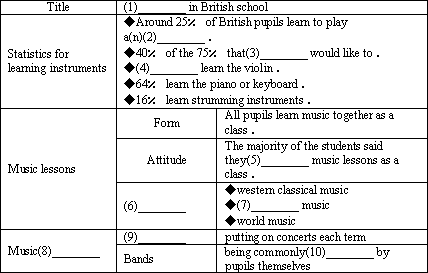
  Can you play a musical instrument?Where did you learn to play it?If you were a pupil in a British school, you would most probably learn at school.Around 25% of British pupils learn an instrument.What's more, of the 75% that don't, 40% would like to.But what instruments do the pupils learn to play?Traditionally, school children learnt classical instruments, such as the piano or violin.This is still true today.Younger children often learn the recorder.As they get older, they start to play the violin or piano.In fact, nearly one out of five music students is learning the violin.The piano, or keyboard, is m ore popular with older children at secondary school.However, things are changing.More pupils than ever before are now learning the guitar.As many as 16% of pupils learning an instrument are strumming(弹奏)its strings.

  British schools do not just offer lessons for instruments.All pupils learn music together as a class.These classes have been changing, too.In the past, the focus of classes was very much Western classical music.But the classes now cover a far wider range of styles, including folk music and world music.In a recent study by Keele University, 64% of boys and 70% of girls said they enjoyed music lessons as a class.They like singing and playing instruments and find the lessons fun.

  Many schools have orchestras(管弦乐队)and put on concerts each term.It is also common for pupils themselves to form their own bands, copying their rock and pop heroes.In conclusion, music plays big part in British schools.Pupils can study and instrument, play music together as a class and even take part in concerts and plays.

阅读理解

  It may be one of Britain’s most successful exports – Miss World.This 53-year-old event took place in China last week and attracted over 120 women worldwide with knockout looks in a mad struggle for the crown.

  Traditional values have long kept the Chinese, especially women, from displaying beauty.But Chinese people have now changed their attitude toward beauty contest, although some men will still be shouting that the winner is no more beautiful than his wife or his former girl friend or even his mother in a sour tone.But such men are not shouting for the right reason.The question to be:Why isn’t there a Mr.World Beauty Contest?

  And a further question to be asked is:Does taking part in a beauty contest show a woman’s courage, wisdom and liberation or rather the opposite- forced choice and a revolting act made under conditions of long-term discrimination?

  Organizers of such beauty contests claim that the contestants are judged on qualities other than just their physical appearance.But still no answer is given to why there isn’t a Mr.Beauty or a Mr.World Contest? Or at least, why isn’t that kind of contest popular? Why is it that only women’s “qualities” need to be recognized but not men’s?

  Think about who is always standing beside a fancy car on show? Is it a boy or a girl? And this is how “qualities” are judged:if the girl looks good, there is little reason why the car beside her is not of high quality.

  The beauty contests go on year after year, with winners enjoying fame which quickly disappears.While such events go on and on, what never changes is the routine practice that in every fancy car show, a girl stands beside a fancy car.What never changes is the need to hold a women’s conference every year to appeal for the promotion of respect for and improvement of women.What never changes is the fate of women as a class.So let’s put more time and resources into trying to change all this rather than holding beauty contests.

(1)

Miss World Beauty Contest in Britain has a history of __________.

[  ]

A.

120 years

B.

about half a century

C.

100 years

D.

about half a year

(2)

Which of the following is TRUE to the passage?

[  ]

A.

Miss World Beauty Contest first began in China.

B.

Women were not allowed to show their beauty in China.

C.

120 women took part in Beauty Contest last week.

D.

Miss World was 53 years old.

(3)

According to the writer ________

[  ]

A.

Chinese women are not allowed to display beauty

B.

the winner of Miss World is not as beautiful as his wife

C.

some men are not shouting for the right person

D.

people can accept a beauty contest in China now

(4)

From the passage we can know the writer thinks that __________.

[  ]

A.

contestants’ qualities are more important than their physical appearance

B.

a Mr.World Contest should be held instead of a Miss World Contest

C.

a boy should stand by a fancy car

D.

women’s social status is still low

(5)

The best title for this passage is __________.

[  ]

A.

What about a Mr.World Contest?

B.

History of Miss World Contest.

C.

Quality or Appearance?

D.

A Boy Standing beside a Fancy Car.

Directions: Read the following passage. Complete the diagram by using the information from the passage.  Write NO MORE THAN 3 WORDS for each answer.

Can you play a musical instrument? Where did you learn to play it? If you were a pupil in a British school, you would most probably learn at school. Around 25% of British pupils learn an instrument. What’s more, of the 75% that don’t, 40% would like to. But what instruments do the pupils learn to play? Traditionally, school children learnt classical instruments, such as the piano or violin. This is still true today. Younger children often learn the recorder. As they get older, they start to play the violin or piano. In fact, nearly one out of five music students is learning the violin. The piano, or keyboard, is more popular with older children at secondary school. However, things are changing. More pupils than ever before are now learning the guitar. As many as 16% of pupils learning an instrument are strumming(弹奏)its strings.

British schools do not just offer lessons for instruments. All pupils learn music together as a class. These classes have been changing, too. In the past, the focus of classes was very much Western classical music. But the classes now cover a far wider range of styles, including folk music and world music. In a recent study by Keele University, 64% of boys and 70% of girls said they enjoyed music lessons as a class. They like singing and playing instruments and find the lessons fun.

Many schools have orchestras(管弦乐队)and put on concerts each term. It is also common for pupils themselves to form their own bands, copying their rock and pop heroes. In conclusion, music plays a big part in British schools. Pupils can study an instrument, play music together as a class and even take part in concerts and plays.

Title 71.___________ in British school

Ⅰ. Statistics for learning instruments

   ● Around 25% of British pupils 72. _____________.

   ● 40% of the 75% that 73._________ would like to.

   ● 74.______ learn the violin.      

● 64% learn the piano or keyboard. 

● 16% learn strumming instruments. 

Ⅱ. Music lessons

● Form → 75.________ learn music together as a class.      

   ● Attitude → the majority of the students said they 76. ___________ music lessons as a class.

   ● 77. ___________ → western classical music / folk music / world music

Ⅲ. Music 78. __________

   ● orchestras→79. ____________ concerts each term     

   ● bands→being commonly 80.___________by pupils themselves.

SECTOIN A

Directions: Read the following passage. Complete the diagram by using the information from the passage.  Write NO MORE THAN 3 WORDS for each answer.

Can you play a musical instrument? Where did you learn to play it? If you were a pupil in a British school, you would most probably learn at school. Around 25% of British pupils learn an instrument. What’s more, of the 75% that don’t, 40% would like to. But what instruments do the pupils learn to play? Traditionally, school children learnt classical instruments, such as the piano or violin. This is still true today. Younger children often learn the recorder. As they get older, they start to play the violin or piano. In fact, nearly one out of five music students is learning the violin. The piano, or keyboard, is more popular with older children at secondary school. However, things are changing. More pupils than ever before are now learning the guitar. As many as 16% of pupils learning an instrument are strumming(弹奏)its strings.

British schools do not just offer lessons for instruments. All pupils learn music together as a class. These classes have been changing, too. In the past, the focus of classes was very much Western classical music. But the classes now cover a far wider range of styles, including folk music and world music. In a recent study by Keele University, 64% of boys and 70% of girls said they enjoyed music lessons as a class. They like singing and playing instruments and find the lessons fun.

Many schools have orchestras(管弦乐队)and put on concerts each term. It is also common for pupils themselves to form their own bands, copying their rock and pop heroes. In conclusion, music plays a big part in British schools. Pupils can study an instrument, play music together as a class and even take part in concerts and plays.

Title 71.___________ in British school

Ⅰ. Statistics for learning instruments

   ● Around 25% of British pupils 72. _____________.

   ● 40% of the 75% that 73._________ would like to.

   ● 74.______ learn the violin.      

● 64% learn the piano or keyboard. 

● 16% learn strumming instruments. 

Ⅱ. Music lessons

● Form → 75.________ learn music together as a class.      

   ● Attitude → the majority of the students said they 76. ___________ music lessons as a class.

   ● 77. ___________ → western classical music / folk music / world music

Ⅲ. Music 78. __________

   ● orchestras→79. ____________ concerts each term     

   ● bands→being commonly 80.___________by pupils themselves.

违法和不良信息举报电话:027-86699610 举报邮箱:58377363@163.com

精英家教网