题目内容
It’s less likely that an earthquake will happen in
A. predicted B. to predict C. being predicted D. predicting

What does fizz (气泡) taste like? In Bubbly (多泡的)drinks such  as sodas, tiny bubbles give the drink a lift--- and have a distinct taste, In a new study on mice, scientists have connected that fizzy-taste feeling to the ability to taste sourness, such as that of oranges or vinegar.
Scientists first thought the taste of bubbles came from the bubbles bursting on the tongue, but now ate starting to think differently. Charles Zuker, of Columbia University, and his team studied the nervous system of mice to understand how the tongue tastes carbon dioxide, which is the gas that makes up the bubbles.
Animals, including human beings, are able to detect different tastes by using taste buds(味蕾) which pick up tastes in the mouth, and then send them to the brain. In the experiment, different groups of mice were genetically engineered to be missing one of the senses involved in taste. “Genetically engineered” means the researchers were able to turn off the switches for certain senses by changing the genes responsible for taste. The mice in one group could not taste sweet; another, sour; the third, bitter, and the fourth, salt. When the scientists gave carbon dioxide to the mice, the nervous systems of all the mice responded to the gas, except those of the mice that could not taste sour.
This shows that the taste of the bubbles must be sour, and that by turning off the ability of the mice to taste sour, the scientists also turned off their ability to taste carbon dioxide. When they studied the cells that detect sourness, the researchers found a protein attached to the cells that is important to the process of tasting carbon dioxide. When carbon dioxide comes into contact with this protein, the protein knocks off particles called protons. These protons(质子), in turn, travel to the brain, which says ,” Hey! That’s a taste!”
It may seem like a lot of work to get from a can of soda to a taste, but the science of the senses is anything but simple, “ Taste is a challenging system to study,” one researcher says.
【小题1】 What is the most important function of the bubbles?
| A.To look interesting . | B.To make drinks taste good. |
| C.To make drinks funny. | D.To produce a lot of fizz. |
| A.sourness has nothing to do with the taste of bubbles. |
| B.there is a connection between sourness and bubbles. |
| C.the taste of bubbles is better if it’s less sour. |
| D.most mice cannot taste carbon dioxide. |
| A.the taste of bubbles is produced by the bubbles bursting on the tongue. |
| B.the nervous systems of mice show how the tongue tastes carbon dioxide. |
| C.taste seems simple but is very complex to research. |
| D.nerve cells sending signals to the brain is the first step in tasting something. |
| A.Nervous Systems Understand How the Tongue Tastes. |
| B.The Process of Taste |
C.The taste of Bubbles. of Bubbles. |
| D.Different Animals Detect Different Tastes. |
The long, lonely voyage of the Japanese ghost ship is over.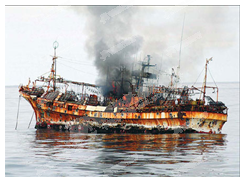
A US Coast Guard cutter poured cannon fire into an abandoned Japanese ghost ship that had been drifting since last year’s tsunami, sinking the vessel into waters more than 305 meters deep in the Gulf of Alaska and removing the danger it posed to shipping and the coastline on Thursday.
The cutter’s guns tore holes in the 164-foot Ryou-Un Maru, and then it began to take on water and lean to one side. In about four hours, the ship disappeared into the sea, said Chief Petty Officer Kip Wadlow.
The ship had no lights or communications system, and its tank was able to carry more than 7,570 liters of diesel fuel. Officials, however, didn’t know exactly how much fuel was aboard.
“It’s less risky than it would be running into shore or running into other ships,” coast guard spokesman Paul Webb said.
The US National Oceanic and Atmospheric Administration and the Environmental Protection Agency studied the problem and decided it is safer to sink the ship than let the fuel evaporate and pollute the sea environment.
Ryou-Un Maru was probably among the first wave of the 1.5 million tons of garbage of refrigerators, washing machines, televisions, roofs and fishing nets heading toward North America since last March when a magnitude-9.0 earthquake struck Japan.
As the coast guard was ready to fire on the vessel, a Canadian fishing vessel, the 19-meter Bernice C, claimed the rights to save the ghost ship in international waters.
Plans to sink it were paused so the Canadian crew could have a chance to take the stricken ship. A Canadian official with knowledge of the situation told the Associated Press that the Bernice C was unable to drag it.
Then the Canadian boat left, and once it was about 10 kilometers from the Japanese vessel, the Coast Guard began to fire, first with 25 mm shells, then a few hours later with ammunition twice that size.
State officials have been working to test the danger of garbage including materials affected by a damaged nuclear power plant, to see if Alaska residents, seafood or wild animals could be affected.
【小题1】Which of the following is NOT the reason for sinking the Japanese ship?
| A.It had no lights or communications system. |
| B.It might be washed up onto the shore. |
| C.It was a danger to other passing ships. |
| D.The oil it carried could pollute the sea. |
| A.the ghost ship was beyond the reach of the Coast Guard’s guns |
| B.the shells were not powerful enough to sink the ghost ship |
| C.state officials worried the ghost ship might give out radiation |
| D.a Canadian fishing boat wanted to save the ghost ship |
| A.Japanese ghost ship arriving at US |
| B.Tsunami garbage heading to US |
| C.Cannon fire sinking Japanese ghost ship |
| D.Japanese ghost ship polluting the Pacific |
The long, lonely voyage of the Japanese ghost ship is over.
A US Coast Guard cutter poured cannon fire into an abandoned Japanese ghost ship that had been drifting since last year’s tsunami (海啸), sinking the vessel into waters more than 305 meters deep in the Gulf of Alaska and removing the danger it posed to shipping and the coastline on Thursday.
The cutter’s guns tore holes in the 164-foot Ryou-Un Maru, and then it began to take on water and lean to one side. In about four hours, the ship disappeared into the sea, said Chief Petty Officer Kip Wadlow.
The ship had no lights or communications system, and its tank was able to carry more than 7,570 liters of diesel fuel. Officials, however, didn’t know exactly how much fuel was aboard.
“It’s less risky than it would be running into shore or running into other ships,” coast guard spokesman Paul Webb said.
The US National Oceanic and Atmospheric Administration and the Environmental Protection Agency studied the problem and decided it is safer to sink the ship than let the fuel evaporate and pollute the sea environment.
Ryou-Un Maru was probably among the first wave of the 1.5 million tons of garbage of refrigerators, washing machines, televisions, roofs and fishing nets heading toward North America since last March when a magnitude-9.0 earthquake struck Japan.
As the coast guard was ready to fire on the vessel, a Canadian fishing vessel, the 19-meter Bernice C, claimed the rights to save the ghost ship in international waters.
Plans to sink it were paused so the Canadian crew could have a chance to take the stricken ship. A Canadian official with knowledge of the situation told the Associated Press that the Bernice C was unable to drag it.
Then the Canadian boat left, and once it was about 10 kilometers from the Japanese vessel, the Coast Guard began to fire, first with 25 mm shells, then a few hours later with ammunition (弹药)twice that size.
State officials have been working to test the danger of garbage including materials affected by a damaged nuclear power plant, to see if Alaska residents, seafood or wild animals could be affected.
【小题1】The plan to fire on the Japanese ghost ship was paused because ____________.
| A.the ghost ship was beyond the reach of the Coast Guard’s guns |
| B.state officials worried the ghost ship might give out radiation |
| C.the shells were not powerful enough to sink the ghost ship |
| D.a Canadian fishing boat wanted to save the ghost ship |
a. Its long, lonely voyage came to an end.
b. The US Coast Guard sank it into the sea.
c. The ship began to float across the Pacific Ocean.
d. A big tsunami was caused by great earthquakes.
e. Bernice C claimed rights to save the ghost ship.
| A.d, c, e, b, a | B.a, b, d, c, e | C.c, e, d, a, b | D.b, a, d, c, e |
| A.Japanese ghost ship arriving at US |
| B.Tsunami garbage heading to US |
| C.Japanese ghost ship polluting the Pacific |
| D.Cannon fire sinking Japanese ghost ship |