题目内容

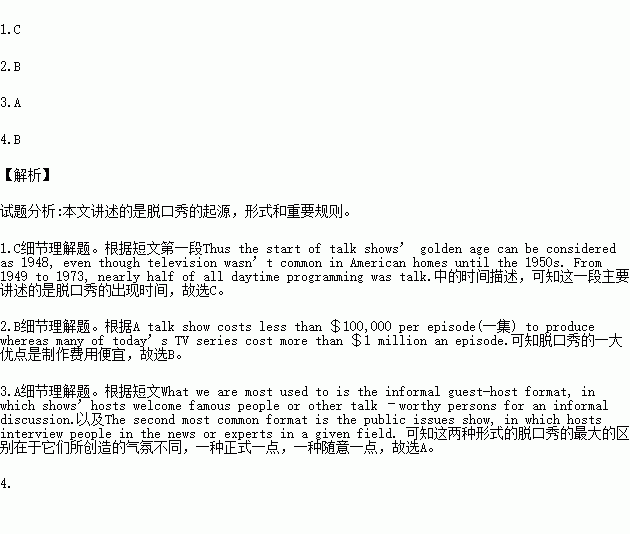
A “talk show” is a show organized mainly around talk. Television talk shows have been around since the dawn of radio. Thus the start of talk shows’ golden age can be considered as 1948, even though television wasn’t common in American homes until the 1950s. From 1949 to 1973, nearly half of all daytime programming was talk.

Why are there so many talk shows? A talk show costs less than $100,000 per episode(一集) to produce whereas many of today’s TV series cost more than $1 million an episode. Thus , if successful, it can produce handsome profits . Still, it takes a lot of work . Since 1948, hundreds of talk shows have come and gone, with only a few having true staying power.

There are several types of talk shows , but while the styles might vary, the format(形式) is limited.

What we are most used to is the informal guest-host format, in which shows’hosts welcome famous people or other talk –worthy persons for an informal discussion.

The second most common format is the public issues show, in which hosts interview people in the news or experts in a given field. Shows that follow this format include both morning news programs and “issue” talk shows:

The Museum of Broadcast Communications’ Bernard M. Timberg notes two governing principles of all successful talk shows:

The host is everything :The host has a high degree of control over their show, from subject matter to comedic atmosphere . They are also the show’s brand and are responsible for it. The host can attract and refuse guests, organize their program and , in many cases, name a successor(继任者) when they retire.

Right here, right now: The second rule is that a talk show must be experienced in the present tense, whether it is broadcast live or taped in front of an audience earlier in the day. They should feel fresh, as if they are happening in the moment, even if the show is a 10-year –old rerun.

1.What is paragraph 1 mainly about?

A. How talk shows appeared? B. Why talk shows appeared?

C. When talk shows appeared? D. Where talk shows appeared?

2.What is an advantage of talk shows?

A. They are easy to make.

B. They are cheap to produce.

C. They come in varied formats.

D. They remain successful for a long time.

3.The two formats of talk shows differ in_____________.

A. the atmosphere they create

B. the time they are broadcast

C. whether they are sent out live

D. whether they invite famous guests

4.What is the key to talk shows’ success according to the second principle?

A. Dealing with the most popular issues.

B. Giving the audience an up-to-date feeling.

C. Inviting the audience to the place where the shows are made.

D. Running the shows several times to refresh the audience’s memory.
练习册系列答案
相关题目

根据短文内容,从短文后的选项中选出能填入空白处的最佳选项,并在答题卡上将该项涂黑。选项中有两项为多余选项。

How to Motivate Yourself to Study

Studying can be one of life’s most boring activities. 1. But you can change your attitude towards the hardship of studying by reminding yourself of a few basic but important truths!

Remind yourself of your purpose. 2. Where do you see yourself in 5, 10, or even 20 years? The time you spend studying now will help to make your future dream a reality. Whether you are working towards a degree, a special skill, or some type of personal achievement, the act of studying is like a bridge between where you are now and where you want to be in the future.!

3. A well-educated person is a powerful person. Knowledge is priceless. A well-educated, knowledgeable person is a person who is able to navigate and excel better within the world around him/her.

Dare yourself to succeed. 4. When you get over the barriers, you’ll realize that personal achievement and fulfillment are wonderful things. Allow yourself to do the things that can contribute to your personal achievement and fulfillment –like studying!

Always keep a positive attitude. Your attitude towards study can have a huge impact on your motivation! 5. But if you have a positive attitude towards your study, you will be able to boost motivation, just by having a positive attitude towards it.

A.Is it never too old to learn?

B.Realize knowledge is power.

C.What are your goals in life?

D.Devote your spare time and energy to study.

E.Thinking negatively is not helpful and will not help you to get motivated.

F.In fact, the very nature of studying goes against the basic human desire to maximize pleasure.

G.Tell yourself you can successfully overcome any real or imagined difficulty standing in your way.

When 12-year-old Taylor Smith wrote a special letter to herself last spring, to be read in 10 years’ time, she didn’t know it would be opened before even a year had passed— and that it wouldn’t be her eyes reading the words.

“She had told me that she had written a letter to herself, and that she was excited that she was going to open it when she was older,”said Taylor’s mother, Mary Ellen Smith.

Instead, it was opened by Taylor’s parents after she died last spring. They posted the letter to Facebook, hoping it would inspire others.

It has. “We’ve gotten letters from lots of parents who have said it has encouraged them to love their kids and love each other,” said Mary Ellen Smith.

In the letter, Taylor congratulated herself on graduating from high school and asked, “Are you in college?”

She also wanted to know if she had been on a plane yet and if the show “Doctor Who” was still on the air.

Taylor also had some words for her future kids. After considering the idea of selling her iPad and getting an iPad mini instead, she told her future self to mention to her kids that “We’re older than the tablet.” She included a drawing of an iPad for them to see.

Taylor died suddenly of pneumonia (肺炎), leaving behind both her parents and an older brother.

“I just want people to know just what an awesome, awesome person she was,” her father, Tim Smith said.

Her mother said, “I can’t bring her back, but I’m so grateful people have been inspired by her story.”

Taylor’s father read the closing words of her letter, which said, “It’s been years since I wrote this. Stuff has happened, good and bad. That’s just how life works, and you have to go with it.”

1.Taylor Smith decided to open her letter when she was ________.

A. 18 years old B. 20 years old

C. 22 years old D. 24 years old

2.Why did Taylor’s parents post her letter to Facebook?

A. To show Taylor Smith’s deep love for her parents.

B. To encourage parents and kids to love each other.

C. To make themselves well-known and make money.

D. To prove Taylor Smith was good at writing.

3.We can learn from the passage that Taylor Smith ________.

A. was a college student

B. had never got an iPad

C. had never taken a plane

D. wanted to join “Doctor Who”.

4.What is the message conveyed at the end of Taylor Smith’s letter?

A. We should develop the habit of keeping a diary.

B. We should accept everything that happens in life.

C. We should stop bad things from happening.

D. We should show our love for our parents in time.

A terrible competition is going on in England, with billions of dollars and hundreds of lives at risk. OK, that’s not true. But competitors from around the world gathered on Thursday for the annual competition to compete for the world’s biggest person who tells lies.

Each participant is given up to five minutes to make up the best fib in the contest, which was founded in honor of 19th-century Bridge Inn landlord Will Ritson, who was reportedly famous for his lies. Competitors gather at the Bridge Inn every year for the competition, a small pub in northwestern England. Anyone but lawyers and politicians can take part in the competition.

A study found that nearly all lies are detectable (可检测的) through visible facial muscle reactions in the person telling a lie. “Thus, while interpersonal cheat often is highly successful, signs of hidden emotional states are communicated clearly to the informed observer,” the study concluded.

A churchman of Carlisle reportedly holds what may be the greatest lie of all time in the competition, simply stating, “I have never told a lie in my life.”

In 2003, Abrie Krueger from South Africa became the first one to win the competition. In 2006, comedian Sue Perkins became the first female to win the competition, telling a tale about people riding camels to work as a result of climate change.

1.Why does the author tell a lie at the beginning of the passage?

A. He likes telling lies.

B. He intends to talk about a contest.

C. Lies can be detected by someone.

D. Nearly everyone has told lies.

2.What does the underlined word “fib” in Paragraph 2 probably mean?

A. Experience. B. Story. C. Lie. D. Plot.

3.Who can’t take part in the competition?

A. Lawyers & politicians. B. Reporters & editors.

C. Doctors & teachers. D. Students & managers.

4.What’s the author’s main purpose of this passage?

A. To explain how to deal with lies.

B. To invite people to take part in the competition.

C. To discuss how to avoid telling lies.

D. To introduce a strange competition.

Have you ever had the strange feeling that you were being watched? You turned around and, sure enough, someone was looking right at you!

Parapsychologists (灵学家) say that humans have a natural ability to sense when someone is looking at them. To research whether such a “sixth sense” really exists, Robert Baker, a psychologist (心理学家) at the University of Kentucky, did two experiments.

In the first one, Baker sat behind unknowing people in public places and stared(盯着)at the backs of their heads for 5 to 15 minutes. The subjects(受试者)were eating, drinking, reading, studying, watching TV, or working at a computer. Baker made sure that the people could not tell that he was sitting behind them during those periods. Later, when he questioned the subjects, almost all of them said they had no sense that someone was staring at them.

For the second experiment, Baker told the subjects that they would be stared at from time to time from behind in a laboratory setting. The people had to write down when they felt they were being stared at and when they weren’t. Baker found that the subjects were no better at telling when they were stared at and when they weren’t.

Baker concludes that people do not have the ability to sense when they’re being stared at. If people doubt the outcome of his two experiments, said Baker, “I suggest they repeat the experiments and see for themselves.”

1.The aim of the two experiments is to ________.

A.explain when people can have a sixth sense

B.study how people act while being watched in the lab

C.study whether humans can sense when they are stared at

D.prove why humans have a sixth sense

2.The underlined word “outcome” in the last paragraph most probably means ________.

A.value B.result

C.performance D.connection

3.In the second experiment, the subjects _________.

A.could tell when they were stared at

B.could tell where they weren’t stared at

C.couldn’t tell who they were stared at or who they stared at

D.couldn’t tell when they were stared at or when they weren’t

4.What can be learned from the passage?

A.People are born with a sixth sense.

B.The experiments support parapsychologists’ idea.

C.The subjects do not have a sixth sense in the experiments.

D.People have a sixth sense in all places.

违法和不良信息举报电话:027-86699610 举报邮箱:58377363@163.com

精英家教网
