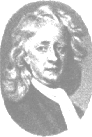
Southeast of an area that was to become the English industrial heartland, in a little village called Woolsthorpe, Isaac Newton made his entry into the world.He was prematurely(过早地)born, and, was so small at his birth, his mother used to say that“he might then have been put into a quart mug”.His widowed mother-Newton's father had died several months before his birth-was to re-marry; and there apparently being no room for a two-year-old boy in the new Newton household-this small misplaced child passed into the care of his grandmother.
Newton had a bad start with his schooling; he has been described as having been one of the poorest performing students in the grammar school in which his grandmother had placed him.The story is that the boy suffered from a blow delivered by a schoolyard bully(欺凌弱小者);or was it that he was struck on the head by an apple:whatever it was, an event occurred whereby“the hard shell which imprisoned his genius was cracked wide open”.The boy was to make a dramatic(戏剧性的)turn around, early in his scholastic career.He was to ask questions which many of us sooner or later have come to ask.What is light and how is it transmitted(传送)?What keeps the moon in the orbit of the earth, and the planets in the orbit of the sun?Why does the apple fall to the ground?Newton came, in time, to answer these questions and was to give positive proof(证据)of these answers, proofs and answers which serve us yet today.
Somehow, interested people managed in 1661 to see that Newton entered Trinity College, Cambridge.
His famous saying“If I have seen further(than you and Descartes)it is by standing upon the shoulders of Giants.”is still well-known nowadays.
(1)
Isaac Newton was born ________
[ ]
A.
in the industrial heartland then
B.
in a village in England
C.
southeast of Woolsthorpe
D.
northwest of Woolsthorpe
(2)
What can we learn about his birth?
[ ]
A.
He was born into a quart mug.
B.
At birth, he was a bit bigger than a quart mug.
C.
He was born ahead of the expected time.
D.
He was mature when he was born.
(3)
What do you think the underlined word“widowed”refer to?
[ ]
A.
A woman whose husband has died and who has not remarried.
B.
A woman who is forced to go in or out of the house through the window.
C.
A woman whose husband is often away from home.
D.
A woman who gives birth to a baby at an early age.
(4)
Which of the following statements is NOT true about Newton's schooling?
[ ]
A.
He was not good at his lessons at the beginning.
B.
He was often bullied by others at the beginning.
C.
He started poorly but made a good turn in time.
D.
He often answered others'questions about everything.
(5)
What happened to Newton in 1661?
[ ]
A.
He aroused great interest all over the world.
B.
He was admitted into the University of Cambridge.
C.
People saw him off when he went into Trinity College.
D.
He said, “If I have seen further(than you and Descartes)it is by standing upon the shoulders of Giants.”
Learn to identify, control and prevent seasonal landscape-disease and landscape-pest problems at the workshop, 3∶30 pm-5 pm.Tuesday at the US National Arboretum,3501 New York Ave NE, Washington, $15; registration required.
202-245-4521 or www.usna.usda.gov.
THROUGH AUG.3
Horticultural(园艺的)Art
Watercolors, pen-and–ink drawings and colored-pencil pieces by the Brookside Gardens School of Botanical Art and Illustration will be on display at the exhibit Botanica 2007:the Art and Science of Plants at Brookside Gardens Visitors Center, 1800 Glenallan Ave, Wheaton, through Aug.3.Free.301-962-1400 or www.brooksidegardens.org.
THROUGH SEPT.9
Botanical(植物学的)Art
Visit Patterns in Nature, an exhibit by Amy Lamb featuring photographs of flowers, leaves and other botanical life, at the US Botanic Garden Conservatory, West Orangerie, 100 Maryland Ave SW, Washington, through Sept.9.The conservatory is open 10 am-5 pm daily.Free.202-225-8333.
THROUGH OCT.8
Botanic Garden Exhibit
Celebrating America's Public Gardens is on view through Oct.8 at the US botanic Garden, 100 Maryland Ave SW, Washington.The exhibit, on the Conservatory Terrace and in the National Garden, features displays of 20 public botanic gardens across the country.Hours are 10 am-5 pm daily.Free.202-200-8956.
(1)
If you want to record your name for an event in advance, you may call ________.
[ ]
A.
202-225-8333
B.
202-245-4521
C.
301-962-1400
D.
202-200-8956
(2)
If you go to Botanic Garden Exhibit, you ________.
[ ]
A.
can enjoy drawings and colored-pencil pieces
B.
can learn how to kill pests living on the plants
C.
can find displays of 20 botanic gardens across the country
D.
will enjoy the photographs of flowers and leaves
(3)
From the advertisement, we learn ________.
[ ]
A.
the first event is about growing healthy plants
B.
all of the events are free of charge
C.
there is no time limit to all the events
D.
you can find all the information of the events either by phone or e-mail
阅读理解
Events Calendar
TUESDAY
Landscape Pests(害虫)
Learn to identify, control and prevent seasonal landscape-disease and landscape-pest problems at the workshop, 3∶30 pm.-5 pm.Tuesday at the US National Arboretum, 3501 New York Ave NE, Washington.$15; registration required.
202-245-4521 or www.usna.usda.gov.
THROUGH AUGUST 3
Horticultural(园艺的)Art
Watercolours, pen-and-ink drawings and coloured-pencil pieces by the Brookside Gardens School of Botanical(植物学的)Art and Illustration will be on display at the exhibit Botanic 2007:The Art and Science of Plants at Brookside Gardens Visitors Center, 1800 Glenallan Ave, Wheaton, through Aug.3.Free.301-962-1400 or www.brooksidegardens.org.
THROUGH SEPTEMBER 9
Botanical Art
Visit Patterns in Nature, an exhibit by Amy Lamb featuring photographs of flowers, leaves and other botanical life, at the US Botanic Garden Conservatory(温室),West Orangerie, 100 Maryland Ave SW, Washington, through Sept.9.The conservatory is open 10 am.-5 pm.Daily.Free.202-225-8333.
THROUGH OCTOBER 8
Botanic Garden Exhibit
Celebrating America’s Public Gardens is on view through Oct.8 at the US Botanic Garden, 100 Maryland Ave SW, Washington.The exhibit, on the Conservatory Terrace and in the National Garden, features displays of 20 public botanic gardens across the country.Hours are 10 am.-5 pm.Daily.Free.202-200-8956.
(1)
If you want to record your name for an event in advance, you may call ________.
[ ]
A.
202-225-8333
B.
202-245-4521
C.
301-962-1400
D.
202-200-8956
(2)
If you go to Botanic Garden Exhibit, you ________.
[ ]
A.
can enjoy drawings and coloured-pencil pieces
B.
can learn how to kill pests living on the plants
C.
can find displays of 20 botanic gardens across the country
D.
will enjoy the photographs of flowers and leaves
(3)
From the advertisement, we learn ________.
[ ]
A.
the first event is about growing healthy plants
B.
all of the events are free of charge
C.
there is no time limit to all the events
D.
you can find the information of all the events either by phone or by e-mail
阅读理解
Have you heard of the saying, “If anything is worth doing, it is worth doing well”? The proverb is a piece of advice to make effort towards perfection in whichever job one does.It could be a small task like folding up your clothes, or a major ne like organizing a business meeting in your later life.
Perfection is nothing but attention to details.If it is your job to dust the furniture at home, dust it so that not a single spot of dirt shows from any angle.If your task is to make the beds, make them so that not a single crease(皱痕)shows on the bed-covers.
There are only two ways to do a job:either sloppily, or well.If you choose the latter path, you need to realize that any job that qualifies as “your” work deserves nothing less than your best.Perfection is an attitude that can be cultivated(培养)with just a little effort.It is a habit that does much good to your later life.Let us prove with an example:you may be asked to turn in an essay on, say, wildlife, for a school project.Instead of writing carelessly a few facts that you already know, you could make the project more effective by looking up reference books, encyclopedias(百科全书)or websites for additional information.You could then go over the finished essay for slips(疏漏)and errors, and provide pictures where necessary.If you make it a habit to put in extra effort in your school homework, will it not help you to handle more difficult projects at the college or university level?
As Michelangelo, the famous 16th century sculptor and painter, once put it:Trifles(琐事)go to make perfection, and perfection is no trifle.
(1)
According to the passage, to achieve perfection is _________.
[ ]
A.
to realize the quality of the work
B.
to pay attention to details of one’s work
C.
to do as many jobs as possible
D.
to form the habit of doing things ahead of time
(2)
The underlined word “sloppily” in Paragraph 3 may mean _________.
[ ]
A.
badly
B.
patiently
C.
carefully
D.
slowly
(3)
What can be inferred from the third paragraph?
[ ]
A.
It is necessary to provide pictures for your essay.
B.
Websites are the sources of information you want.
C.
Perfection is a habit that promises a good future.
D.
You should make much effort to develop perfection.
(4)
The purpose of writing this passage is to _________.

 备战中考寒假系列答案