To discover whether bees can see colors, the following experiment is set up. A table is put in a garden and on the table is a piece of blue cardboard (硬纸板) with a drop of syrup (糖浆) on it. After a short time, bees come to the syrup. The bees then fly to their hive (蜂窝) and give the syrup to other bees in the hive. Then they return to the feeding-place which they have discovered. After a while, the blue cardboard with the syrup on it is taken away. Instead of this card, a blue card is now put on the left side of the first feeding-place and a red card to its right. These new card have no syrup on them. Thus, the blue card is on the left, the red card on the right, and there is nothing where the first blue feeding-card used to be. Very soon bees arrive again, and fly straight to the blue card. None to the red card.

To do the experiment, altogether how many cards do you need to prepare?

A. Two, one blue and one red.                           B. Three, two blue and one red.

C. Three, one blue and two red.                      D. Four, two blue and two red.

If figure 1 (图1) below shows the table top during step 1 of the experiment, which picture in figure 2 represents (代表) step 2?

  (blue card with syrup              blue card          red card )


  Figure 1:

  Figure 2:

A              B            C            D                

During step 2 of the experiment, the bees come to_______.

the original blue card with syrup on it

the new blue card with no syrup on it

the empty space where original blue card was

the new blue card with syrup on it

The experiment has proved that bees _______.

A. cannot see colors                       B. can see colors

C. cannot see blue                 D. cannot see red

第四部分:任务型阅读(共10小题;每小题l分,满分10分)

请认真阅读下列短文,并根据所读内容在文章后表格中的空格里填入一个最恰当的单词。注意:每个空格只填1个单词。请将答案写在答题卡上相应题号的横线上。

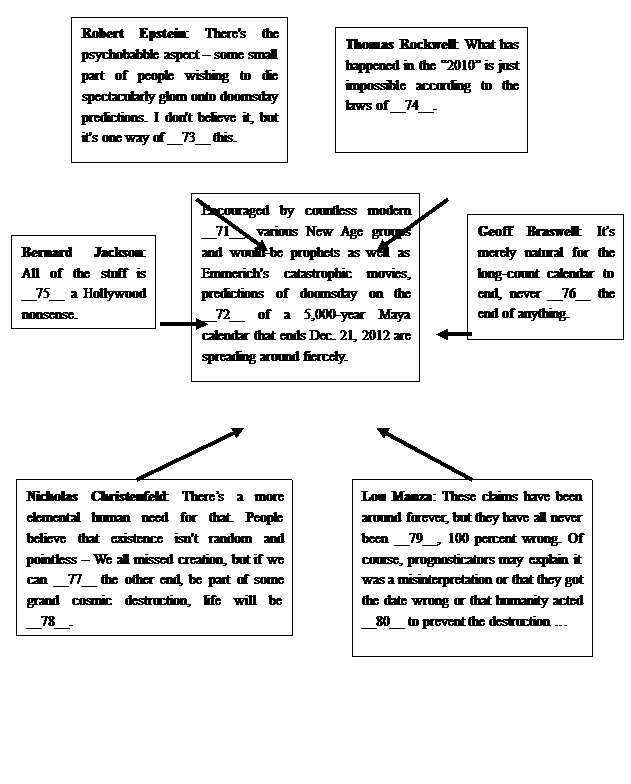
Experts debunk Maya doomsday(末日) predictions -- But that hasn't stopped books, movies from cashing in.

If the ancient Maya and filmmaker Roland Emmerich are correct, the apocalypse(大灾变) will happen very fast, maybe quicker than his new 2??-hour movie.

Predictions of global ruination are rippling around the globe with seismic(地震的) force, all loosely based on a 5,000-year Maya calendar that ends Dec. 21, 2012. Countless Web sites and blogs anticipate(预料) the end of days, as do various New Age groups and would-be prophets(预言者) offering guidance and how-to tips. On Amazon.com , you can read hundreds of book titles combining the year 2012 with terms such as “apocalypse,” “catastrophe” and “end of the world.”

As always, doomsday sells — and a lot of people are buying it.

“There's the psychobabble(心理呓语) aspect,” said Robert Epstein, former editor of Psychology Today magazine and a lecturer at the University of California San Diego. “It's the Sigmund Freud/death wish idea: People glom onto(对…感兴趣) doomsday predictions because there's some small part of them that wants to die, and die spectacularly(壮观的). I don't believe it, but it's one way to look at this.”

It's Emmerich's way. The German director specializes in wreaking havoc on an epic scale, from climatic cataclysm in 2004's “The Day After Tomorrow” to angry aliens and reptiles in “Independence Day” and “Godzilla.”  In “2012,” he finishes the job.

The digitized disasters of “2012” are oversized, overwrought and sometimes literally over the top, as when a humongous tsunami washes over the Himalayan mountains, whose average height exceeds 20,000 feet. Meanwhile in Los Angeles, a 10.5-magnitude earthquake — a temblor at least 30 times more powerful than any real quake ever recorded — yanks the city apart like a giant zipper, sending chunks sliding into the Pacific Ocean.

That's not physically possible, of course. Nor is a 10.5-magnitude quake, said Thomas Rockwell, a geologist at San Diego State University. To generate that much energy, “you'd need a rupture that extends all around the planet.”

All of that other stuff “is pure Hollywood bunk,” said Bernard Jackson at the UCSD Center for Astrophysics and Space Sciences.

Entertaining, though, unless you happen to believe the Maya really predicted the end of the world. They didn't, said Geoff Braswell, a UCSD anthropologist. The long-count calendar doesn't signal the end of anything except the end of that particular calendar. “It's just like a car odometer. Unfortunately, hardly anybody reads ancient Mayan. Modern media hype(骗局), on the other hand, is almost inescapable.

Nicholas Christenfeld, a professor of psychology at UCSD, suggests a more elemental human need. Being swallowed by the Earth or incinerated in a giant fireball “fits neatly with the idea that people want to believe there's a plan, that existence isn't random and pointless,” Christenfeld said.

“We all missed creation, but if we can bear witness at the other end, be part of some grand cosmic destruction, that gives life meaning,” he said. 

It helps, too, not to think very hard about the facts, said Lou Manza, a professor of psychology at Lebanon Valley College in Annville, Pa. “These claims have been around forever, and they have all been false, 100 percent wrong,” Manza said.

Of course, prognosticators(预言者, 占卜者) usually have an explanation for that, Christenfeld said.

“They might say it was a misinterpretation,” he said. “They got the date wrong. They might claim humanity acted in time to prevent the destruction. Or faith came to the rescue because people believed something bad was going to happen, it didn't have to happen.”


 “It’s our tradition to help each other”, added Tenpa, a medical official in neighbouring Madoi County, who said Yushu has always been quick to help other areas in times of trouble. “We have suffered many dangers and each time people in Yushu have sent food and clothes. We are always thankful to them and hopefully we proved it by being the first rescue team to arrive in Yushu after the earthquake.”

  The Madoi medical team arrived just hours after the violent 7.1-magnitude earthquake hit Yushu. In two weeks, they have treated at least 1,800 people, while the county has donated 400,000 yuan.

  The biggest fear in the earthquake area is the outbreak of diseases. Tenpa said, “Keeping things clean in the shelter is very hard. Even hand washing is almost impossible because of lack of water. Our team is spraying disinfectant (喷洒消毒剂) and we hope that will work.”

  After driving for 13 hours with his medical team, Tian Jiancan said he immediately found a 40-year-old who was seriously injured after being trapped in a toppled house. Tian had to operate on the man in his emergency medical van. “If we had been one hour later, he would probably be dead. It’s good to see him out of danger now.” Tian’s medical team has treated over 3,200 people, including a 15-day-old baby and a 105-year-old man. They also helped to put up tents against winds, where patients are protected well.

  One local man said although most doctors cannot speak Tibetan, they have shown their care and love through their actions.

60. Which of the following is TRUE according to the passage?

 A. This is the first time that Tibetans have faced great dangers.

   B. People in Yushu have always been ready to help each other.

   C. Madoi was also hit by the 7.1-magnitude earthquake.

   D. Tian’s team is the second rescue team to arrive Yushu.

61. What is the closest meaning to the underlined words in paragraph 7?

   A. a house on the top floor                      B. a house which had no roofs

   C. a house which fell down                          D. a house which was poorly built

62. How many people have been rescued by the medical teams according to the passage?

   A. About 1,800.                B. 3,200.                C. At least 5,000.          D. 4000,000.

63. What is the passage mainly about?

A. People in Yushu are encouraged by the medical team workers.

B. The doctors went along quite well in spite of the language trouble.

C. The Madoi medical team was the first to arrive at the earthquake-hit area.

D. The medical workers made great efforts to help the people suffering from the earthquake.

第二节  完形填空 (共20小题,每题1. 5分,满分30分)

    阅读下面短文,掌握其大意,然后从36—55各题所给的四个选项中,选出最佳选项。

Learn and Earn

    Charlie and Jackie joined a wholesale company (批发公司) together just after graduation. They both worked very hard.

    After several years, the boss made Jackie sales manager but Charlie   36   a salesman. One day Charlie could not   37   it any more. He handed in his resignation letter (辞职信) to the boss and complained(抱怨) that the boss did not   38   hard-working employees(雇员), but only raised those who tried to please him. He thought that it was really   39  .

    The boss knew that Charlie had spared no   40   for the company all these years, but in order to help Charlie to realize the   41   between him and Jackie, the boss asked Charlie to do the   42  . "Go and find out if there is anyone selling watermelons(西瓜) in the market." Charlie went, returned and   43   said, "Yes." The boss asked, "How much per kg?" Charlie went back to the market to ask and returned to   44  , "$ 12 per kg."

    The boss told Charlie that he would ask Jackie the   45   question. Jackie went, returned and said, "Boss, only one person selling watermelons. $ 12 per kg, $ 100 for 10 kg. He has a   46   of 340 melons. On the table are 58 melons, and every melon weighs about 15 kg,   47   from the South two days ago. They are fresh, red, and of good   48  ."

    Charlie was   49    and he realized the difference between himself and Jackie.  He decided not to   50   but to learn from Jackie.

    My dear friends, you know, a more   51   person is more observant, thinks more and understands in   52  . For the same matter, he sees several years ahead,   53   you see only tomorrow. The difference between a year and a day is 365 times, so how could you   54   ?

    Think: how far have you seen ahead in your life? How   55   are you?

36.A. made     B. became      C. remained    D. kept

37.A. take      B. do      C. get      D. put

38.A. enjoy    B. meet   C. repay  D. value

39.A. unusual B. unfair C. careless      D. selfless

40.A. rest       B. trouble       C. effect  D. effort

41.A. competition  B. relationship       C. difference   D. distance

42.A. following     B. finding       C. shopping    D. searching

43.A. still       B. again  C. even   D. only

44.A. offer     B. answer       C. remind       D. repeat

45.A. difficult B. familiar      C. same   D. simple

46.A. total      B. lot      C. pile     D. number

47.A. taken     B. come  C. bought       D. heard

48.A. value     B. quality       C. condition    D. shape

49.A. struck    B. moved       C. puzzled      D. encouraged

50.A. stay       B. stop    C. work   D. leave

51.A. important     B. intelligent   C. successful   D. hardworking

52.A. time      B. depth  C. need   D. common

53.A. while    B. though       C. unless D. since

54.A. see B. think   C. know  D. win

55.A. hopeful B. thoughtful  C. helpful       D. meaningful

违法和不良信息举报电话:027-86699610 举报邮箱:58377363@163.com

精英家教网