题目内容
What we really concern is _____ those orphans can recover from the earthquake psychologically.
A. that B. if C. why D. whether
D
【解析】
试题分析:句意:我们真正关心的是那些孤儿能否在心理上从地震(的伤害)中恢复过来。表语从句中表示是否,用whether不用if. 只用whether不用if的情况:1.主语从句放在句首 2. 引导表语从句 3.介词后,不定式前 4. 与or或or not连用。5. discuss后。故D正确。
考点:考查whether和if的区别。

How Room Designs Affect Our Work and Feelings
Architects have long had the feeling that the places we live in can affect our thoughts, feelings and behaviors. But now scientists are giving this feeling an empirical(经验的,实证的) basis. They are discovering how to design spaces that promote creativity, keep people focused and lead to relaxation.
Researches show that aspects of the physical environment can influence creativity. In 2007, Joan Meyers-Levy at the University of Minnesota, reported that the height of a room's ceiling affects how people think. Her research indicates that higher ceilings encourage people to think more freely, which may lead them to make more abstract connections. Low ceilings, on the other hand, may inspire a more detailed outlook.
In additions to ceiling height, the view afforded by a building may influence an occupant's ability to concentrate. Nancy Wells and her colleagues at Cornell University found in their study that kids who experienced the greatest increase in greenness as a result of a family move made the most gains on a standard test of attention.
Using nature to improve focus of attention ought to pay off academically, and it seems to, according to a study led by C. Kenneth Tanner, head of the School Design & Planning Laboratory at the University of Georgia. Tanner and his team found that students in classrooms with unblocked views of at least 50 feet outside the window had higher scores on tests of vocabulary, language arts and maths than did students whose classrooms primarily overlooked roads and parking lots.
Recent study on room lighting design suggests than dim(暗淡的) light helps people to loosen up. If that is true generally, keeping the light low during dinner or at parties could increase relaxation. Researchers of Harvard Medical School also discovered that furniture with rounded edges could help visitors relax.
So far scientists have focused mainly on public buildings. "We have a very limited number of studies, so we're almost looking at the problem through a straw(吸管)," architect David Allison says. "How do you take answers to very specific questions and make broad, generalized use of them? That's what we're all struggling with."
【小题1】What does Joan Meyers-Levy focus on in her research?
| A.Light. | B.Ceilings. | C.Windows. | D.Furniture. |
| A.the shape of furniture may affect people's feelings |
| B.lower ceilings may help improve students' creativity |
| C.children in a dim classroom may improve their grades |
| D.students in rooms with unblocked views may feel relaxed |
| A.the problem is not approached step by step |
| B.the researches so far have faults in themselves |
| C.the problem is too difficult for researchers to detect |
| D.research in this area is not enough to make generalized patterns |
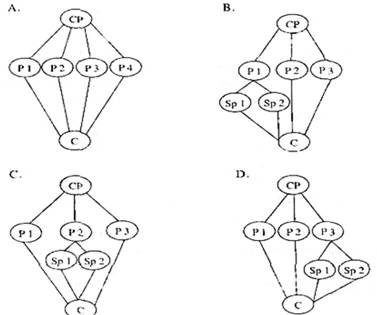
CP: Central Point P: Point SP: Sub-point(次要点) C: Conclusion
Parents are often amazed at how fast their child grows and develops. New research has determined that the ability to quantify may develop much sooner than most parents realize.
Kristy Vanmarle, professor of the University of Missouri, has determined that contrary to what previous studies have shown, infants(婴儿)are able to quantify substances(物质)—like sand or water—as early as 10 months. As long as the difference between the two substances is large enough, infants will choose the larger amount, especially when it comes to food.
With the assistance of her team researchers, Vanmarle tested the quantifying skills of babies by presenting them with two cups: one containing a small amount of food, and one containing a larger amount. Consistently, the babies chose the larger amount.
“Several studies throughout the last 15 years have shown that infants are very good at telling how many objects they see; however, infants don’t seem to count things like water or sand,” Vanmarle said. “What we’re saying is that they can quantify substances; it’s just much harder. The infants can see how much food goes into each cup and compare that in their memories. They decide which amount is larger, and they almost always select the larger one.”
“This information further refutes(驳斥)the long-held idea that babies know nothing of the world,” Vanmarle said.
“Since psychologists have begun studying infants with sensitive measures, we’ve discovered a lot of early abilities. I think for parents, it should be exciting to know that there’s somebody in there that has some fundamental and basic knowledge of the world, and that knowledge is guiding their development,” Vanmarle said.
In the future, Vanmarle says this kind of study could be linked to a child’s progress in math-related skills, although programs marketed to increase those abilities, such as “Baby Einstein,” still have mixed reviews when it comes to academic study.
【小题1】 The quantifying ability refers to the ability to .
| A.choose between different substances | B.describe the quantity of something |
| C.get much knowledge of the world | D.obtain math-related skills |
| A.The process of doing research. | B.The final choice of infants. |
| C.The scientific findings. | D.The observation of infants’ behavior. |
| A.through their natural abilities | B.with the help of parents |
| C.on personal preference | D.by saying numbers |
| A.some parents don’t care about their kids |
| B.scholars disagree on baby-training programs |
| C.little research has been done on infants |
| D.people used to think the world is known to babies |
| A.Unique Quantifying Methods | B.Amazing Baby-training Ideas |
| C.Early Human Abilities | D.Breakthrough in Baby Studies |
The latest research suggests that the key factor separating geniuses from the merely accomplished is not I.Q., a generally bad predictor of success. Instead, it’s purposeful practice. Top performers spend more hours practising their craft. It you wanted to picture how a typical genius might develop, you’d take a girl who possessed a slightly above average language ability. It wouldn’t have to be a big talent, just enough so that she might gain some sense of distinction. Then you would want her to meet, say, a novelist, who coincidentally shared some similar qualities. Maybe the writer was from the same town, had the same family background, or shared the same birthday.
This contact would give the girl a vision of her future self. It would hive her some idea of a fascinating circle who might someday join. It would also help if one of her parents died when she was 12, giving her a strong sense of insecurity and fuelling a desperate need for success. Armed with this ambition, she would read novels and life stories of writers without end. This would give her a primary knowledge of her field. She’s be able to see new writing in deeper ways and quickly understand its inner workings.
Then she would practise writing. Her practice would be slow, painstaking and error-focused. By practising in this way, he delays the automatizing process. Her mind wants to turn conscious, newly learned skills into unconscious. Automatically performed skills. By practising slowly, by breaking skills down into tiny parts and repeating, she forces the brain to internalize a better pattern of performance. Then she would find an adviser who would provide a constant stream of feedback, viewing her performance form the outside, correcting the smallest errors, pushing her to take on tougher challenges. By now she is redoing problems—how do I get characters into a room—dozens and dozens of times. She is establishing habits of thought she can call upon in order to understand or solve future problems.
The primary quality our young writer possesses is not some mysterious genius. It’s the ability to develop a purposeful, laborious and boring practice routine; the latest research takes some of the magic out of great achievement. But it underlines a fact that is often neglected. Public discussion is affected by genetics and what we’re “hard-wired” to do. And it’s true that genes play a role in our capabilities. But the brain is also very plastic. We construct ourselves through behaviour.
【小题1】The passage mainly deals with________.
| A.the function of I.Q. in cultivating a writer |
| B.the relationship between genius and success |
| C.the decisive factor in making a genius |
| D.the way of gaining some sense of distinction |
| A.come to understand the inner structure of writing |
| B.join a fascinating circle of writers someday |
| C.share with a novelist her likes and dislikes |
| D.learn from the living examples to establish a sense of security |
| A.her adviser forms a primary challenging force to her success. |
| B.her writing turns into an automatic pattern of performance |
| C.she acquires the magic of some great achievement |
| D.she comes to realize she is “hard-wired” to write |
| A.A fuelling ambition plays a leading role in one’s success |
| B.A responsible adviser is more important than the knowledge of writing. |
| C.As to the growth of a genius, I.Q. Doesn’t matter, but just his|her effort. |
| D.What really matters is what you do rather then who you are. |