题目内容

Pop idols are celebrities who burn brighter than regular stars. If a star is someone you can recognize on the street, an idol is someone who will cause a stir at a public appearance.

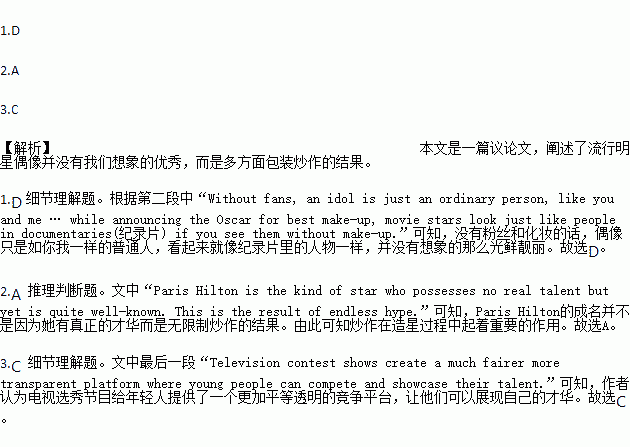
Without fans, an idol is just an ordinary person, like you and me. As Reese Witherspoon once said while announcing the Oscar for best make-up, movie stars look just like people in documentaries(纪录片) if you see them without make-up.

I was once invited to a private party where about half of the guests were stars and the other half entertainment reporters. Guess what? The good-looking ones were the reporters because they tend to be young, and they glow without make-up.

Some idols are born; some are made. Most idols are created by a machine called the entertainment industry. They may have some charms and talent, but not enough to become famous. They are the raw material out of which a star, or even an idol, is made. An army of behind-the-scenes assistants will hype(炒作) or even make up their virtues and hide their shortcomings.

Paris Hilton is the kind of star who possesses no real talent but yet is quite well-known. This is the result of endless hype. If you are thrust into the limelight often enough, you can become a celebrity without having any talent.

Television contest shows create a much fairer more transparent platform where young people can compete and showcase their talent. The soap opera is another platform for idol making. These drama

series are long, giving an actor much needed exposure. The actors and actresses are always well-lit, made up and beautifully dressed. Now all they need is some good dialogue from the scriptwriter(编 剧).

1.Which of the following statements agrees with the writer’s viewpoint?

A. Most idols are born.

B. The entertainment industry is more popular.

C. Many stars are often good looking

D. Pop idols are not as pretty as you think.

2.Why does the writer use the example of Paris Hilton?

A. To show that hype is an important element in making a star.

B. To indicate that Paris Hilton is very famous.

C. To prove a star often lacks talent.

D. To show a star is popular because of the acting skills.

3.What does the writer think of the television contest show?

A. More practical. B. More formal. C. More equal. D. More competitive.
练习册系列答案
相关题目

You must have written your research paper, your personal essay, your book review-----whatever your school class requires. You think you have provided good information in the needed number of words.1.

But is it really done? Many teachers and professional writers believe that writing is revision.2.

Revision of writing is a necessary skill for students. The classroom is a good place to practice patience, concentration and listening. There are rewards with spending time with your thoughts and really taking time to compose your ideas in an orderly and reasonable way. You should put away your paper after you have written a first version, or draft. Wait several hours, maybe overnight, before working on it more.3. Not only are you refreshed, but you’re looking at things through different eyes. That’s what revision literally means—to see again through different eyes.

Following a four-step process may help you with your paper. The first step in the process is invention. It includes forming many questions about your subject. It is called “question-storming”.4.Then comes the revision period. Take your time to read what you’ve written, to think about it, and maybe to re-shape it based on what you see now, as a kind of new person looking at it with a reader’s eyeglasses rather than a writer’s. The fourth step is called “publication”.5.In a sense, anytime you turn it over to another person, that’s publication.

Probably, the process takes away some of the tension of writing. And worry about the quality of your writing often disappears when you share that writing.

A. Perfect writing is not possible.

B. In the second step, you draft and compose a paper.

C. And you feel good because your work is finished.

D. This is just like returning to a job after a vacation.

E. This does not mean your writing is professional publication.

F. What is most important is getting your thoughts and ideas on paper.

G. In other words, writing well means making needed changes and rewriting.

(内蒙古赤峰市高三2016届三模)“I have rights. I have the right of education. I have the right to play. I have the right to sing. I have the right to talk. I have the right to go to market.I have the right to speak up.”

That was Malala Yousafzai. She was _______about girls' rights to an education, something _______by the Taliban militant group.

About a year after that interview, 15-year old Malala was shot _______the head by a Taliban gunman. She ________, and continued her work to help young women get an education. On Friday, at age 17, Malala became the youngest person ever awarded a Nobel Peace prize. She _______it with Kailash Satyarthi of India. The 60-year-old activist has led peaceful demonstrations _______child slavery and forced labor.

The _______that the award is shared is significant. Malala is a Pakistani Muslim, Satyarthi is an Indian Hindu.Their nations are_______. Malala says the award gives a message to people of love between Pakistan and India and between different ______.

Malala came to the press conference _______from school. She spoke mostly without note, she talked for about 15 minutes, and she described how she'd been in the _______lesson at 10:15 in the morning, and she knew it was a(an)________day, she knew the Nobel Peace awards were going to be announced, and at 10:15 she had said to______, that she didn't expect that she was going to get the award.

Then a teacher came to the chemistry class________she was, and she was________to one side told that she had won the award, but she decided__________ that that she would stay and finish her lesson.

She had a physics lesson before coming and________the speech. And she talked about how she felt honored to have received this award.

“I'm feeling honored that I'm being______as a Nobel laureate(获奖者), and I have been honored with this-this______award to the Nobel Peace Prize. And I'm proud that I'm the______Pakistani and the first young woman or the first young person who's getting this award. It's a great honor for me.”

1.A. taking up B. holding up C. summing up D. speaking up

2.A. supported B. approved C. objected D. opposed

3.A. in B. at C. on D. to

4.A. died B. struggled C. escaped D. survived

5.A. speaks B. shares C. gets D. accepts

6.A. for B. towards C. against D. through

7.A. news B. information C. idea D. fact

8.A. friends B. rivals C. relatives D. neighbors

9.A. religions B. cultures C. countries D. areas

10.A. slowly B. hurriedly C. quickly D. direct

11.A. math B. chemistry C. physics D. geography

12.A. important B. necessary C. wonderful D. useful

13.A. her B. them C. herself D. themselves

14.A. who B. which C. where D. what

15.A. taken B. fetched C. brought D. carried

16.A. beyond B. beneath C. beside D. despite

17.A. giving B. offering C. leading D. talking

18.A. advised B. realized C. chosen D. asked

19.A. splendid B. precious C. concise D. enormous

20.A. best B. first C. greatest D. smartest

Christina Parra brushed her cane(手杖) across the carpet at the entrance to Walgreens. She tapped her way past the shopping carts (手推车) and red lipsticks she could only _______.

Christina, a 16-year-old with two prosthetic(假的) brown eyes, had visited this store several times in _______ for this moment: She was shopping. Love songs _______ through the loudspeakers of the North Highlands, California store. Christina reached the end of Aisle (通道) 1-A and turned right, _______ her way past smooth bottles of liquid soap, toward the individual soap bars. She wanted to buy a bar of soap. A simple goal, but not _______ an easy one.

Christina was 18 months old when she was diagnosed with cancer in both her eyes. Doctors _______Christina’s left eye immediately; a few years later, they removed the right. Since then, activities other kids _______ for granted—taking a bus, _______ the street, shopping at a store—have posed(造成) plenty of _______ for her.

The teacher showed the little girl how to find her classroom by __________ her cane along a lawn’s edge. She learned to count driveways while __________ to a certain address. Yet for a long time, shopping still seemed __________. How would she ever walk __________ those vast aisles, __________with row after row of products she couldn’t see?

Finally, Christina told her teacher that she was ready to shop__________. Together, they took inventory (目录册) at Walgreens. Over the course of several __________, Zermeno told Christina the kinds of products each aisle held; Christina took careful __________ on her Braille computer (盲人电脑).

And __________ it was, on Monday, that her __________came to rest on the bars of soap. She felt her way down to a lower shelf, until she __________ the one she wanted.

1.A. see B. find C. imagine D. smell

2.A. search B. preparation C. praise D. favor

3.A. went B. got C. flew D. passed

4.A. forcing B. feeling C. finding D. losing

5.A. fortunately B. clearly C. necessarily D. differently

6.A. removed B. cured C. treated D. rebuilt

7.A. make B. take C. have D. get

8.A. cleaning B. building C. crossing D. wandering

9.A. challenges B. joy C. pleasure D. disasters

10.A. waving B. tapping C. touching D. moving

11.A. appearing B. turning C. pointing D. walking

12.A. scary B. uncertain C. possible D. frightened

13.A. across B. through C. over D. by

14.A. surrounded B. covered C. filled D. decorated

15.A. of her own B. on her own C. to her own D. at her own

16.A. failures B. efforts C. attempts D. visits

17.A. notice B. attention C. focus D. notes

18.A. so B. yet C. moreover D. besides

19.A. cane B. fingers C. nose D. cart

20.A. saw B. smelled C. bought D. located

Rujuta Teredesai grew up in Pune,a city in India.She saw that girls and boys in her community were not treated equally.Girls were responsible for all the household work.1.women didn't have the same rights as men.They often suffered from mistreatment and sometimes even physical violence.

2.But she saw that organizations working to end gender discrimination usually paid attention only to the actions and attitudes of girls. "Nobody talked to young boys about equality," she said.3.The organization,Equal Community Foundation (ECF), now reaches 40,000 people in 20 communities in Pune.

ECF matches small groups of boys,ages 14 to 17,with male mentors for a 15-week period.The mentors talk to the boys about treating girls with respect.4.They discuss times when the boys experienced unfair treatment. Then they work with the boys to come up with ways the boys can help spread tolerance.Boys have completed projects like making maps of the safest routes for girls to walk at night.

"What we have found is that these boys don’t mean to be discriminatory," Teredesai says. "They don't mean to hurt someone.5." When boys work to make girls' lives better,everyone in the community wins.

A.They help boys relate to girls’ experiences.

B.It's part of the solution to end discrimination.

C.It's just that they don't realize they’re doing it.

D.Many families didn't send their daughters to school.

E.Unfair treatment of girls and women is a problem in India.

F.Teredesai wanted to make a difference for girls and women.

G..So she decided to create a space for boys to learn about girls' rights.

Facebook is an Internet-based social network site that lets people get in touch with family and friends and reach out to people with common interests around the world, all through computer. It is very popular, with more than 900 million users. If Facebook were a country, it would have about three times the population of the United States.

Documents filed with US. financial regulators say Facebook has hundreds of millions of active users who send billions of messages each day and upload 250 million photographs on their personal pages. Facebook users have registered 100 billion “friends.”

On Facebook, “Friending” someone means you add the person to your list of people you can communicate with directly, which often allows the person to see more information about you than you share with the general public.

Facebook was started by Mark Zuckerberg and other students at Harvard University in 2004, and has grown at an amazingly fast pace.

Facebook makes money when advertisers pay to get access to hundreds of millions of Facebook users. Advertisers can often direct their messages to the people most interested in their products because Facebook computers keep track of information that users place on their pages. For example, a person interested in diving, planning a wedding, looking for work, or suffering from diabetes(糖尿病) may see advertisements related to those topics.

Facebook has become so much a part of the culture of the United States and other nations that it has been the subject of a Hollywood movie. It is a key marketing tool for many businesses, and its users’ content has been used as evidence in some divorce or criminal cases.

1.From the first paragraph, we can learn that ________.

A. about 900 million Americans are using Facebook

B. Facebook is widely used in the world

C. Facebook is a country in the Internet

D. Facebook is a place where people can meet face to face

2.If you are a friend of someone on Facebook, you__________ .

A. will have 100 billion friends

B. can download 250 million photographs

C. will share more private information

D. have to send message every day

3.Advertisers use Facebook because they can know__________.

A. who are interested in their products

B. how to keep track of information

C. what products are popular with the young

D. where their products are sold well

4.What might be the most suitable title for the passage?

A. Who starts Facebook?

B. How to use Facebook?

C. When is Facebook on?

D. What is Facebook?

违法和不良信息举报电话:027-86699610 举报邮箱:58377363@163.com

精英家教网