ÌâÄ¿ÄÚÈÝ

ÊéÃæ±í´ï£¬Éú»îÖÐÎÒÃǶ¼ÐèÒªÅóÓÑ£¬ÎÒÃǸýύÔõÑùµÄÅóÓÑ£¬²»Í¬µÄÈËÓв»Í¬µÄ¿´·¨¡£ÇëÈÏÕæÔĶÁÏÂÃæµÄÒýÓï(quotation)£¬°´ÒªÇóÓÃÓ¢Óïдһƪ¶ÌÎÄ¡£

A true friend is a source of strength and hope.

¡ªJonathan Lockwood Huie

ÄÚÈÝÒªÇó£º

1£®Ì¸Ì¸Äã¶Ô¸ÃÒýÓïµÄÀí½â£»

2£®ÄãµÄÏà¹Ø¾­Àú£»

3£®Ç¡µ±µÄ½áβ¡£

×¢Ò⣺1.¶ÌÎÄ¿ªÍ·ÒѸø³ö£¬²»¼ÆÈë×Ü´ÊÊý£»

2£®ÎÄÖв»ÄܳöÏÖ¿¼ÉúµÄ¾ßÌåÐÅÏ¢£»

3£®´ÊÊý100×óÓÒ¡£

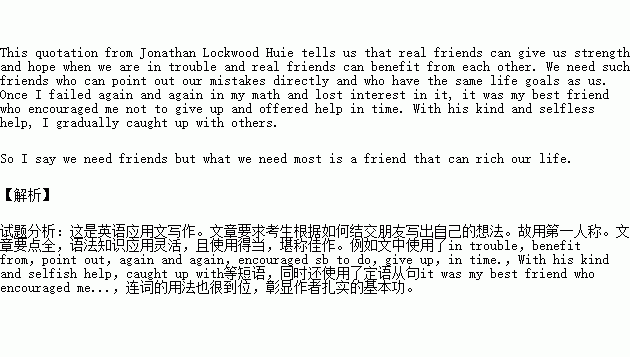
This quotation from Jonathan Lockwood Huie tells us that_________________________

___________________________________________________________________________
___________________________________________________________________________

___________________________________________________________________________

___________________________________________________________________________

Á·Ï°²áϵÁдð°¸
Ïà¹ØÌâÄ¿

Mosquitoes have an extraordinary ability to target humans far away and fly straight to their unprotected skin. Regrettably, mosquitoes can do more than cause an itchy(·¢Ñ÷µÄ£©wound. Some mosquitoes spread several serious diseases£¬including Dengue£¬yellow fever and malaria.

Over one million people worldwide die from these diseases each year. New research now shows how mosquitoes choose who to bite.

Mosquitoes need blood to survive. They are attracted to human skin and breath. They smell the carbon dioxide gas, which all mammals breathe out. This gas is the main way for mosquitoes to know that a warm-blooded creature is nearby.

But mosquitoes also use their eyes and sense of touch. Michael Dickinson is a professor at the California Institute of Technology. His research shows how these small insects, with even smaller brains£¬use three senses to find a blood meal.

Michael Dickinson¡¯s team used plumes¡ªa material that rises into the air of carbon dioxide gas into a wind tunnel. They then used cameras to record the mosquitoes. The insects followed the plume.

Then, the scientists placed dark objects on the lighter colored floor and walls of the tunnel. Mr. Dickinson said, at first, the mosquitoes showed no interest in the objects at all. ¡°What was quite striking and quite surprising is that the mosquitoes fly back and forth for hours. These are hungry females and they completely ignore the objects on the floor and wall of the tunnel. But the moment they get a hit of CO2, they change their behavior quite obviously and now would become attracted to these little visual blobs (°ßµã£©.¡±

This suggested to the researchers that a mosquito¡¯s sense of smell is more important in the search for food. Once mosquitoes catch a smell of a human or animal£¬they also follow visual signals.

1.What do mosquitoes mainly use to find their targets?

A. Sense of smell B. Sense of touch

C. Sense of sight D. Smart brains

2.The first response of the mosquitoes to the objects in the experiment is _______.

A. to fly to the dark ones

B. to catch and stick to them

C. to take no notice of them

D. to attach themselves to them

3.How can we avoid being attacked by mosquitoes according to the text?

A. Don¡¯t let them see us.

B. Use dark objects to stop them.

C. Make them fly back and forth for hours.

D. Attract them to objects full of carbon dioxide gas.

4.What can be the best title for the text?

A. How Do Mosquitoes Survive?

B. Why Do Mosquitoes Need Blood?

C. How Do Mosquitoes Choose to Bite You?

D. Why Do Mosquitoes Attack the Human Being?

ÔĶÁÀí½â¡£

Sunstroke is a condition that can quickly go from dangerous to deadly, especially if proper care isn't given immediately.

Sunstroke, sometimes called heatstroke, is a result of the body temperature rising above the safe limit. This causes the body's necessary functions to stop working.

It's usually pretty easy to avoid sunstroke, as long as proper action is taken. In that case, you need to act as quickly as possible to return that person's body to a safe temperature. Here are a few tips to help treat sunstroke.

Call for help

Call to get an ambulance as quickly as possible. This should be the first thing you do, especially if the sunstroke person has fainted (»èµ¹). Also, call for help from anyone nearby if you're in a public place. If there's no one around, call someone nearby if they can get there sooner than an ambulance. Ask everyone to bring you as much water as possible, if there isn't much nearby.

Get the person to a cooler area

If there's a building nearby, aim for that. Anywhere with plenty of air conditioners and water is perfect. If a building isn't available, bring the person to a well?shaded area.

Get the water flowing

If the person is still conscious, get him or her to drink water. If there's a bathtub available, fill it with cool water and put the person in it.

If your water supply is limited, you have to save it. Dampen a towel or shirt and put it on the person's body. Focus on the face, neck, and chest.

Fan the person

Getting moving air over the person cools him or her down. Use anything, a towel or sheet, a shirt, your hands, or a piece of board. This is where having many people around really helps, as they can combine to fan the entire body.

1.When does a person get sunstroke?

A£®When the body doesn't function.

B£®When proper care is given immediately.

C£®When someone is exposed to the sun too long.

D£®When the body temperature goes up beyond what one can bear.

2.What is mainly discussed in the passage?

A£®The first aid for sunstroke.

B£®The causes of sunstroke.

C£®The chief symptoms of sunstroke.

D£®The essential prevention of sunstroke.

3.Which of the following is NOT mentioned in the text?

A£®Call for assistance from others.

B£®Leave the sunstroke person in the shade.

C£®Put a wet towel on the person's face.

D£®Help the person take some medicine.

4.The text probably comes from________.

A£®a guidebook B£®a book review

C£®a medical magazine D£®an official document

Î¥·¨ºÍ²»Á¼ÐÅÏ¢¾Ù±¨µç»°£º027-86699610 ¾Ù±¨ÓÊÏ䣺58377363@163.com

¾«Ó¢¼Ò½ÌÍø