题目内容

美国某中学举办英语暑假训练营,开设以下课程:cooking,swimming,giving first-aid,playing football/ basketball。假定你是李华,请你写封申请信,报名参加其中一门课程的学习。

内容包括:1.你感兴趣的一门课程;2.为什么想学这门课程;3.你期望从中学到什么。

注意:1.词数:100左右;2.可以适当增加细节,以使行文连贯。

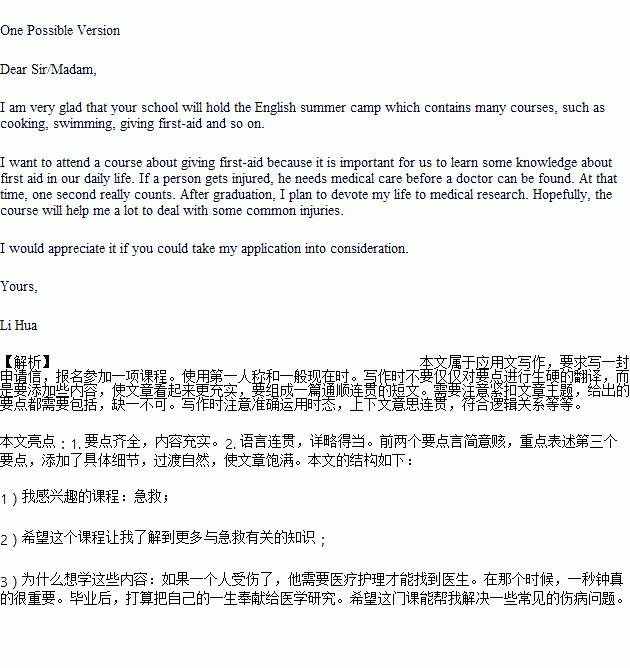
Dear Sir/Madam,

Yours,

Li Hua
练习册系列答案
相关题目

Our family’s first hosting experience began in January of 2015 with our Italian daughter Victoria. We had so much fun with her that we could not___________to experience a new, different country, so we__________to host another World Heritage Exchange Student.

As soon as we saw Merna’s information, we knew she was_________,a YES Scholarship student, and Egyptian. We began to fall in love with our Egyptain__________right away. We Skyped, and emailed for five months________she arrived in the US. When she__________got off the plane, it was as if we were finally a(n)________family again.

My husband and I grew up believing that other cultures_______us, and hosting a foreign Exchange Student just seems so_________for us. We felt it would be a__________experience for our children to grow up seeing other cultures and learning to love others as a(n)_________. Our small children are enjoying the experience vastly, learning a new language________, and realizing that the other side of the world is not all that________our country.

Merna is small, loving, helpful, charming, caring and a real__________to our lives. She has ________us all so much. We cannot__________our lives without our Italian and Egyptain daughters. We do plan to travel to________countries because of them, and we will be sending our children as exchange students to live with our new_________families.

I want to thank World Heritage for_________a chance for our family to grow from four children to six children all in one year. We are all excited at this experience of a lifetime and will forever________it.

1.A. help B. choose C. wait D. intend

2.A. applied B. afforded C. managed D. remembered

3.A. brilliant B. ambitious C. cute D. loyal

4.A. friend B. student C. daughter D. relative

5.A. once B. after C. since D. before

6.A. even B. already C. just D. ever

7.A. big B. foreign C. free D. whole

8.A. appeal to B. stick to C. belong to D. take to

9.A. common B. natural C. apparent D. simple

10.A. normal B. personal C. promising D. rewarding

11.A. companion B. reminder C. equal D. individual

12.A. little by little B. few by few C. one by one D. side by side

13.A. amongst B. unlike C. opposite D. about

14.A. guest B. heroine C. believer D. blessing

15.A. offered B. warned C. taught D. left

16.A. live B. enjoy C. imagine D. continue

17.A. other B. another C. all D. both

18.A. extended B. increased C. formed D. loved

19.A. having B. providing C. getting D. allowing

20.A. conduct B. appreciate C. desire D. adore

Compliments can be sent in all shapes and sizes. They can range from congratulating co-workers on their hard work to telling someone how good that shirt looks on him or her. 1. In other words, compliments, no matter how small or great they are, can make anyone feel good. Next time, if you want to give someone some compliments, keep these tips in mind.

• Perfect your compliments. People feel much more appreciated when you say exactly why you think that person deserves some praise. That’s to say, back your compliments up with examples of why you think that person did a good job. 2.

• Don’t put it off. Too many people wait until what they think is the perfect moment to send a compliment. 3. What you have in your head as a perfect moment may never happen. If you feel that a compliment is appropriate, the best time is now.

4. Don’t ever tell someone that something he or she has done is great and then point out what he or she was doing beforehand wasn’t so great. Compliments are meant to make people feel good, and that’s it. Don’t bring other things into them because comparing the present and the past can just make someone feel bad about themselves.

• Be selfless. 5. Not only is this very selfish, but it destroys all of the sincerity right out of the compliments. If you think someone’s hair looks nice, say so — but don’t do it just because you’re having a new hairstyle and want some validation (确认) for your own look.

A. Give a 100% compliment.

B. Don’t be one of those people!

C. It’s always a nice idea to give a compliment with a smile.

D. The best compliment leaves no room for any misunderstanding.

E. Your sincere compliments can make someone’s entire day better.

F. Never compliment someone because you want a compliment back.

G. Adding examples makes your compliments more sincere and effective.

New research proves it wrong that the loss of one sense may sharpen other senses. A new study from the University of Montreal found that blind people have no sharper sense of smell than the sighted. The loss of sight simply makes blind people pay more attention to how they sense smells, the researchers said.

“If you enter a room in which coffee is boiling, you will quickly look for the coffee machine. However, for a blind person, he or she will only have the smell of coffee as information,” said a researcher, Mathilde Beaulieu-Lefebvre.

“There is a saying that blind people have better smell than the sighted. We are proving it wrong,” said Maurice Ptito, a professor at the University of Montreal. “However, the blind do set themselves apart as they are somewhat better than the sighted at deciding what direction a sound is coming from.”

It is further found that the blind use a certain part of the brain more than the sighted when they smell. They also use the part which is normally used for sight. “That’s interesting because it means that part of the brain is reorganized and used in a new way,” said Ptito.

The research on the sense of smell could lead to new applications that are likely to help guide blind people in their surroundings.

1.How do blind people know coffee is boiling?

A. By looking for the coffee machine. B. By using the sense of smell.

C. By sharpening their sense of sight. D. By doing a scientific study.

2.The underlined phrase “set themselves apart” probably means “ ”.

A. put themselves aside B. make themselves puzzled

C. give themselves up D. make themselves distinguishing

3.In which part of a magazine can we most probably read this passage?

A. Science. B. Food.

C. Culture. D. Music.

Kids with special needs refer to any kid who might need extra help because of a medical,emotional,or learning problem.For example,kids who cannot walk need wheelchairs.They not only need equipment that helps them get around,but they might need to have ramps(坡道)or elevators available.1.

Kids with an illness would have special needs,too2.Kids with sight problems might need Braille books to read.Kids with hearing problems might need hearing aids.

3.It might be harder to do normal things,like learning to read or just getting around the school.The good news is that parents,doctors,nurses,teachers,and others can help.The goal is to help kids be as independent as possible.

Other kids can also be a big help.How?By being a friend.Kids who use a wheelchair or have lots of health problems want friends just as you do.But meeting people and making friends can be difficult.4.Be sure to tell a teacher if you see someone being bullied(欺辱)or teased.

5.Being friendly to kids with special needs is one of the best ways to be helpful.As you get to know them they may help you understand what it's like to be in their shoes.And you'll be helping fill a very special need,one that everybody has-the need for good mends.

A.Some kids might laugh at or make fun of them.

B.It is good manners to offer help to kids with special needs.

C.Life can be challenging for a kid with special needs.

D.They also might need to get a special bus to school.

E.They might need medicine or other help as they go about their daily activities.

F.Also,try to be helpful if you know someone with special needs.

G.Someone could have trouble with anxiety,but you wouldn't know it unless told about it.

The 2016 Nobel Prize in Physics is shared by three scientists, the Royal Academy of Sciences announced in Stockholm on Tuesday. The Nobel Prize in Physics 2016 was divided, with one half awarded to David J. Thouless, the other half to F. Duncan M. Haldane and J. Michael Kosterlitz “for theoretical discoveries of topological phase transitions and topological phases of matter(物质拓扑相变和拓扑相).”

Haldane said he was “very surprised” at the news, adding that he was glad that their discoveries found something previously unnoticed by many, and that they revealed “more possibilities for looking for new materials.” He particularly pointed out that a lot of work was still ongoing.

The year’s prize amount is 8 million Swedish krona(0.93 million US dollars), and will be split properly between the three winners.

The winners are given a sum of money when they receive their prizes, in the form of a document confirming the amount awarded. The amount of prize money depends upon how much money the Nobel Foundation can award each year. The purse has increased since the 1980s, when the prize money was 880,000 SEK per prize. In 2009, the monetary award was 10 million SEK (US$1.4 million; ?950,000). In June 2012, it was lowered to 8 million SEK.

If there are two winners of a particular prize, the award money is divided equally between the winners. If there are three, the awarding committee can choose to divide the money equally, or award one-half to one winner and one-quarter to each of the others. It is common for winners to donate prize money to benefit scientific, cultural, or charities.

1.How much price money does Thouless get?

A. 8 million Swedish krona.

B. 6 million Swedish krona.

C. 4 million Swedish krona.

D. 2 million Swedish krona.

2.According to the passage, Haldane thought that his work_________

A. was far from ending

B. was based on many previous studies

C. had perfectly been completed

D. had surprised the whole world

3.The amount of prize money _________. .

A. has been ever increasing since the 1980s

B. has been ever decreasing since the 1980s

C. remains 880,000 SEK each year after 2012

D. differs according to the Nobel Foundation’s affordability

4.What does the last paragraph talk about?

A. The purpose of the award money.

B. How the award money is dealt with.

C. How the laureates are selected.

D. The number of laureates per prize.

The story goes that some time ago, a man had a very lovely little daughter. One day the man ______ his 3-year- old daughter for ______ a roll of gold wrapping paper. Money was tight and he became ______ when the child tried to decorate a ______ to put under the Christmas tree. ______, the little girl brought the gift to her ______ the next morning and said, “This is for you, Daddy.”

The man was ______ by his earlier ______, but got angry again when he found out the box was ______. He yelled at her,saying, “Don’t you know, when you give someone a present, there is ______ to be something inside?” The little girl looked ______ at him with tears in her eyes and cried, “Oh, Daddy, it’s not empty ______. I blew kisses into the box. They are all for you, Daddy.”

The father felt regret. He ______ his arms around his little girl, and begged for her ______.

Only a short time later, an ______ took the life of the child. It is also told that her father kept that gold box by his bed for many ______ and whenever he was discouraged, he would take out a(n) ______ kiss and remember the love of the child who had put it there.

In a very real sense, each one of us, as human beings, has been given a gold container ______ with unconditional love and kisses from our children, family members, friends, and God. There is simply no other ______, anyone could hold, more ______ than this.

1.A. asked B. praised C. begged D. punished

2.A. wasting B. stealing C. selling D. holding

3.A. glad B. angry C. sad D. upset

4.A. room B. hall C. box D. ball

5.A. However B. So C. Therefore D. And

6.A. father B. mother C. teacher D. sister

7.A. puzzled B. surprised C. scared D. embarrassed

8.A. overwork B. overreaction C. overcoat D. overpass

9.A. empty B. heavy C. full D. wet

10.A. said B. believed C. supposed D. used

11.A. down B. back C. up D. forward

12.A. at all B. after all C. above all D. in all

13.A. put B. turned C. handed D. gave

14.A. kindness B. forgiveness C. sadness D. carelessness

15.A. event B. incident C. accident D. action

16.A. days B. months C. nights D. years

17.A. imaginary B. kind C. gentle D. warm

18.A. filled B. pleased C. crowded D. equipped

19.A. world B. feeling C. possession D. love

20.A. expensive B. precious C. comfortable D. interesting

违法和不良信息举报电话:027-86699610 举报邮箱:58377363@163.com

精英家教网