题目内容

Mr.Bush, together with his wife and daughter ________ going to Japan next week.

[  ]

A.are

B.is

C.will be

D.would be

答案:B
解析:

主语部分Mr.Bush, together with his wife and daughter中核心主语是Mr.Bush


练习册系列答案
相关题目

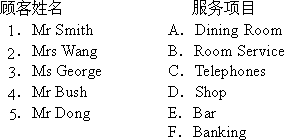
信息匹配

请阅读下列应用文及相关信息,并按照要求匹配信息。

首先,请阅读下列的应用文:

  A.Dining Room

  Breakfast is served in the dining room from 8 to 9∶30 am alternatively, the room staff will bring a breakfast tray to your room at any time after 7 am.In this case, please fill out a card and hang it outside your door when you go to bed.

Lunch:12 to 2∶30 p. m Dinner:7∶30 to 9 p. m

  B.Room Service

  This operates 24 hours a day;phone the Reception Desk, and your message will be passed on to the room staff.

  C.Telephones

  To make a phone call, dial 0 for Reception and ask to be connected.We apologize for delays in putting calls through when the staff(职员)are very busy.There are also public telephone booths near the Reception.

  D.Shop

  The hotel shop is open for small things, gifts and toiletries(化妆品)from 9 am to 5∶30 p. m.

  E.Bar

  The hotel bar is open from 12 to 2 pm, and 7 pm to 1 am.

  F.Banking

  The Reception staff will cash cheques and exchange money in many foreign currencies.

请阅读下面顾客信息,然后匹配适合他/她的信息:

  Mr:Smith lives in Room 2416, but the computer in the room doesn’t work.He wonders how to ask for help.

  Mrs:Wang lives in Room 2320, she wants to know how to make a phone call to her family in another city far away.

  Ms:George lives in 3808, she needs to buy toiletries.

  Mr:Bush from Britain is living in Room 1809, he now has only Pounds with him, and wonders where to exchange his money.

  Mr:Dong living in Room 8809, wants to eat breakfast in his room next morning.

听力(共两节,满分20分)

第一节(共5小题;每小题1分,满分5分)

听下面5段对话。每段对话后有一个小题,从题中所给的A、B、C三个选项中选出最佳选项。听完每段对话后,你都有10秒钟的时间来回答有关小题和阅读下一小题。每段对话仅读一遍。

1.What’s the weather like?

A.It’s fine.

B.It’s rainy.

C.It’s too hot.

2.What are they probably talking about?

A.TV shows.

B.Stories

C.Books

3.How old is Tina now?

A.19.

B.20.

C.21.

4.Where did Alice go at the weekend?

A.To the countryside

B.To the entertainment park

C.To the cinema

5.Why didn’t Helen come to the party?

A.She was not invited.

B.She forgot the time.

C.She had a piano lesson.

第二节(共15小题;每小题1分,满分15分)

听下面5段对话,每段对话或独白后有几个小题,从题中所给的A、B、C三个选项中选出最佳选项。听完每段对话后,你都有10秒钟的时间来回答有关小题和阅读下一小题。每段对话读两遍。听第六段材料, 回答第6至7题。

6.What gift does the man give Jane?

A.A dog.

B.A T-shirt.

C.A skirt.

7.Who has made the skirt for Jane?

A.The man.

B.Her mother.

C.Her grandmother.

听第七段材料,回答第8至10题。

8.How often does the man eat out?

A.4 times a week.

B.5 times a week.

C.At least once a day.

9.What kind of food does Lisa prefer?

A.Chinese food.

B.Italian food.

C.French food.

10.What can we learn from the talk?

A.The restaurant is rather big.

B.The restaurant sells noodles.

C.The restaurant is famous for eggs.

听第八段材料,回答第11至13题。

11.What happened to David?

A.He lost his way.

B.He couldn’t rent a car.

C.The car broken down.

12.What’s David trying to do?

A.Call the service station.

B.Change the appointment.

C.Say hello to Mr.Bush.

13.When will David meet Mr.Bush at his office?

A.At 1∶30 pm today.

B.At 11∶30 pm today.

C.At 1∶30 pm tomorrow.

听第九段材料,回答第14至17题。

14.When will Jane leave?

A.Tomorrow morning.

B.Tomorrow evening.

C.The day after tomorrow.

15.Who will go to meet Jane at the station?

A.Her uncle.

B.Her aunt.

C.Her sister.

16.What will the weather be like there?

A.Cool and dry.

B.Hot and wet.

C.Cold and wet.

17.Why is Jane going to see her uncle?

A.She misses him.

B.He is not well.

C.She needs his help.

听第十段材料,回答第18至20题。

18.Who could the text be written for?

A.Schoolchildren.

B.Parents.

C.Teachers.

19.What’s the second advice?

A.Get up early.

B.Go to bed early.

C.Do things the night before.

20.What kind of breakfast is suggested?

A.A sweet breakfast.

B.A simple breakfast.

C.A fast breakfast.

On the 36th day after they had voted, Americans finally learned Wednesday who would be their next president: Governor George W. Bush of Texas.

Vice President Al Gore, his last realistic avenue for legal challenge closed by a U. S. Supreme Court decision late Tuesday, planned to end the contest formally in a televised evening speech of perhaps 10 minutes, advisers said.

They said that Senator Joseph Lieberman, his vice presidential running mate, would first make brief comments. The men would speak from a ceremonial chamber of the Old Executive office Building, to the west of the White House.

The dozens of political workers and lawyers who had helped lead Mr. Gore’s unprecedented fight to claw a come-from-behind electoral victory in the pivotal state of Florida were thanked Wednesday and asked to stand down.

“The vice president has directed the recount committee to suspend activities,” William Daley, the Gore campaign chairman, said in a written statement.

Mr. Gore authorized that statement after meeting with his wife, Tipper, and with top advisers including Mr. Daley.

He was expected to telephone Mr. Bush during the day. The Bush campaign kept a low profile and moved gingerly, as if to leave space for Mr. Gore to contemplate his next steps.

Yet, at the end of a trying and tumultuous process that had focused world attention on sleepless vote counters across Florida, and on courtrooms form Miami to Tallahassee to Atlanta to Washington the Texas governor was set to become the 43d U. S. president.

The news of Mr. Gore’s plans followed the longest and most rancorous dispute over a U. S. presidential election in more than a century, one certain to leave scars in a badly divided country.

It was a bitter ending for Mr. Gore, who had outpolled Mr. Bush nationwide by some 300000 votes, but, without Florida, fell short in the Electoral College by 271votes to 267—the narrowest Electoral College victory since the turbulent election of 1876.

Mr. Gore was said to be distressed by what he and many Democratic activists felt was a partisan decision from the nation’s highest court.

The 5-to –4 decision of the Supreme Court held, in essence, that while a vote recount in Florida could be conducted in legal and constitutional fashion, as Mr. Gore had sought, this could not be done by the Dec. 12 deadline for states to select their presidential electors.

James Baker 3rd, the former secretary of state who represented Mr. Bush in the Florida dispute, issued a short statement after the U. S. high court ruling, saying that the governor was “very pleased and gratified.”

Mr. Bush was planning a nationwide speech aimed at trying to begin to heal the country’s deep, aching and varied divisions. He then was expected to meet with congressional leaders, including Democrats. Dick Cheney, Mr. Bush’s ruing mate, was meeting with congressmen Wednesday in Washington.

When Mr. Bush, who is 54, is sworn into office on Jan.20, he will be only the second son of  a president to follow his father to the White House, after John Adams and John Quincy Adams in the early 19th century.

Mr. Gore, in his speech, was expected to thank his supporters, defend his hive-week battle as an effort to ensure, as a matter of principle, that every vote be counted, and call for the nation to join behind the new president. He was described by an aide as “resolved and resigned.”

While some constitutional experts had said they believed states could present electors as late as Dec. 18, the U. S. high court made clear that it saw no such leeway.

The U.S. high court sent back “for revision” to the Florida court its order allowing recounts but made clear that for all practical purposes the election was over.

In its unsigned main opinion, the court declared, “The recount process, in its features here described, is inconsistent with the minimum procedures necessary to protect the fundamental right of each voter.”

That decision, by a court fractured along philosophical lines, left one liberal justice charging that the high court’s proceedings bore a political taint.

Justice John Paul Stevens wrote in an angry dissent:” Although we may never know with complete certainty the identity of the winner of this year’s presidential election, the identity of the loser is perfectly clear. It is the nation’s confidence in the judge as an impartial guardian of the law.”

But at the end of five seemingly endless weeks, during which the physical, legal and constitutional machines of the U. S. election were pressed and sorely tested in ways unseen in more than a century, the system finally produced a result, and one most Americans appeared to be willing at lease provisionally to support.

The Bush team welcomed the news with an outward show of restraint and aplomb. The governor’s hopes had risen and fallen so many times since Election night, and the legal warriors of each side suffered through so many dramatic reversals, that there was little energy left for celebration.

The main idea of this passage is

[A]. Bush’s victory in presidential election bore a political taint.

[B]. The process of the American presidential election.

[C]. The Supreme Court plays a very important part in the presidential election.

[D]. Gore is distressed.

     What does the sentence “as if to leave space for Mr. Gore to contemplate his next step” mean

[A]. Bush hopes Gore to join his administration.

[B]. Bush hopes Gore to concede defeat and to support him.

[C]. Bush hopes Gore to congraduate him.

[D]. Bush hopes Gore go on fighting with him.

     Why couldn’t Mr. Gore win the presidential election after he outpolled Mr. Bush in the popular vote? Because

[A]. the American president is decided by the supreme court’s decision.

[B]. people can’t directly elect their president.

[C]. the American president is elected by a slate of presidential electors.

[D]. the people of each state support Mr. Bush.

     What was the result of the 5—4 decision of the supreme court?

[A]. It was in fact for the vote recount.

[B]. It had nothing to do with the presidential election.

[C]. It decided the fate of the winner.

[D]. It was in essence against the vote recount.

     What did the “turbulent election of 1876” imply?

[A]. The process of presidential election of 2000 was the same as that.

[B]. There were great similarities between the two presidential elections (2000 and 1876).

[C]. It was compared to presidential election of 2000.

[D]. It was given an example.

Proverbs(谚语) are quite common in spoken English. We do not normally put them in a composition or letter. Sometimes it is helpful if you know what common proverbs mean. Here are a few examples:
Once bitten, twice shy. If a dog bites me, I shall be twice as careful in future when I see it. This proverb is also used to apply to many things and not only to dogs. If you have been cheated at a shop, you will not go to the same shop again. 
A bird in the hand is worth two in the bush. If I am a hunter, trying to catch birds, it is better to catch one bird than to see two birds in a bush but not be able to catch them. Thus this means that what you have already got is better than the chance of being able to get something bigger in the future.   
Too many cooks spoil the broth(soup). When too many people do something together, they get in each other’s way and cannot do a good job.
To pour oil on troubled waters Is to try to calm things down. Oil is lighter than water. If a ship is in trouble at sea, another ship may come to help it. The second ship can send small boats to rescue people. However, it may first pour oil on the sea to make the sea less rough.
Don't be a dog in a manger(马槽). Means “ Don’t be selfish.” In a stable(马厩), the manger is the place where the horse’s food is put. Sometimes a dog will sleep in the manger and bard when a horse comes to get its food. The dog does not want to eat the hay in the manger but it will not let the horse eat it.
He’s sitting on the fence. Means that somebody will not say whether he is in favour of a plan or against it. He is sitting on a fence between two opposing sides, perhaps waiting to see which side will win.
He who pays the piper calls the tune. A piper is a musician . The man who employs or pays a musician can say what tunes the man will play. Thus this means that if a man provides the money for a plan, he can say how it will be carried out.
You can’t get blood out of a stone means that you can’t get something out of a person who has not got any of the things you want. For example, you cannot get a million dollars from a poor man.
【小题1】Peter had a bicycle which was much too small for him but he did not want to let his younger brother ride on it. His mother was angry and said to him : “______”.

A.You cannot get blood out of a stoneB.Don’t be a dog in a manger
C.The early bird gets the wormD.Don’t be a horse in the manger
【小题2】Mr Wang paid for a new school. Some people did not like the design of the school but they did not argue with Mr Wang because ________.
A.he was sitting on the fenceB.once bitten, twice shy
C.he who pays the piper calls the tuneD.a bird in the hand is worth two in the bush
【小题3】Mrs Chen wanted to buy a new dress. Her husband suggested that she buy it from a shop near their home. Mrs Chen disagreed because she had been cheated by that shop. Then she said: “ I won’t go there again because___.”
A.a bird in the hand is worth two in the bushB.I am sitting on the fence
C.Once bitten, twice shyD.too man cooks spoil the broth
【小题4】Mr brown had quite a good job in Hong Kong but he thought that if he went to Singapore he might get a much better job with more money and a large house. His wife did not want him to leave his job in Hong Kong and she warned him that _____.
A.a bird in the hand is worth two in the bushB.too many cooks spoil the broth
C.you cannot get blood out of a stoneD.he who pays the piper calls the tune

President Barack Obama has complained about the loss of privacy that comes with being leader of the United States, regretting the loss of simple pleasures such as a long walk or a trip to the car wash or supermarket.
"I just miss – I miss being unknown," he said. "I miss Saturday morning, rolling out of bed, not shaving, getting into my car with my girls, driving to the supermarket, squeezing the fruit, getting my car washed, taking walks. I can't take a walk."
His dream, he said, was to "go through Central Park and watch folks passing by ... spend the day watching people – I miss that".
Faced with criticism for playing more golf than most previous occupants of the White House, he explained that the sport was simply the best way of getting relaxed.
"It's the only excuse I have to get outside for four hours," he told Hearst magazines.
Though he said he enjoyed his life in the White House, he felt disillusioned(醒悟的,幻想破灭的) with the some of the ways of Washington, which he has failed to change, such as the "kabuki dance(日本歌舞)" among political parties before serious policy discussions begin. His comments may be seen as excuse by critics who have accused him of appearing too detached(漠然), and being slow to engage in important issues such as Libya and the near shutdown of the US government last week.
Since arriving at the White House in January 2009, Mr Obama has already racked up(打)60 rounds of golf in office, more than George W Bush did in his eight years.
In terms of ability, Golf Digest magazine has ranked Mr Obama eighth out of the 18 presidents who played the game since it became established in the early 20th century.
【小题1】What do the second paragraph and the third paragraph mainly tell us?     .

A.Obama wishes to enjoy simple pleasures.
B.Obama likes going shopping with his girls.
C.Obama likes to take a walk.
D.Obama likes to watch folks passing by.
【小题2】According to Obama, he plays golf to ___________.
A.avoid criticism
B.show his ability
C.get relaxed
D.show his advantage over the former presidents
【小题3】What does the underlined word “It” refer to in the fifth paragraph?
A.Playing golf.B.Getting relaxed.
C.Changing some ways of Washington.D.Watching people
【小题4】What is the best title of the passage?
A.Obama complains about lack of privacy as president
B.Obama can’t live a normal life
C.Obama is often criticized
D.Obama likes to play golf

违法和不良信息举报电话:027-86699610 举报邮箱:58377363@163.com

精英家教网