题目内容

阅读理解

The Yellow River is the second longest river in China.It rises in the mountains in Qinghai and flows right across China to the Yellow Sea.Both the river and the sea are called Yellow because of the yellow mud which the river carries down from the desert into the sea, making the water a yellow color.When the river reaches the flat plain and flows less fast, it drops much of its mud, filling up the riverbed and forcing the water to overflow its banks and flood the countryside for miles.These terrible floods wash away crops and destroy whole villages.They have brought death and famine(饥饿)to so many people that the river is sometimes called“China's sorrow.”In order to prevent the floods, they have built banks of earth, called dykes(河堤)along both sides.As the river brought down more mud and broke through the dykes, people mended them and built them higher, until now in some parts the river flows as much as twenty feet above.In spite of the danger of floods, farming has been carried on for centuries.

(1)

Where does the yellow mud come from?

[  ]

A.

From the desert.

B.

From the riverbed.

C.

From the sea.

D.

From the riverbanks.

(2)

The flood comes when ________.

[  ]

A.

the river flows fast

B.

the river overflows its banks

C.

the river reaches the plain

D.

the river drops its yellow mud

(3)

Which of the following is NOT true?

[  ]

A.

The terrible floods used to destroy many villages.

B.

Many Chinese people suffered a lot from the river in history.

C.

Farming cannot be carried on till now.

D.

Floods often brought famine and death to the people.

(4)

To prevent the floods, people today ________.

[  ]

A.

have built higher banks all along the river

B.

have moved away the mud on the riverbed

C.

have built dams and waterworks

D.

have built new buildings along the river banks

答案:1.A;2.B;3.C;4.C;
练习册系列答案
相关题目

阅读理解

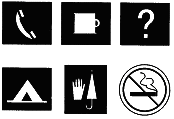
  In the 1970s, with ever-increasing international travel and tourism, the United States Department of Transportation decided to design a set of symbols(符号)for airports, stations, and public facilities(设施). The aim was to design symbols that would be clear to people in a hurry and to those who can not read English. Therefore, the set of symbols shown below was designed. Then the designers planned an experiment with an international sample(抽样调查) of 8-year-old children from Sweden. Japan, France, Canada, and Britain. The purpose of the experiment was to determine how clear the symbols would be to the children, who were not experienced international travelers.

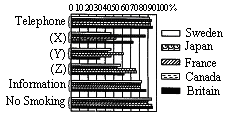
  The children were shown the set of sample symbols, and were then asked to explain to the experimenters what the symbols meant. The researchers thought that if the international sample of children could understand them, the grown-up travelers would probably also recognize their meanings. The following graph(图表) shows the percentages of correctly explained symbols.

  The experiments discovered that most of the children easily understand the telephone receiver and cigarette symbols. However, there were some interesting differences in their answers to the other four symbols. The Japanese children most easily understood the symbol standing for“coffee shop”. The experimenters thought that this fact showed children in Japan are more familiar with such shops than children in Sweden and Canada. The Japanese, French, and Canadian children all equally recognized the idea of“information”showed by the question mark.

  Interestingly, the French and Canadian children understood the symbol referring to“campground(露营地)”better than the other children. Again, the researchers thought that recognition of a symbol shows how common the activity is in a country.

  One particularly difficult symbol was that of the umbrella and glove used for“lost and found”, which was correctly explained by less than 50% of the children in four of the five countries. On the basis(基础) of this finding, the experimenters decided to add a question mark to make this symbol easier to understand.

1.Which of the following shows the correct meaning of(X), (Y), and (Z) in the graph above?

[  ]

A.Campground, Coffee Shop, Lost and Found.

B.Lost and Found, Campground, Coffee Shop.

C.Coffee shop, Lost and Found, Campground.

D.Telephone, No smoking, Information.

2.If we compare the Japanese and French children's understanding of the question mark and cigarette symbols, then we can find a difference of _____ between these symbols.

[  ]

A.0%   B.10%

C.80%   D.90%

3.The _____ symbol was the most difficult for the Japanese children to understand.

[  ]

A.cup   B.question mark

C.tent   D.umbrella and glove

4.Which of the following statements is TRUE?

[  ]

A.The experimenters thought Japanese children drink coffee.

B.The most difficult symbol was changed to make it clearer.

C.The question mark symbol is the least difficult in all five countries.

D.The researchers thought children would know as much as grown-ups.


第二部分 阅读理解(共两节,满分50分)
第一节 阅读下面短文,从每题所给的四个选项(A、B、C和D)中,选出最佳选项,并在答题卡上将该项涂黑。(共20小题;每小题2分,满分40分)
A
The Erie Canal was the first important national waterway built in the US. It crossed New York from Buffalo on Lake Erie Troy to Albany on the Hudson River. It joined the Great Lakes with the Atlantic Ocean. The canal served as a route over which industrial goods could flow into the west, and materials could pour into the east. The Erie Canal helped New York develop into the nation's largest city.
The building of the canal was paid for entirely by the state of New York. It cost $ 7,143,789, but it soon gained its price many times over. Between 1825, when the canal was opened, and 1882, when toll charges(过运河费)were stopped, the state collected $ 121,461,891.
For a hundred years before the Erie was built, people had been talking about a canal which could join the Great Lakes and the Atlantic Ocean. The man who planned the Erie Canal and carried the plan through was De Witt Clinton. Those who were against the canal laughingly called it "Clinton's Ditch(沟)". Clinton talked and wrote about the canal and drew up plans for it. He and Governor Morris went to Washington in 1812 to ask for help for the canal, but they were unsuccessful.
Clinton became governor of New York in 1817, and shortly afterwards, on July 4,1817, broke ground for the canal in Rome, N.Y. The first part of the canal was completed in 1820. As the canal grew, towns along its course developed fast. The length of the canal is 363 miles.
41.We can see that the Erie Canal______
A.joined the Great Lakes together
B.crossed New York Lakes together
C.played an important part in developing New York City
D.was the first waterway built in the US
42.It can be inferred that______into the Atlantic Ocean.
A.the Great Lakes flow                                              B.the Hudson River flows
C.Lake Erie flows                                                 D.the Erie Canal flows
43.Which of the following is TRUE according to the passage?
A.The Erie Canal brought profits of over $ 114,000,000.
B.It's 363 miles from the Great Lakes to the Atlantic Ocean.
C.The West was more advanced than the East when the canal was built.
D.Many other states helped New York build the canal.
44.We can learn from the passage that______.
A.Clinton broke ground for the canal at both ends
B.Clinton started building the canal before he became governor
C.all parts of the canal were completed at the same time
D.construction of the canal took eight years

三、阅读理解(共两节,40分)

第一节(共15小题;每小题2分,共30分)

       阅读下列短文,从每题所给的四个选项A、B、C、D)中,选出最佳选项,并在答题卡上将该项涂黑。

       When you go to St.Petersburg, the number of attractions can seem large.If you are short of time, or just want to make sure to hit the highlights, these are the top must-see sights in St. Petersburg.

1.The Hermitage Museum

       The Hermitage Museum is one of the most important sights to see for any visitor to St. Petersburg. There are lots of different paintings by the old masters in the Hermitage. Prepare to come face-to-face with classie Western artists.

2. Kizhi Island

       Kizhi Island is an open-air museum of wooden architecture from the Karelia Region of Russia. These impressive structures are made entirely without nails - the wood fits together with joints and grooves(沟槽).

3. Peterhof

       Peterhof is as beautiful as it is fun. You’ll be charged for admission, but go to Petethof when the fountaions are working—during the day in the summer. They are shut off in winter evenings.

4. The Church of Our Savior on the Spilt Blood

       Love it or hate it, the Church of Our Savior on the Spilt Blood in St. Petersburg is an enthralling must-see sight. The beautiful look may make y our eyes brighten, and the painting sinside the church will make you say “Wow!”

5. The Bronze Horseman Statue

       The so-called Bronze Horseman is a part of Russian culture and a symbol of St. Petersburg. Made famous by Alexander Pushkin, this statue of Peter the Great sitting on his horse can truly show Peter the Great’s influence on the Russian idce of greatness.

51.If you are interested in pairtings, you’d better go to         .

       A.Peterhof and Kizhi Island

       B.the Hcrmitagee Museum and Peterhof

       C.Kizhi lsland and the Church of Our Savior on the Spilt Blood

       D.the hermitage Museum and the Church of Our Savior on the Spilt Blood

52.We can learn from the passage that           .

       A.visitors can visit Peterhof for free

       B.the buildings of Kizhi Island are made of wood

       C.the fountains in Peterhof can be seen all year round

       D.the largest collection of Russian arts is in the Hermitage Museum

53.The main purpose of the passage is to         .

       A.show the wonderful history of Russia

       B.persuade artists to study St. Petersburg

       C.recommend the famous buildings in Russia

       D.introduce the must-see sights in St. Petersburg

54.The underlined phrase (in Para 1) “hit the highlights” means         .

       A.to save more time               B.to learn more knowledge

       C.to go to the high buildings      D.to visit the most interesting sights

阅读理解
The Adventure Guides Program
     New Member Information for the Adventure Guides Program ( for children aged 4-12)
     What Is the Adventure Guides Program All about?
     The objectives of the program are:
     ● Fostering companionship and setting foundation for positive, lifelong relationships between parent and child
     ● Increased understanding of one another
     ● Expanded awareness of spirit, mind and body
     ● Great memories
     ● Fun!!!
     Parent and Child Will Be Joining…
     The nationwide affilicated(隶属的) program sponsored by local YMCA's and part of the National Council of YMCA's
     A smaller group of families called a "circle"
     What Is the Time Commitment?
     ● Program runs from October to May (ending with the Memorial Day Parade)
     ● One "circle" activity per month ( one circle decides on fees and dates)
     Additional all participant activities (scheduled by Wilton Family Y) -additional fees and registration required.
     Outing Dates: To Be Announced
     What Do I Do Now?
     ● Registration is on-going.  Registration forms are available online under "Registration".
     ● You will be notified by the Wilton Family Y of which "circle" you and your child are in and who your "circle" leader is.
     ● You will be notified by your "circle" leader as to when your first parent/child "circle" meeting will take place.
     Fees:
     Participant: Full Child or Family member $110. 00 / Program member $200. 00
     Sibling: Full child or Family member $75. 00 / Program member $150. 00
     Adult: Family member FREE / Program member $125. 00
     Wilton Family Y Contact Information:
     Geoff Malyszka Teen Director 762-8384 ext. 224
     E-mail: gmalyszka@wiltonymca.  org
     Kim Murphy Early Childhood Ed.  Director762-8384 ext. 214
     E-mail: kmurphy@wiltonymca.  org
1. Which of the following is true about "circle"?
A. You and your children will make up a "circle". 
B. A "circle" activity will be held once a month.  
C. You have the right of choosing your "circle" leader.
D. You are free to choose to become a member of a "circle".
2. What information can you get from the passage?
A. There is no extra fees for additional all participant activities. 
B. The program will be held only in October and May
C. You can register just by making a call to 762-8384 ext. 224. 
D. It has not been decided yet when you will go out.
3. The passage is mainly written for _____.
A. parents and their children
B. adventurous travelers
C. international students
D. children with bad memories
阅读理解
                                            The Cost of Higher Education
     Individuals(个人)should pay for their higher education.
    A university education is of huge and direct benefit to the individual.Graduates earn more than
nongraduates.Meanwhile, social mobility is ever more dependent on having a degree.However, only
some people have it.So the individual, not the taxpayers, should pay for it.There are pressing calls on
the resources(资源)of the government.Using taxpayers' money to help a small number of people to
earn high incomes in the future is not one of them.
    Full government funding(资助)is not very good for universities.Adam Smith worked in a Scottish
university whose teachers lived off student fees.He knew and looked down upon 18thcentury Oxford,
where the academics lived comfortably off the income received from the government.Guaranteed salaries, Smith argued, were the enemy of hard work;and when the academics were lazy and incompetent, the
students were similarly lazy.
    If students have to pay for their education, they not only work harder, but also demand more from their
teachers.And their teachers have to keep them satisfied.If that means taking teaching seriously, and giving
less time to their own research interests, that is surely something to celebrate.
    Many people believe that higher education should be free because it is good for the economy(经济).
Man y graduates clearly do contribute to national wealth, but so do all the businesses that invest(投资)
and create jobs.If you believe that the government should pay for higher education because graduates are
economically productive, you should also believe that the government should pay part of business costs.
Anyone promising to create jobs should receive a gift of capital from the government to invest.
     Therefore, it is the individual, not the government, who should pay for their university education.

1. The underlined word"them"in Paragraph 2 refers to ________.

A. taxpayers      
B. pressing calls
C. college graduates  
D. government resources

2. The author thinks that with full government funding ________.

A. teaching are less satisfied
B. students are more demanding
C. students will become more competent
D. teachers will spend less time on teaching

3. The author mentions businesses in Paragraph 5 in order to ________.

A. argue against free university education
B. call on them to finance students' studies
C. encourage graduates to go into business
D. show their contribution to higher education

违法和不良信息举报电话:027-86699610 举报邮箱:58377363@163.com

精英家教网