题目内容
【题目】假定英语课上老师要求同桌之间交换修改作文,请你修改你同桌写的以下作文。作文中共有 10处语言错误,每句中最多有两处。每处错误仅涉及一个每词的增加、删‘或修改。
增加:在缺词处加一个漏子符号(∧),并在其下面写出该加的词。
刪除:把多余的词用斜线(\)划掉。
修改:在错的词下划一横线,并在该词下面写出修改后的词。
注意:1.每处错误及其修改均仅限一词;
2.只允许修改10处,多者(从第11处起)不计分。
As is known to all that the same body language may have different meaning in different cultures. If we don t use body language properly, we may be misunderstanding.
Last year I had a holiday in Thailand. I was walking in the street while I saw a boy falling down. I quickly ran over, help him stand up and patted him on the head. Surprisingly, he seemed very much angry and walked away. I had meant to comfort him with the way we Chinese usually do. Later, I know that it’s impolite to pat a child’s head in Thailand. I feel it is time that I learn more about other cultures.
Obviously body language is an important part of international communication. Only when we know more about other cultures can we have better understanding of foreigners.
【答案】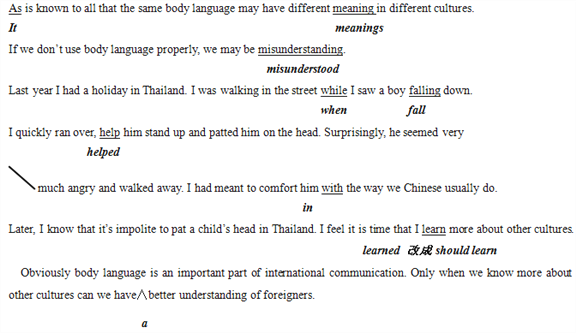
【解析】考查形式主语。that the same body language may have different meanings in different cultures.是句子真正的主语,句首需要一个形式主语,所以as改成it。
考查名词单复数。被different修饰,所以应该用名词复数。meaning改成 meanings。
考查语态。“我们”和“误解”之间是被动关系,用被动语态,所以misunderstanding改成misunderstood。
考查when,while引导时间状语从句的区别。when可以和延续性动词连用,也可以和短暂性动词连用;而while只能和延续性动词连用,所以while改成when。
考查固定句型。see sb. do sth. 的句型,指看到了某人做某事的全过程,而see sb. doing sth.指看到了某人正在做某事,所以falling改成fall。
考查时态。and连接并列的谓语动词,表示发生在过去的事情,用一般过去时,所以help改成helped。
考查词汇的用法。very much修饰动词, very修饰形容词,这里修饰形容词,所以very much改成very。
考查介词。我本打算按照我们中国人常用的方式来安慰他。表示“按照……的方式”,用in,所以with改成in。
考查固定句型。It's time + that clause 时,that可省略,time可由high, about修饰,从句中的谓语动词有两种形式,或者用动词的过去式(be用were);或者用should + 动词原形(should不能省略)。此句型为虚拟语气句型,表示“现在某人该做某事了”。含有该事早该去做而未做,现在去做似乎都为时已晚的意思。所以learn改成learned或者should learn。
考查固定用法。a better understanding of更好地理解,是固定用法,所以better前面加a。