题目内容

完形填空.

Steve, a lawyer, is my older brother. In the _______ of my father who died when I was six, Steve gave me important instructions that helped me grow into an adult. For example, Steve taught me to face the _______ of my behavior. Once when I returned in _______ from a Saturday baseball game, it was Steve who _______ the time to ask me what happened. When I _______ that my baseball had flown through Mrs Holt's basement window, _______ the glass with a crash, Steve encouraged me to _______ to her. After all, I _______ not have played in the path between buildings. _______ my knees shocked as I explained, I _______ to pay for the window if she would return my ball.

I also learned from Steve that _______ property is a sacred thing. After I found a silver pen in my fifth?grade classroom, I wanted to _______ it, but Steve explained that it might be important to _______ else in spite of the fact that it had little value. He reminded me of _______ I'd hate to lose the small dog my father gave me. I returned the pen to my teacher, Mrs. David.

Yet of all the _______ Steve gave me, his respect for _______ is the most vivid in my mind. When I was twelve, I killed an old brown sparrow in the park with a BB gun. ________ with my accuracy, I screamed to Steve to come from the house to have a look. I shall never forget the _______ he stood for a long moment and stared at the bird. “Did it _______ you first, Mark?” he asked. I didn't know what to answer. I really felt terrible then, but that moment _______ out as the most important lesson my brother taught me.

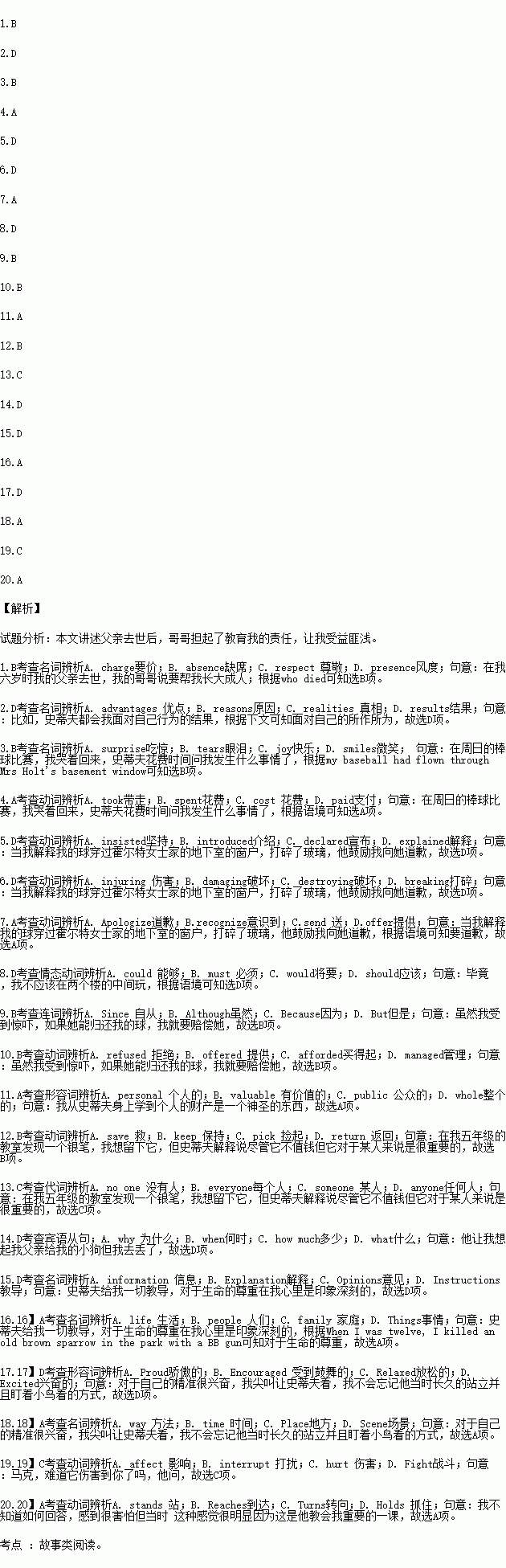
1.A. charge B. absence C. respect D. presence

2.A. advantages B. reasons C. realities D. results

3.A. surprise B. tears C. joy D. smiles

4.A. took B. spent C. cost D. paid

5.A. insisted B. introduced C. declared D. explained

6.A. injuring B. damaging C. destroying D. breaking

7.A. Apologize B. recognize C. send D. offer

8.A. could B. must C. would D. should

9.A. Since B. Although C. Because D. But

10.A. refused B. offered C. afforded D. managed

11.A. personal B. valuable C. public D. whole

12.A. save B. keep C. pick D. return

13.A. no one B. everyone C. someone D. anyone

14.A. why B. when C. how much D. what

15.A. information B. explanation C. opinions D. instructions

16.A. life B. people C. family D. things

17.A. Proud B. Encouraged C. Relaxed D. Excited

18.A. way B. time C. place D. scene

19.A. affect B. interrupt C. hurt D. fight

20.A. stands B. reaches C. turns D. Holds
练习册系列答案
相关题目

阅读下列短文 ,从每题所给的四个选项 (A、B、C、和D)中 ,选出最佳选项。

What is time? Is it a thing to be saved or spent or wasted, like money? Or is it something we have no control over, like the weather? Is time the same all over the world?

That's an easy question, you say. Wherever you go, a minute is 60 seconds, an hour is 60 minutes, a day is 24 hours, and so forth. But in America, time is more than that. Americans see time as a valuable resource. Maybe that's why they are fond of the expression, "Time is money."

Because Americans believe time is a limited resource, they try to conserve and manage it. People in the U.S. often attend seminars or read books on time management. It seems they all want to organize their time better. Professionals carry around pocket planners — some in electronic form — to keep track of appointments and deadlines. People do all they can to squeeze more time out of their time. The early American hero Benjamin Franklin expressed this view best: "Do you love life? Then do not waste time, for that is the stuff life is made of."

To Americans, punctuality is a way of showing respect for other people's time. Being more than 10 minutes late to an appointment usually calls for an apology and an explanation. People who are running late often call ahead to let others know of the delay. Of course, the less formal the situation is, the less important it is to be exactly on time. At informal get-togethers, for example, people often arrive as much as 30 minutes past the appointed time.

To outsiders, Americans seem tied to the clock. People in other cultures value relationships more than schedules. In these societies, people don't try to control time, but to experience it. Even Americans would admit that no one can master time. Time — like money — slips all too easily through our fingers. And time — like the weather — is very hard to predict. Nevertheless, time is one of life's most precious gifts. And unwrapping it is half the fun.

1.What’s the main topic of this passage?

A. What is time? B. Time among Americans.

C. Make good use of time. D. How to control time?

2.What’s the meaning of the underlined word “conserve”?

A. protect B. develop

C. produce D. assist

3.The sentence "Americans seem tied to the clock" in paragraph 5 probably means ________.

A. Americans often carry a clock with them.

B. Americans can take control over time.

C. Americans often make full use of time.

D. Americans can not predict the time.

4.We can safely draw a conclusion from this passage that _________.

A. Americans have more time than others

B. by using pocket planners, people can have more time

C. for informal meeting, Americans often arrive 30 minutes earlier

D. Americans often attend seminars, because they want to use time better

阅读理解。

Dog owners now have a little help understanding their angry friends. A new device called Bow-Lingual “translates” dog barks into English, Korea or Japanese.

Bow-Lingual’s Japanese inventors spent much time and money analyzing dog barks. They found that dog noises can be broken down into six different emotions: happiness, sadness, frustration, anger, assertion and desire. Part of the Bow-Lingual device hangs on the dog’s collar. The other part is a handle-held unit for the owner. When the dog barks, the unit displays translated phrases.

Some people have scoffed at Bow-Lingual. “Who would pay US $ 120 to read a dog’s mind?” they ask, but those who have purchased Bow-Lingual praise the device. Pet owner Keiko Egawa, of Japan, says it helps her empathize with her dog, Harry. “Before we go to the park, he always says he wants to play,” says Egawa, “and after a walk, he always says he is hungry. ”

Bow-Lingual is not yet available in Chinese. So you’d better keep studying Studio Classroom, or soon your dog may know more English than you do!

1.The writer of this passage is most likely to be _____.

A. an advertiser B. a reporter

C. a dog owner D. an expert on dog barks

2.What does “scoffed at” mean in the 3rd paragraph?

A. Doubted about. B. Questioned at.

C. Laughed at. D. Shouted at.

3.Which of the following is TRUE according to the passage?

A. Bow-Lingual is a new device that enables dogs to talk in English, Korean or Japanese.

B. Dog owners now can understand their dogs better as they stay longer with them.

C. People who have used the Bow-Lingual say it helps them better understand their dogs.

D. Chinese dog owners need keep studying to know more English than their dogs.

4.What’s the best title for the passage?

A. A little help for dog owners.

B. Dog barks and their different emotions.

C. Dogs that can talk.

D. Bow-Lingual’s inventors.

违法和不良信息举报电话:027-86699610 举报邮箱:58377363@163.com

精英家教网