题目内容

书面表达

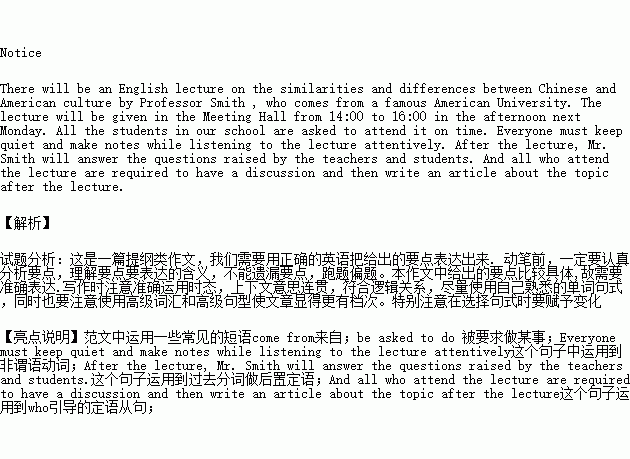
来自美国某知名大学的Smith教授将于下周一来我校举行讲座并在讲座后回答师生提出的问题.请根据下面的内容以学生会的名义写一则通知:

主题:中美文化的异同

时间:14:00 pm---16:00 pm

地点:学校会议厅

参加人员:全校学生

注意事项:①不喧哗,认真听讲,做好笔记;

②听完讲座后,进行讨论并写一篇相关的文章;

注意

1. 词数100左右;

2. 不要遗漏要点,并保持行文连贯;

3. 不要逐条翻译,要形成一篇短文;

4. 生词:相似 similarity (n.)
练习册系列答案
相关题目

As the population of the planet increases, so does the number of homes, businesses, parking lots, schools, airports and roadways. All these structures use electricity and need to be lighted. Humans demand these lights. They want their homes more comfortable and they want their streets safe. The problem is that researchers are finding that all the light is having a negative effect on humans and wildlife as well.

Less than 10 years ago I drove to a thinly populated section of my town, lay down in the middle of the road and watched an attractive meteor shower (流星雨). The area was short of homes, street lights and traffic. If I did that today, I wouldn't be able to see the meteor shower as well. Due to the increase in street lights, I would surely be run over by a car.

Nowadays scientists are finding light pollution can be almost as bad as carbon dioxide pollution. If you've ever taken a flight at night, the view is beautiful, but you must remember that all the light you see wastes electricity. The crew of the space shuttles see an even bigger picture of how extensive the wasted electricity is worldwide.

One of the saddest parts of light pollution is that most of it is unnecessary and most of the outdoor light that we use is wasted. One only needs to look at a row of street lights to see how much of the light shines upwards and lights the sky: a total waste of electricity.

Additionally, somewhere electricity needs to be produced, and the production of electricity creates pollution by releasing greenhouse gases. This affects the air we breathe and our quality of life.

Scientists are also studying the effects of light pollution on wildlife. Thousands of birds die each year when they crash into highly lighted buildings, as they become puzzled by the light. It has been long known that tiny baby sea turtles become lost and follow lights on the shore instead of heading towards the sea.

Fortunately, light pollution is one of the easiest sources of pollution that can be corrected without a negative effect. Following some guidelines and a little searching on Google can give you many ideas on how to reduce your contribution to light pollution.

1. It is implied in Paragraph 3 that the best way to deal with light pollution is ________.

A. reducing the output of the lights

B. avoiding the use of unnecessary lighting

C. educating people about light pollution

D. inventing environmentally- friendly lights

2.Which of the following is the effect of light pollution?

A. Many animals species have died out.

B. More traffic accidents happen every day.

C. The air we breathe may be polluted.

D. It is much easier for us to watch meteor showers.

3.What can be inferred from the text?

A. We are almost at a loss how to deal with light pollution.

B. Global warming results in light pollution in some way.

C. Astronauts can’t see clearly in space nowadays.

D. Some animals use natural light to direct their movements.

4.What will probably be provided following the last paragraph?

A. Helpful tips for surfing the Internet.

B. approaches to decreasing light pollution.

C. Benefits of searching on Google.

D. More bad effects of light pollution.

阅读下面短文和问题,根据短文内容和每个题后的具体要求,在答题卡相应题号后的横线上写下相关信息,完成对该问题的回答。答语要意思清楚,结构正确,书写工整。

It’s 2010, outside the gate of a school somewhere in the UK. Some teenagers are talking. One says to another,” I’m tired of jamming after school---it’s really vanilla. Let’s go for a za, OK?” Two adults are walking past. They hear what the teenagers are saying, but they don’t understand a word. (What the teenagers said was,” I’m tired of hanging around after school---it’s really boring. Let’s go for a pizza.”)

This is nothing new---teenagers always invent new words and phrases. They create words for everyday things---words that mean good or porents or bad or good-looking, and so on. Look at these different ways of saying good in recent decades:

1960s---groovy (or fab)

1970s---neat

1980s---ace

1990s---wicked

2000s---cool

But, of course, the words you use depend on your interests, your friends, the music you listen to and the part of the country you live in. Different groups of teenagers have different likes and dislikes, and so they also have different expressions.

So why do teenagers invent new words, or invent new meanings for old words? Many people think it’s because they don’t want adults to understand, but that probably isn’t true---the real reason is that teenagers like to be creative and play with language, so they have fun creating new words.

And what do parents and old people think about it all? Most of them don’t worry about it---after all, they had their own special words when they teenagers too. But, some adults complain about “teen talk” and get quite annoyed by it. But that’s all part of the fun for the teenagers!

1.What is the way of teenagers’ saying good in the 2000s?(只用一个单词)

____________________________________________________________________________

2.Why do teenagers invent new words? (不多于七个单词)

____________________________________________________________________________

3.What is the topic of the passage? (不多于四个单词)

____________________________________________________________________________

根据短文内容,从短文后的选项中选出能填入空白处的最佳选项。选项中的两项为多余选项。

Cell Phones: Hang Up or Keep Talking

Millions of people are using cell phones today. In many places, it is actually considered unusual not to use one. 1. They find that the phones are more than a means of communication – having mobile phone shows that they are cool and connected.

The explosions around the world in mobile phone use make some health professionals worried. Some doctors are concerned that in the future many people may suffer health problems from the use of mobile phones. Mobile phone companies are worried about the negative publicity(负面报道)of such ideas. _2.__

On the other hand, signs of change in the issues of the brain and head can be detected with modern scanning equipment. In one case, a traveling salesman had to retire at a young age because of serious memory loss. 3. This man used to talk on his mobile phone for about six hours a day, every day of his working week, for a couple of years.

4. The answer is radiation(辐射). High-tech machines can detect very small amounts of radiation from mobile phones. Mobile phone companies agree that there is some radiation, but they say the amount is too small to worry about.

As the discussion about the safety continues, it appears that it’s best to use mobile phones less often.

___5. Use your mobile phone only when you really need it. In the future, mobile phones may have a warning label that says they are bad for your health. So for now, it’s wise not to use your mobile phone too often.

A. They will possibly affect their benefits.

B. In many countries, cell phones are very popular with young people.

C. What do the doctors worry about?

D. What is it that makes mobile phones potentially harmful?

E. They say that there is no proof that mobile phones are bad for your health.

F. He couldn’t remember even simple tasks.

G. Use your regular phone if you want to talk for a long time.

Ten years ago I used to be very fit. I rode a bike to work and I got a lot of exercise at weekends. I used to play tennis a lot and go for long walks. In those days I didn’t earn very much. I had a job in an office. It wasn’t a very good job but I had a lot of time to do the things I enjoyed doing.

Then, about eight years ago, I got a much better job. The pay was better, but the hours were a lot longer. I bought a car and drove to work every day. I began to take people out to lunch. And I began to put on weight, too. I stopped playing tennis and going for long walks at weekends because I just didn’t have any time for things like that any more.

There’s a lot of stress(压力) in my job. Perhaps that’s why I started drinking more than I used to. For example, I used to have only half a glass of whisky when I got home, but then I started filling my glass to the top, and instead of having one glass, I would have several. I started smoking a lot, too. I never used to smoke at all.

Two months ago I had a heart attack. At first I just couldn’t believe it. Luckily it wasn’t very serious. The doctor advised me to stop smoking and to eat less. He also advised me to work less and get more exercise. But I just haven’t any time! My job takes everything out of me!

Sometimes I wonder if I should get another job. Perhaps I could do something as I used to. But if I do that, I won’t earn as much. I have a family to support. I have to think of them, too. I just don’t know what I should do. What do you think?

1.The writer’s health is becoming worse mainly because ________.

A. he is very fond of his job

B. he likes drinking and smoking

C. he doesn’t care about his health

D. his work makes him feel stressful

2.According to the passage, when the author got the better job, which of the following is NOT true?

A. He got higher pay.

B. His working hours weren’t long.

C. He found it very stressful.

D. He had little free time at weekends.

3.What can we learn about the author?

A. The author is not sure what he should do now.

B. The author has taken the doctor’s advice already.

C. The author has got another new job.

D. The author feels much better now.

阅读下面短文,从短文后各题所给的四个选项(A, B, C和D)中,选出可以填入空白处的最佳选项,并在答题卡上将该项涂黑。

“Daily Star, sir” called Jason, carrying some newspapers under his arm. The little boy had been running up and down the street, but there were still twenty ______ left. His voice was almost gone and his heart was ______. The shops would soon close, and all the people would go home. He would have to go home too, carrying the papers _______ money. He had hoped to sell more papers tonight to make more money to buy a_____for his mother and some seeds for his bird. That was why he had bought the papers with all his money. He ______ as he thought of his failure to sell all his papers.

“You don’t know the _____of selling papers. You must shout, “Hot news! Bomb bursting!” another newsboy Chad told Jason. “_____ it’s not in the paper at all,” replied Jason. “Just run away quickly ______they have time to see, and you’ll _____out and get your money,” Chad said.

It was a new _____to Jason. He thought of his bird with no ______ and the cake he wanted to buy for his mother, but was ______ that he would not tell a lie. Though he was ______ a poor newsboy, he had been ______ some good things.

The next afternoon Jason went to the office for his papers _____ Several boys were crowding around Chad, who declared with a ______ smile that he sold six dozen the day before. He added that Jason _______ money because he would not tell a lie. The boy _____ at Jason. “You wouldn’t tell a lie yesterday, my boy?” A gentleman at the office came up and patted Jason’s shoulder ______.”You’re just the boy I am looking for.” A week later, Jason started his new______. He lost sale of twenty papers because he would not tell a lie, but got a well-paid job because he told the truth.

1.A. shopsB. coinsC. peopleD. papers

2.A. openB. heavyC. pureD. weak

3.A. instead ofB. in return forC. regardless ofD. in exchange for

4.A. cupB. cardC. combD. cake

5.A. gave inB. broke downC. got awayD. showed up

6.A. difficultyB. processC. goalD. secret

7.A. AndB. ButC. ForD. So

8.A. beforeB. sinceC. thoughD. unless

9.A. callB. dropC. sellD. reach

10.A. editionB. ideaC. policyD. task

11.A. breadB. insectsC. seedsD. water

12.A. concernedB. amazedC. excitedD. determined

13.A. stillB. alreadyC. justD. also

14.A. taughtB. handedC. awardedD. allowed

15.A. at onceB. by chanceC. as usualD. on purpose

16.A. proudB. gentleC. warmD. polite

17.A. borrowedB. lostC. madeD. saved

18.A. laughedB. shoutedC. noddedD. stared

19.A. bravelyB. gratefullyC. fondlyD. modestly

20.A. dutyB. businessC. jobD. method

违法和不良信息举报电话:027-86699610 举报邮箱:58377363@163.com

精英家教网