题目内容

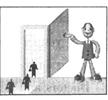
Close the door of fear behind you, and you ____ the door of faith open before you.

A.saw

B.have seen

C.will see

D.are seeing


【答案】

C

【解析】

试题分析:考查固定句型。固定句型:祈使句+连词+主句;主句使用将来时或者情态动词的形式。该句型就等与if引导的条件句+主句。故C正确。

考点:考查固定句型

点评:。固定句型:祈使句+连词+主句;主句使用将来时或者情态动词的形式。该句型就等与if引导的条件句+主句。


练习册系列答案
相关题目

“So teach him to close the door”, my daughter Emma responded after listening to me 36   , again, about the dog coming in from the back door, bringing with him a blast of Buffalo January   37   air.

Teach a dog to close a door behind him? That has got to be a really, really   38    thing to do.But then she took it a step   39   .“Come on, Kolby”, she said, grabbing some treats(犒劳物) and   40   him in front of the open door.“Touch.” And “touch” he did, which moved the door to a   41   position.She  42   him with a treat, smiled, looked at me, and said “see!” And I saw and became   43   .Over the last few days I have been with Kolby.Each time he comes in I bring him back to the   44  door and ask him to close.There have been   45   in the beginning, but lately more and more successes

However, there remains much work to be done.I have to get him to follow my hand signal again and again  46   he will close the door from a distance.But, I now realize, as long as you keep to the focus , the    47    will be completed, and, with the way things are   48   , completed quickly.

What a  49   treat to have a dog that can close the door after himself! Even more wonder can be found in the  50   I learned so clearly from both Emma and Kolby.

A wish is just a wish until you decide to take  51  .Once you   52  the belief that it is “too hard”, then it remains “too hard ” and out of  53  .Once you want to accomplish a goal, and  54   that it is “easy”, then it becomes “easy” to do what needs to be done.Just  55    doing it.

A.complain       B.scream      C.worry       D.scare

A.thin       B.fresh C.dirty  D.cold

A.interesting     B.funny       C.tough       D.possible

A.again     B.further      C.deeper      D.backward

A.pushing  B.catching    C.driving     D.positioning

A.stopped  B.fixed C.closed       D.checked

A.rewarded       B.provided   C.offered     D.thanked

A.moved   B.convinced C.concerned D.puzzled

A.open      B.closed       C.broken      D.perfect

A.pleasures       B.experiments     C.failures     D.pauses

A.in case   B.even if      C.as if  D.so that

A.interest  B.task   C.profit       D.harmony

A.changing       B.reacting    C.progressing      D.happening

A.wonderful     B.small C.different   D.simple

A.knowledge    B.skills C.lessons      D.experience

A.patience B.part   C.delight      D.action

A.hold on to B.pay attention to    C.come up with        D.live up to

A.date       B.touch C.reach       D.power

A.prove     B.decide      C.approve    D.realize

A.imagine B.start  C.keep  D.enjoy


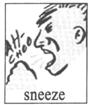
When you cough or sneeze, you’d better turn your head away from others and cover your mouth with the full part of your hand. And then, you should say, “Excuse me.”
This seems so simple, but it is surprising how many kids have never been told to do this. Actually, I notice adults all the time who cough and sneeze in public without placing a hand over the mouth. One important thing I point out to the kids is that after they sneeze or cough on their hands, they should wash their hands as soon as possible. If not, they will be passing those germs (细菌) along to everything and everyone they touch.
If you come to a door and someone is following you, hold the door. If the door opens by pulling, pull it open, stand to the side, and allow the other person to pass through first, then you can walk through. If the door opens by pushing, hold the door after you pass through.
After a few weeks of seeing kids try to get through doors in the school and watching them enter restaurants as the door hit other people, I knew I had to discuss the problem with my students. Teaching them small acts of kindness, such as letting someone else go through a door first as they hold it open, may seem unimportant, but it can go along way toward helping students realize hot to be polite and thank others. Once they’ve been told, they’re halfway there.
When we have to go up moving stairs, we will stand to the right. That will give others who are in a hurry a choice of walking up the left-hand side of the moving stairs. When we are going to enter a lift, the underground, or a doorway, we will wait for others to exit before we enter.
After college when I moved to London, I was surprised at how polite everyone was in the subways. I was even more touched when I traveled to Japan. In both places, people made efforts to make way for others. On moving stairs, everyone stood to the right and walked to the left. On lifts, everyone would stand over to the side and allow others to exit before they would begin to enter.
【小题1】When you cough or sneeze, you should ________.

A.touch everythingB.cover your mouth
C.point out to the kidsD.pass the germs to others
【小题2】If you come to a door and someone is following you, you’d better _______.
A.hold the doorB.pass throughC.close the doorD.stand to the side
【小题3】From the passage we ca know the writer is a ________.
A. doctorB.travelerC.parentD.teacher
【小题4】A. The passage is mainly about ______.
A. the rules of behavior in public         B. the easy of communication
C. the acts of kindness among people      D. the knowledge of social life

The relationship between humans and animals has always been complex. Some cultures have developed entire belief systems around favored animals. Even in cultures with less formal belief systems, connections between people and animals still lead to commonly accepted opinions about animals.

These belief systems usually develop around the animals that interact (互动) with humans most frequently. Therefore, it should not be surprising that so many stories surround the most common of animals: rats. Rats live side by side with humans all over the world and regularly interact with people. Human-rat coexistence may be common all around the world, but different cultures respond to that closeness in different ways.

In the United States and Europe, one typical attitude is that the rat is a pest. This could be due to the common belief that rats spread disease. Actually, they don’t, at least not directly, but many people don’t know that. The Pied Piper of Hamlin, a well-known children’s story, is one example of how rats have been described in Western literature: in that story, rats cause such a problem that a town has to hire a piper to call them all away.

In many Latin American countries, the rat is described in a very different way. The story of the tooth fairy (a fairy believed by children to leave money while they sleep in exchange for a tooth that has come out) is common all over the world, but in Latin America, the “fairy” is a rat! Rats do have very strong teeth, which could explain the association. Clearly, this shows another attitude toward rats that is much more positive.

Yet another attitude toward the rat can be seen in the Chinese Zodiac (生肖). The Rat is one of the animals of the Zodiac. Like the other zodiac animals, the Rat is neither entirely good nor entirely bad. It’s described as clever and friendly, but also tricky and not entirely honest. That may be the most accurate description of the rat so far. Whether you like rats or not, it’s hard to deny their reputation for cleverness.

As many people are discovering these days, rats can even make excellent pets, so long as you remember to close the cage carefully!

1.What does the passage mainly talk about?

A. A trend of keeping rats as pets.              

B. How different cultures look at rats.

C. How humans get along with animals.          

D. Favored animals in different cultures.

2.The rats in The Pied Piper of Hamlin appear______.

A. unpleasant        B. honest         C. smart        D. unusual

3.The tooth fairy in Latin America mentioned in Paragraph4 is to show______.

A. the tooth fairy is lovely                     

B. rats look very frightening

C. rats are welcome in Latin American countries

D. the story of the tooth fairy is common all over the world

4.According to the author, rats______.

A. don’t spread disease               

B. should be treated as pests

C. are fairly described in the Chinese Zodiac         

D. are kept as pets by more and more people

5.The passage is probably taken from a ______.

A. travel guide           B. news report        C. nature magazine       D. history textbook


违法和不良信息举报电话:027-86699610 举报邮箱:58377363@163.com

精英家教网