Ella Fant was a middle-aged lady who lived with her only son John in a small house. She ___1___ John very much. In her ___2___ he couldn’t do anything ___3___. Every morning she would give him breakfast ___4___ bed and bring him the papers to ___5___. It isn’t really true that he was too ___6___ to work ?in fact he had tried a few ___7___. First of all he was a window-cleaner and in his first week he managed to ___8___ at least six windows. Then he ___9___ a bus conductor and on his second ___10___ a passenger stole his bag with all the fares(车费) collected. He ___11___ lost his job as a postman ___12___ he sent off all the letters when he should have taken them to people’s houses. It seemed that there was ___13___ suitable work for him. So he ___14___ to join the army. Mrs. Fant was so ___15___ about this that she told the ___16___ to all her neighbours. “My John is going to be a soldier,” she said, 揾e is going to be the best soldier there ___17___ was, I can tell you!?

Then the great day came ___18___ he was to march past the palace in the parade(接受检阅的队伍). His ___19___ mother travelled to the city early in the morning to be sure of getting a good ___20___ in the crowd.

The parade was full of sound and colour. But when John and his ___21___ came in sight some of the people watching ___22___ laughing at the one who couldn’t keep pace with the others as they marched along.

But Ella Fant, who was filled with ___23___, shouted at the top of her voice: 揕ook at ___24___!They’re all out of ___25___ except my John! Isn’t he the best! ?

1. A. depended on  B. waited on   C. trusted       D. loved

2. A. hope      B. eyes    C. head   D. beliefs

3. A. wrong    B. great   C. good   D. strange

4. A. to   B. at       C. in       D. by

5. A. check     B. read    C. keep   D. sign

6. A. lazy       B. young C. weak   D. shy

7. A. ones       B. years   C. tasks   D. jobs

8. A. rub B. drop   C. break  D. clean

9. A. followed       B. met     C. became      D. found

10. A. day      B. try      C. route   D. chance

11. A. thus      B. even   C. once   D. only

12. A. even if B. so that C. because      D. though

13. A. some    B. such    C. less     D. no

14. A. began   B. promised    C. managed    D. decided

15. A. excited B. worried      C. anxious      D. curious

16. A. incident       B. change       C. news   D. matter

17. A. yet       B. even   C. never  D. just

18. A. where   B. since   C. when  D. till

19. A. proud   B. kind    C. strict   D. lucky

20. A. time     B. position      C. experience  D. impression

21. A. neighbours   B. army officer      C. mother       D. fellow soldiers

22. A. couldn’t help      B. shouldn’t burst out    C. stopped      D. kept

23. A. sadness B. happiness   C. surprise      D. regret

24. A. them    B. those   C. that     D. him

25. A. sight    B. order  C. mind   D. step

Paris in the springtime was, is and always will be, something rather special. Why not experience it for yourself with this excellent break for four days? This attractive city has something to offer to everyone and with prices at just £129.
Your break begins with comfortable bus transfer (运送) from local pick-up points and travel to Paris is via cross-channel ferry, arriving at your hotel in the evening. The Ibis is an excellent quality hotel with private equipments in all rooms: satellite TV, radio, telephone and alarm clock. It has a bar and restaurant and is situated about two miles south of Notre Dame , enabling you to explore Paris with ease.
The following day, after continental breakfast (included), the bus takes you on a comprehensive sightseeing tour of the city, during which you will see the Eiffel Tower, Champs Elysees, L’Arc de Triomphe, the Louvre, in fact almost every famous landmark you have ever heard of. You then leave Paris and take a short drive to the magnificent Palace of Versailles, the home of Louis XIV. The tour ends mid-afternoon back in Paris where you will have the remainder of the day at your leisure. In the evening there is a “Paris by Night” tour showing you the beautiful buildings with bright lights.
Day three takes you to Montmarter, perhaps the most attractive quarter. In the afternoon you are free to explore this beautiful city as you wish, perhaps a pleasure voyage on the River Seine, wander around the beautiful gardens or look among the antique shops(古董店). In the evening you will have the opportunity to visit the best nightclub in the city, the splendid Paradis Latain. On the final day it’s back to the UK via channel ferry.
Included in the price of £129 per person :
●Return comfortable bus travel to Paris
●Return ferry crossings
●3 nights housing in a twin bedded room in a Central Paris hotel with private facilities
●Continental breakfast during your stay
●Guided sightseeing tour of “Paris by Day” and “Paris by Night”
●Visit to the Chateau of Versailles (admission not included )
●Tour around Montmartre
【小题1】What is the purpose of this passage?

A.To show the price of traveling to Paris .
B.To tell tourists the routes to Paris.
C.To introduce the city of Paris.
D.To attract tourists to Paris.
【小题2】During the stay in Paris, the tourists will _________.
A.have a “Paris by Night” tour on the first evening
B.live in a hotel two miles away from Paris
C.have free time for half a day
D.have a pleasure voyage on the River Seine together
【小题3】What does the underlined word “quarter” mean in the passage?
A.An area.
B.A period of time.
C.A coin worth 25 cents.
D.One of four equal parts.
【小题4】 According to the passage, which of the following is true?
A.The Palace of Versailles is not in the center of Paris.
B.The tourists can telephone in the Ibis without paying.
C.It will take you a long time to get to Montmartre from Paris.
D.The tourists will spend the night in the antique shops on the third day.

The Great Fire of London started in the very early hours of 2 September 1666. In four days it destroyed more than three-quarters of the old city, where most of the houses were wooden and close together. Over one hundred people became homeless, but only a few lost their lives.

   The fire started on Sunday morning in the house of the King’s baker(面包师)in Pudding Lane. The baker, with his wife and family, was able to get out through a window into the roof. A strong wind blew the fire from the bakery(面包房)into a small hotel next door. Then it spread quickly into Thames Street. That was the beginning.

   By eight o’ clock three hundred houses were on fire. On Monday nearly a kilometer of the city was burning along the River Thames. Tuesday was the worst day. The fire destroyed many well-known buildings, old St Pauls and the Guildhall among them.

  Samuel Pepys, the famous writer, write about the fire, “People threw their things into the river. Many poor people stayed in their houses until the last moment. Birds fell out of the air because of the heat .”

  The fire stopped only when the King finally ordered people to destroy hundreds of buildings in the path of the fire. With nothing left to burn, the fire became weak and finally died out.

  After the fire, Christopher Wren, the architect(建筑师), wanted a city with wider streets and fine new houses of stone. In fact, the streets are still narrow, but he did build more than fifty churches, among them the mew St Pauls.

  The fire caused great pain and loss, but after it London was a better place: a city for the future and not just of the past.

1.The fire began in_________ .

A. a hotel    B. the palace   C. Pudding Lane    D. Thames Street

2.The underlined word “family” in the second paragraph means_________ .

A. home       B. children     C. wife and husband    D. wife and children

3.Why did the writer cite(引用)Samuel Pepys?

A. Because Pepys was among those putting out the fire.

B. Because Pepys also wrote about the fire.

C. To show that poor people suffered most.

D. To give the reader a clearer picture of the fire.

4.How was the fire put out according to the text?

A. The soldiers came to help.

B. All the wooden houses in the city were destroyed.

C. People managed to get enough water from the river.

D. Houses standing in the path of the fire were destroyed according to the King’s order.


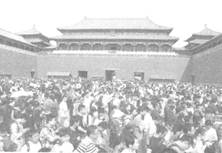
Most tourist destinations around China are witnessing travel peaks during the eight-day Mid-Autumn Festival and National Day holidays that run through Sunday. In Beijing, the Palace Museum, or the Forbidden City, attracted 182, 000 tourists on Tuesday, the biggest number on a single day, as millions of visitors arrived in the national capital. “We saw absolutely nothing but people’s heads,’’ said Guo Zhijun, 42, of Henan province. “We wanted our 11-year-old son to learn something from the trip, but we only ended up very tired. ”

Earlier, from Sunday noon to midday Monday, garbage collected at Tian’anmen Square in the heart of the city amounted to 7.9 tons, a quarter more than that in the same period of last year.

In the eastern coastal city of Qingdao, its top five major tourist sites attracted more than 200, 000 visitors on Tuesday.

Yesterday, thousands of cars jammed two 20-kilometer mountain roads winding to and out of the Lushan Mountain scenic area in the eastern province of Jiangxi. The area, with about 3, 000 car parking spaces, was unable to contain at least 8, 000 inbound cars, said head of the Lushan Mountain public security bureau.

The Lushan Mountain tourism administration temporarily stopped selling entrance tickets to prevent the traffic from growing on Tuesday afternoon. Similar measures could be taken during the rest of the holidays, a police officer said.

Emergency measures have been taken at other scenic sites. Crowded visitors overwhelmed the capacity(承载量)of the cable cars at Huashan Mountain, in Shaanxi province, leaving tens of thousands stuck at the peak late into Tuesday night. According to China Central Television, restless visitors demanded refunds from the tourism committee, and a lot of visitors had to give up and walk down the mountain.

Chen Li, deputy director of the Shaanxi Provincial Public Security Department, said on his micro blog that more than 300 policemen and government officials climbed up the mountain to help trapped visitors. Fearing that tourist sites might become too crowded, many people are staying at home, going shopping or making short suburban trips. A resident Mr. Wang in Nanchang, capital of Jiangxi, canceled long-distance travel plans after learning of heavy traffic on many highways during the first two days of the holidays. Instead, Wang, his wife and son went fishing in the suburbs before having a picnic.

1.What happened in the Forbidden City that Tuesday?

A.There were far more visitors coming than expected.

B.A large number of zones were opened to the visitors.

C.Over 7.9 tons of garbage was collected.

D.More than 200, 000 visitors gathered there.

2.What does the underlined word “overwhelmed” mean in paragraph 6?

A.showed up        B.added to          C.reached beyond    D.filled in

3.The writer wrote this article to________________.

A.advise traveling to different places to learn something

B.warn people not to climb those mountains on holidays

C.encourage people to change the travel plans according to the traffic

D.suggest we stay at home or go shopping during those holidays

4.Which of the following might be the best title?

A.Experiences from Different Travel Plans

B.Travel Peaks in China's Tourist Sites

C.Floods of People to the Forbidden City

D.Problems with Travelling on Holiday


HOW TO BOOK

By phone:

Call Ticketmaster 24 hr Booking Line

on 0844 847 2484

Online:

www.PalaceandOperaHouse.org.uk

or www.ticketmaster.co.uk

In Person:

The Palace Theatre Ticket Centre,

Oxford Street. Manchester, Ml 6FT

(Mon Sat 10am-8pm)

By Post:

Stating the performance and choice of seats ,enclosing(附寄)a cheque , postal order ,or your credit card details to The Palace Theatre Ticket Centre , Oxford Street , Manchester , Ml 6FT . Please enclose a stamped addressed envelope.

Save pounds on tickets NOW!

Join Live Nation’s Card for just £30 a year and enjoy a whole range of discounts and benefits .You’ll save money from the first time you use your Live Card—not just on tickets ,but on programmes and reduced booking fees . Live Card members often join the audience on opening nights or enjoy generous discounts throughout the run of a show.

Call 0844 499 6699 to join Live Card today.

By getting together as a group of 10 or more you can save money on tickets for your favourite  shows.

Group bookers benefit from a direct free telephone booking line, and don’t pay booking fees .Invitations to parties and book-now-pay-later programmes are all part of our great service to group bookers. Join the hundreds of people already taking advantage of our group booking.

Call 0800 587 5007 to talk to one of our group booking assistants about your group visit to the Palace Theatre or Opera House.

For further information please call 0161 245 6609.

1.If you want to join Live Card to save money on tickets, you can call       .

A.0844 847 2484                         B.0800 587 5007

C.0844 499 6699                         D.0161 245 6609

2.How can you pay for a ticket when you book by post?

A.By visiting the website of a post office.

B.By going to your local bank in person.

C.By enclosing your Live Card in an envelope.

D.By providing your credit card information.

3.What benefit can group bookers enjoy according to the text?

A.Delayed payment for tickets.               B.Invitations to opening nights.

C.Reduced booking fees by phone            D.Generous discounts on tickets.


违法和不良信息举报电话:027-86699610 举报邮箱:58377363@163.com

精英家教网