题目内容
Most teenagers are given pocket money by their parents in United Kingdom of Great Britain and Northern Ireland. Teenagers get between £7 and £20 a Week. They spend it on fast food, clothes, the cinema, concerts, magazines and mobile phone.
Lazy parents?
37% of parents pay teenagers to clean the room, and 66% of parents pay teenagers to take the rubbish out.
Lazy teens?
51% of teenagers don't make their beds before they leave home. Only 13 % of teenagers wash the car for money. Some parents even pay their teenagers to do their homework.
Equality? Not yet!
Boys get more money than girls for most odd jobs. For washing the dishes, boys get about £4 and girls get about £1.
And if you need some more money?
Teens get an extra £250 a year out of their parents except pocket money! About 50% of teens get gifts of money from their grandparents. Go to Mum if you need extra money! She gives more than Dad.
Where you live makes a difference!
Parents in Scotland and the North of England give the most pocket money.
Spending
51% spend their money on clothes. 30% buy cosmetics, jewelry and toiletries (化妆品). Less than 40% of teenagers save their money.
Earnings
Here is what some children told us about their pocket money: I get £30 a month. I have to take the rubbish out and tidy my room. -- Emma, 15, Edinburgh
I get £10 a week. But I have to clean the car and the house and load and unload the dishwasher. I usually save the money. -- James, 12, Sheffield.
I get £7.50 a week. I have to be "good" but I don't have to do any jobs for the money. -- Lain, 13, Cardiff.
I get £5 a week. But our neighbors go away a lot and they give me £25 a week for looking after their cats. -- Richard, 13, Belfast.
68. Which of the following would be the best title for the test?
A. How to get pocket money. B. Pocket money in Britain.
C. How to spend pocket money. D. How teenagers everywhere get pocket money.
69. Which of the following statements is true according to the passage?
A. Most parents are so lazy that they let their children do housework.
B. Most teens are too lazy to do housework unless they are given pocket money.
C. Boys and girls aren't equal in getting pocket money when they do odd jobs.
D. It isn't right for children to ask for pocket money.
70. We can infer from the passage that.
A. boys earn the same amount of money at home as girls
B. only rich parents give children pocket money
C. girls earn more money at home than boys
D. most children don't save their pocket money
71. Who probably gets the most pocket money for a whole year according to the passage?
A. Richard. B. James. C. Lain. D. Emma.
【小题1】B
【小题2】C
【小题3】D
【小题4】A

 轻巧夺冠周测月考直通中考系列答案
完形填空 (共20小题;每小题l分,满分20分)
When Andra Rush started her trucking company, all she had was an old van,two used pick-up trucks and the simple certainty of a 23-year-old girl. But she planned to make her fortune in about four years to 36 her true goal: dealing with poverty on Native American reservations across North America. "I thought I could retire by the time I was 27," says Rush, "At that age, you don't know 37 you don't know."
Rush is 49 now and 38 working hard. Her tiny start-up just outside Detroit has 39 to a $400 million North American business. Today Rush is a(an) 40 not only for Native Americans but also for women in the male-controlled world of trucking.
Rush was 41 30 miles outside Detroit. When the teenage Rush visited the reservation for the first time, she was 42 by the poverty and lack of hope. "I really wanted to 43 " she says.
She graduated from the University of Michigan in 1982. She took a nursing job with a 44 pay and then practiced at an air goods company, 45 the speed of package pickups and deliveries made a little more a little more profits. "I thought I could do that 46 ," Rush says.
Within six months, Rush had ten employees, and clients(客户) 47 Ford and GM were paying her to 48 small packages from the airport. Ford was the first to offer her a job trucking parts between its plants and supplier.
By 2001, many of Rush's 1,000 employees were Native Americans, working alongside people of every 49 But she felt she hadn't done enough. 50 she joined forces with a Canadian parts maker to design and gather auto components.
She located the plants near reservations, 51 opportunities where they were needed most. By 2009, her auto parts business was earning $370 million 52 .
She's come a long way from the 53 23-year-old who thought "the cash would just roll in." But Rush wouldn't change a thing: "I love my job," she says. "I 54 the fact that you can start to get some motivation and keep 55 yourself—and then suddenly you lift your head and it's been 25 years"
| 【小题1】 |
|
| 【小题2】 |
|
| 【小题3】 |
|
| 【小题4】 |
|
| 【小题5】 |
|
| 【小题6】 |
|
| 【小题7】 |
|
| 【小题9】 |
|
| 【小题10】 |
|
| 【小题11】 |
|
| 【小题12】 |
|
| 【小题13】 |
|
| 【小题14】 |
|
| 【小题15】 |
|
| 【小题16】 |
|
| A.in case | B.in turn | C.in return | D.in need |
| 【小题18】 |
|
| 【小题19】 |
|
| 【小题20】 |
|
Vans, Keds, Dollies—they sound like the names of rock bands, but if you have teenagers, you'll know they're actually the latest in teenage footwear.
But experts are now warning that the current shoe fashions will be causing teenagers discomfort in the short term and storing up years of foot, knee and back pain in the future.
Here, the experts identify the problems caused by teenagers' shoe choice.  KEDS/VANS
Slip-on shoes with elastic (弹性的)sides are particularly popular among teenage boys - with Keds and Vans the most sought-after brands.
The main problem is that they are just too flat—so flat that the heel, which strikes the ground first, also becomes damaged and painful.
BALLET PUMPS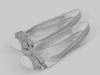 The worst shoes of all are such light and thin dolly shoes. The problem is partly their flatness, as with Keds and Vans. However ballet pumps, which have no string or heel, have other specific problems.
“As the shoe has no fastening device, it relies on the toes to keep the shoe on, causing an awkward gait(步法), this leads to short- and long-term problems such as calluses(茧子), heel and knee pain.”
WEDGES AND STILETTOS These shoes can also cause problems with gait. They may look good, but the heels on these are so high they can force the wearer's body weight forward, making them very unstable.
Teens who wear these shoes regularly are also in danger of joining those millions of women with constant back pain.
SCHOOL SHOES
So what do podiatrists(足科医生)have on their wish list, especially for everyday wear?
Something in a natural, breathable fabric, with a string to hold it on, with a small heel and a deep toe-box that does not press the toes, such as Clark's, Marks & Spencer or Rhino.
If your teen insists on wearing 'bad' shoes, get them some simple foot orthotics(矫形器) in the shoes. These support and correct the movement of the foot and, properly fitted by a podiatrist, can often transform their walk and halt the damage.
【小题1】 Of all the shoes mentioned in the passage, which can cause the worst problems?
A.Marks & Spencer . . | B.Wedges & Stilettos. |
| C.Keds and Vans. | D.Ballet Pumps. |

【小题3】 The underlined word “halt” in the last paragraph probably means _______.
| A.increase | B.worsen | C.stop | D.cure |
| A.trendy shoes may ruin teenagers’ health |
| B.fashionable shoes all have orthotics in them |
| C.experts are strongly against wearing popular shoes |
| D.podiatrists are expert at producing branded shoes |
| A.Sports. | B.Science. | C.Health. | D.Shopping. |
Parents should stop blaming themselves because there’s not a lot they can do about it. I mean the teenager problem. Whatever you do or however you choose to deal with it, at certain times a wonderful, reasonable and helpful child will turn into a terrible animal.
I’ve seen friends deal with it in all kinds of different ways. One strict mother insisted that her son, right from a child, should stand up whenever anyone entered the room, open doors and shake hands like a gentleman. I saw him last week when I called round. Sprawling himself (懒散地躺) on the sofa in full length, he made no attempt to turn off the loud TV he was watching as I walked in, and his greeting was no more than a quick glance at me. His mother was ashamed. “I don't know what to do with him these days,” she said. “He’s forgotten all the manners we taught him.”
He hasn’t forgotten them. He’s just decided that he’s not going to use them. She confessed (坦白) that she would like to come up behind him and throw him down from the sofa onto the floor.
Another good friend of mine let her two daughters climb all over the furniture, reach across the table, stare at me and say, “I don’t like your dress; it’s ugly.” One of the daughters has recently been driven out of school. The other has left home.
“Where did we go wrong?” her parents are now very sad. Probably nowhere much. At least, no more than the rest of that unfortunate race, parents.
【小题1】This text is most probably written by ______.
| A.a specialist(专家) in teenager studies | B.a headmaster of a middle school |
| C.a parent with teenage children | D.a doctor for mental health problems |
| A.the change from good to bad that’s seen in a child |
| B.the way that parents often blame themselves |
| C.the opinion that a child has of his parents |
| D.the advice that parents want their children to follow |
| A.pay no attention to them | B.are too busy to look after them |
| C.have come to hate them | D.feel helpless to do much about them |
| A.Parents have no choice but to try to accept it. |
| B.Parents should pay still some attention to the change. |
| C.Parents should work more closely with school teachers. |
| D.Parents are at fault for the change in their children. |