题目内容
Young people frequently say that they want to exercise, but they just can’t find the time.
The solution just might be in-office interval training.
Recent studies show that very short but intense exercise rapidly builds and maintains fitness and health, even when the workout is only a few minutes long.
Work the stairs
You can complete an excellent, effective — and very brief — workout in an office stairwell, says Martin Gibala, a professor of kinesiology at McMaster University in Canada and an expert on interval training.
For a study that he and his colleagues presented earlier this year, they asked 12 out-of-shape women in their 20s to warm up for two minutes by slowly walking up and down stairs in a campus office building.
They completed three of these abbreviated stair workouts per week for six weeks.
By the end, their aerobic fitness had improved substantially, the researchers reported, by about as much as if they had been running or cycling each week for hours.
Fidget your way to fitness.
Parents and teachers may once have urged you to sit still, but wiggling, tapping your toes, standing briefly, and otherwise fidgeting as much as possible at your desk is in fact good for your body.
In one recent study, college students showed healthier blood flow in their lower legs if they fidgeted than if they did not.
Even better, a 2008 study found that among office workers, those who frequently fidgeted burned as many as 300 calories more each day than those who resolutely stayed still.
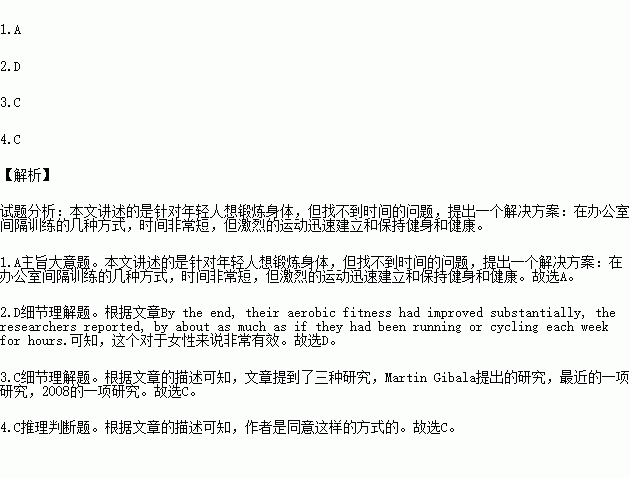
1. What does the passage mainly want to tell us?
A. several ways to work out within short time
B. short exercise does no good to health
C. how to find time to exercise
D. fitness can be improved
2.According to the experiment, women spending two minutes working stairs for six weeks __________.
A. didn’t benefit from workout
B. felt more unhealthy
C. became fatter in figure
D. benefited a lot
3.How many studies are shown in the passage?
A. One B. Two C. Three D. Four
4.The writer may agree ___________.
A. sitting still during work hours
B. lying as often as possible
C. trying to frequently walk back and forth
C. standing and working without any stop

 天天向上一本好卷系列答案
 小学生10分钟应用题系列答案