题目内容

Parents will do anything for their children. Whether it would be the food, clothes, or the place they live in, parents will always make sure their children have the best of everything. One of the biggest concerns that parents currently have is educating their children. They are faced with lots of difficulties when it comes to education for their young ones. Choices include private school, charter school, public school or home schooling.

Fortunately for parents,there are a variety of different strategies that they can take in order to increase their child’s overall intelligence. According to Ross A. Thompson, PhD, professor of psychology at the University of California at Davis, a child’s brain will actually reach 90% of its full size by the time they start kindergarten.

Researchers at Northwestern University in Chicago concluded that playing a musical instrument directly affected the brain stem, the lower section of the brain. Moreover, children that learn an instrument at an early age tend to continue it when they are older. And numerous studies show that a well balanced meal is essential for a child’s mental as well as physical health. Some other researchers recommended that a second language should be taught when children are in preschool. They state that three to four years of age is the perfect time and that any age under four would work perfectly well for a child’s brain development.

The average child will learn how to read between kindergarten and second grade. Many parents can give their children a jump start by teaching them to read before they start school. Children could have an adequate background of the alphabet and sounds of words before attending school. This can be done by simply reading to them whenever you want. The more comfortable they get, the easier the process will be.

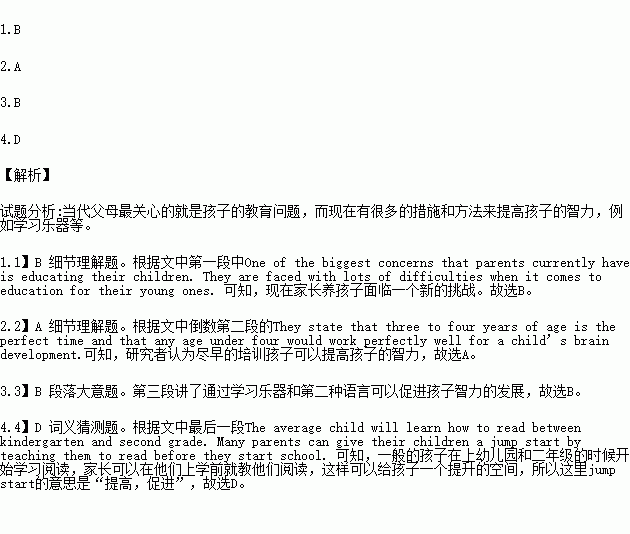
1.From the first paragraph, we can infer that ________.

A. parents find it hard to satisfy their kids’ various demands

B. parents meet a new challenge when raising their kids

C. parents have more choices in offering education to their kids

D. parents get actively involved in the process of their kids’ growth

2.What suggestion may the researchers in the passage make?

A. To train kids as early as possible.

B. To try as many means as possible.

C. To help kids develop as fully as possible.

D. To use as many available resources as possible.

3.What is the third paragraph mainly about?

A. The proper time to teach children to learn languages.

B. The effective ways to help develop children’s brains.

C. The vital factors to have a great effect on children’s health.

D. The practical steps to arouse children’s interest in study.

4.We can replace the words “jump start” in the last paragraph with ________.

A. inspirationB. introductionC. suggestionD. promotion
练习册系列答案
相关题目

阅读下面短文,掌握其大意,然后从21—30各题所给的A、B、C和D项中,选出最佳选项。

A man worked in a post office. His job was to handle(处理) all that had unclear addresses. One day he came across a letter which was to God. He opened it and it , "Dear God, I am an 83-year-old woman and I live on a very small pension (养老金). Yesterday someone stole my . There was a hundred dollars in it, which was all the money I had until my next pension comes. Next Thursday is Thanksgiving Day, and I have invited my last two friends for . Without that money, I have to buy food with. I have no family to , and you are my only . Can you please help me?" The man was , and went around showing the letter to all the other workers. Each of them their wallets and donated a few dollars. By the time he his showing, he had collected 96 dollars. then he sent it to the old woman. Thanksgiving Day came and went. The workers forgot about it. Then one day, there came another letter from the old lady to God. All the gathered around when the letter was . It read, "Dear God, how can I ever thank you enough for what you did for me? Because of your kindness, I was able to a lovely dinner for my friends. We had a very day, and I told my friends about your gift. Thank you very much!" Seeing this, all the workers felt with the nice thing they had done. They looked into each other’s eyes and smiled.

1.A. stamps B. money C. mail D. postcards

2.A. spoken B. written C. recorded D. pointed

3.A. noticed B. talked C. read D. told

4.A. clothes B. purse C. house D. food

5.A. borrowed B. wished C. paid D. left

6.A. dinner B. fun C. business D. picnic

7.A. nothing B. anything C. something D. everything

8.A. live in B. live on C. turn to D. turn back

9.A. family B. hope C. friend D. partner

10.A. excited B. amazed C. surprised D. moved

11.A. gained B. earned C. searched D. explored

12.A. finished B. planned C. started D. toured

13.A. Or B. As C. And D. But

14.A. gradually B. usually C. especially D. easily

15.A. friends B. workers C. officers D. guests

16.A. sent B. replied C. accepted D. opened

17.A. bring B. choose C. prepare D. enjoy

18.A. nice B. strange C. common D. formal

19.A. traditional B. wonderful C. expensive D. extra

20.A. annoyed B. confident C. pleased D. hopeful

Until late in the 20th century, most Americans spent time with people of generations. Now mid-aged Americans may not keep in touch with old people until they are old themselves. That’s because we group people by age. We put our three-year-olds together in day-care center, our 13-year-olds in school and sports activities, and our 80-year-olds in senior-citizen homes. Why?

We live away from the old for many reasons: young people sometimes avoid the old to get rid of fears for aging and dying. It is much harder to watch someone we love disappear before our eyes. Sometimes it’s so hard that we stay away from the people who need us most.

Fortunately, some of us have found our way to the old. And we have discovered that they often save the young.

A reporter moved her family onto a block filled with old people. At first her children were disappointed. But the reporter baked banana bread for the neighbors and had her children deliver it and visit them. Soon the children had many new friends, with whom they shared food, stories and projects. “My children have never been less lonely,” the reporter said.

The young, in turn, save the old. Once I was in a rest home when a visitor showed up with a baby. She was immediately surrounded. People who hadn’t gotten out of bed in a week suddenly were ringing for a wheelchair. Even those who had seemed asleep wake up to watch the child. Babies have an astonishing power to comfort and cure.

Grandparents are a special case. They give grandchildren a feeling of security and continuity. As my husband put it, “my grandparents gave me a deep sense that things would turn out right in the end.”

Grandchildren speak of attention they don’t get from worried parents. “My parents were always telling me to hurry up, and my grandparents told me to slow down,” one friend said. A teacher told me she can tell which pupils have relationships with grandparents: they are quieter, calmer, more trusting.

1.Now in an American family, people can find that ________.

A. children never live with their parents

B. not all working people live with their parents

C. aged people are supported by their grandchildren

D. grandchildren are supported by their grandparents

2.The reason why old people are left alone may be that ________.

A. the old don’t like to live in a big family

B. the young can’t get enough money to support the old

C. different generations have different lifestyles

D. the old are too weak to live with the young

3.The fact that the reporter told us shows that ________.

A. old people in America lead a hard life

B. old people in America enjoy banana bread

C. she had no time to take care of her children

D. old people are easy to get along with

4.Seeing a baby, the old people get excited because ________.

A. they had never seen a baby before

B. the baby was clever and beautiful

C. the baby brought them the image of life

D. the baby’s mother would take care of them

阅读下面短文,从短文后各题所给的四个选项(A、B、C和D)中,选出可以填入空白处的最佳选项.

We often hear the saying “we often hurt those we love or those closest to us!”

Think of the times that we were ________ or upset with someone or about something that happened. Those emotions are ________ with us when we arrive home. How do we ________ them? We let them out on whoever may be the ________ person in the line of fire. It could be our wife or husband, children and even the dog or cat. ________ this behavior is not respectful, we have all done it.

We understand this part of being ________ and we learn to deal with it. Usually we say sorry for our bad behavior later to the man we hurt. But kids so not get ________! They don’t ________ that it’s just because we are human or it’s just a reaction to something totally unrelated. We may raise our voice, ________, or even slam a door. We may even ________ our child a fool and ask them ________ they are so stupid.

To a kid this is hurtful and ________, which can cause anxiety and a ________ of confidence. The more it ________, the worse the child feels. It can affect their social life, school life and even life at home, causing them to become ________, or turn inward. These emotions ________ much worse behavior if not dealt with.

Children need to be ________ with respect and honesty. Once hurt happens, make sure we ________ to that child, get his full attention and wholeheartedly ________ for our loss of control. Take full ________ for our actions.

1.A. happyB. angryC. excitedD. satisfied

2.A. stillB. yetC. againD. only

3.A. handleB. avoidC. changeD. protect

4.A. lastB. goodC. wiseD. first

5.A. UntilB. AfterC. AlthoughD. Before

6.A. importantB. humanC. specificD. friendly

7.A. itB. themC. one D. those

8.A. realizeB. suspectC. worryD. wonder

9.A. whistleB. laughC. mournD. yell

10.A. nameB. callC. makeD. offer

11.A. whyB. howC. whenD. where

12.A. encouragingB. damaging

C. boringD. interesting

13.A. senseB. lackC. kindD. part

14.A. occursB. growsC. provesD. fails

15.A. honestB. braveC. aggressiveD. active

16.A. break intoB. rely onC. lead toD. result from

17.A. treatedB. cheatedC. controlledD. blamed

18.A. shoutB. goC. comeD. rush

19.A. apologizeB. prayC. regretD. care

20.A. pleasureB. offenceC. pressureD. responsibility

阅读下面短文,掌握其大意,然后从第21—40 各题所给的四个选项(A、B、C 和D)中,选出最佳选项,并在答题卷上将该项涂黑。

Sudha Chandran, a classical dancer from India, had to have her right leg cut after a car accident. She was also ________ on her career road.

Though the accident brought her bright career to a ________, she didn’t give up. In the ________ months that followed, Sudha met a doctor who developed an artificial ________ made from rubber filled with sponge (海绵). So ________ she wanted to go back to ________ after she had been fitted with an artificial leg. Sudha knew that she believed in ________ and could realize her dream, and ________ she began her courageous journey back to the world of dancing — ________ to balance, bend, stretch, walk, turn, twist and twirl.

After every public recital (个人表演), she ________ ask her dad about her performance. “You ________ have a long way to go” was the answer she used to get ________. In January 1984, Sudha made a historic ________ by giving a public recital in Bombay. She performed in such a great manner that it ________ everyone to tears and this ________ pushed her to the number one position again. That evening when she asked her dad the ________ question, he didn’t say anything. He just touched her feet as a praise.

Sudha’s comeback was ________ moving an event that a film producer ________ to make the story into a hit film. When someone asked Sudha how she had ________ to dance again, she said quite simply, “YOU DON’T NEED FEET TO DANCE.” ________ is impossible in this world. If you have the will to win, you can achieve anything.

1.A. left aloneB. cut offC. kept outD. put out

2.A. topB. heightC. pointD. stop

3.A. unforgettableB. painfulC. busyD. free

4.A. flowerB. legC. giftD. box

5.A. strangelyB. graduallyC. heavilyD. strongly

6.A. homeB. schoolC. dancingD. walking

7.A. the doctorB. the stageC. herselfD. her dad

8.A. howeverB. evenC. sinceD. therefore

9.A. startingB. rememberingC. wantingD. learning

10.A. couldB. wouldC. shouldD. might

11.A. yetB. everC. alsoD. still

12.A. in returnB. in turnC. in surpriseD. in anger

13.A. changeB. movementC. comebackD. promise

14.A. madeB. movedC. letD. forced

15.A. storyB. performanceC. decisionD. accident

16.A. sameB. newC. normalD. interesting

17.A. suchB. thisC. veryD. so

18.A. allowedB. pretendedC. refusedD. decided

19.A. triedB. managedC. thoughtD. imagined

20.A. NothingB. AnythingC. SomethingD. Everything

违法和不良信息举报电话:027-86699610 举报邮箱:58377363@163.com

精英家教网