题目内容

根据短文内容,从短文后的选项中选出能填入空白处的最佳选项,并在答题卡上将该项涂黑。选项中有两项为多余选项。

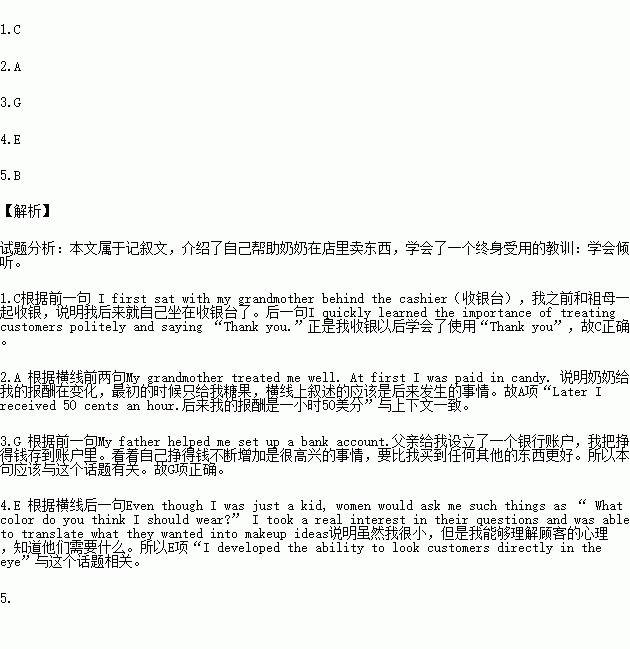
I was eight when I first sat with my grandmother behind the cashier in her store. 1. . I quickly learned the importance of treating customers politely and saying “Thank you.”

My grandmother treated me well. At first I was paid in candy. 2. .I worked every day after school, and during the summer and on weekends and holidays from 8 a.m. to 7 p.m. My father helped me set up a bank account. 3. .

By the time I was 12, My grandmother thought I had done such a good job that she promoted me to selling cosmetics(化妆品). 4. . Even though I was just a kid, women would ask me such things as “ What color do you think I should wear?” I took a real interest in their questions and was able to translate what they wanted into makeup ideas. I ended my selling with a record amount of cosmetics.

5. To be a successful salesperson, you didn’t need to be a Rocket scientist—you needed to be a great listener. Today I still carry this lesson with me: I listen to customers. I expect my customers are no longer women purchasing cosmetics from me; instead, they are kids who tell me which toys they would like to see.

A. Later I received 50 cents an hour.

B. The job taught me a valuable lesson

C. She let me sit there by myself before long

D. My grandma’s trust taught me how to handle responsibility

E. I developed the ability to look customers directly in the eye

F. Soon I found myself looking more beautiful than ever before.

G. Watching my money grow was more rewarding than anything I could have bought.
练习册系列答案
相关题目

Chinese female scientist Tu Youyou won the 2015 Nobel Prize in medicine on October 5 for her discoveries concerning a novel treatment against Malaria(疟疾). This is the first Nobel Prize given to a Chinese scientist for work carried out within China.

Tu shared the prize with Irish-born William Campbell and Satoshi Omura of Japan, who were honored for their revolutionary anti-roundworm treatment. 84-year-old Tu is awarded this prize for her contribution to cutting the death rate of malaria, reducing patients’ suffering and promoting mankind’s health. Although she received several medical awards in the past, the 2015 Nobel Prize is definitely the most privilege reward that recognizes Tu’s dedication and perseverance in discovering artemisinin(青蒿素), the key drug that battles malaria-friendly parasites(寄生虫).

However, her route to the honor has been anything but traditional. She won the Nobel Prize for medicine, but she doesn’t have a medical degree or a PhD. In China, she is even being called the “three-noes” winner: no medical degree, no doctorate, and she’s never worked overseas. No wonder her success has stirred China’s national pride and helped promote confidence of native Chinese scientists.

The fact that Tu has none of these three backgrounds reminds us that science should be more accessible to all. One shall be able to become a scientist no matter what kind of background he or she comes from, as long as one dives into scientific research. There have been discussions on people who really love science but are never able to achieve much during their whole life. Their contributions can never be ignored. They work so hard to prove the wrong way so that the future researchers will be closer to the right one.

As the first Chinese mainland Nobel Prize Winner of natural science award, Tu’s record-breaking winning also serves as a reminder to those who are too eager for instant success. Science is never about instant success. Tu spent decades on scientific research before its value is officially acknowledged. There is no way to measure how much one devotes to science and compare it with how much reward he or she may get.

1. It can be concluded from the text that ______.

A. Tu worked home and abroad to conduct her research

B. Tu got the Nobel Prize for her anti-roundworm treatment

C. The Nobel Prize is the first award to recognize her work

D. Her discovery of artemisinin has helped to cut Malaria death rate

2.The author seems to agree that a person who is more likely to become a scientist is the one with _____.

A. a sense of national pride

B. Relevant academic knowledge

C. a desire to achieve success

D. enthusiasm for scientific research

3. In writing the passage, the author intends to ___________.

A. inform readers of the news and make comments

B. discourage the pursuit of instant success in science

C. remind readers of the principles of scientific research

D. praise the award winner and encourage scientific research

America's child movie star Shirley Temple Black died late Monday evening at the age of 85. Her fans in China are also deeply saddened. Temple is just one example of movie stars that China adored, and still adores. Here's our editor's pick of the top movie stars who have influenced China.

1. Sylvester Stallone

Oh, Rambo! The first strong American man that China knew. His accented English, easily recognizable even for someone who doesn't speak English, and his eyes that never seemed to smile, makes him someone whom cannot be forgotten. He represented the strong American image, and even stirred a boxing and bodybuilding fever in China.

2.Charlie Chaplin (April 16, 1889 – December 25, 1977)

In the 20th century, it is not too much to say that Einstein made the greatest contributions to science, and not many would disagree that Chaplin did the same for film. He was the first actor that introduced comedy to most Chinese viewers, and politically, he was also a close friend of China’s. His silent films broke the barrier of language and his form of art was recognized by all. It will be a difficult task to find a person in China who does not recognize Chaplin, even today.

3. Shirley Temple ( April 23, 1928 – February 10, 2014)

When Chinese audiences saw this adorable child star for the first time on screen, Shirley Temple had already lived for more than half a century. In her movies, she was always alone or in trouble, but this adorable little blonde(金发女郎) could always resolve anything with her kindness, push away the fogginess and bring about light. The brand "Shirley Temple" was a product of the Great Depression. People watched her act to forget their hardships as Temple entertained the poor, the rich, adults and children alike. Several decades later, when her films were screened in China, the effects were the same.

4. Audrey Hepburn( May 4, 1929 – January 20, 1993)

She will forever be the princess in Chinese people's hearts. Even to this day, a large number of tourists go to Rome to visit the Mouth of Truth with their lovers and eat ice cream on the Spanish Steps. Her sense of style seems to never go out of style. When she was alive, she was living perfection. Even after her death, she has remained an icon. That's something that only Audrey Hepburn is capable of.

1.According to the passage, who was most known for comedy in China?

A. Sylvester Stallone B. Charlie Chaplin

C. Shirley Temple D. Audrey Hepburn

2. What can we learn from the passage?

A. Sylvester Stallone taught boxing and bodybuilding and caused a fever in China.

B. Charlie Chaplin was China’s close friend because he introduced comedy to China.

C. Audrey Hepburn’s movie made the Mouth of Truth and the Spanish Steps popular.

D. Shirley Temple’s works can only help Americans forget hardships and enjoy life better.

3. What does the underlined word “icon” mean in the passage?

A. symbol B. sign C. mystery D. heroine

4. In which part can we most probably read this passage?

A. Art B. Columns

C. Music & Theater D. Film &TV

Hollywood is on the edge of a nervous breakdown. Worried about an industry wide writers’ strike, struck by a series of theater-chain bankruptcies(破产), burdened with unreasonable corporate profit, requirements and seemingly incapable of producing consistently creative movies, the American film industry is in a period of soul-searching. There’s little doubt it will survive this crisis. But most insiders agree there is disease at both ends of the business—where film are produced, and where they’re shown---that may take years to overcome.

While annual box-office income increases for nine straight years, largely due to increased ticket prices, the number of actual tickets sold declined for the second year in a row. The construction boom has added nearly 10,000 theaters(more than 200,000 more seats) in the last five years. But due to a static(静止的)audience base, eight major chains have gone into bankruptcy and several others are in terrible financial situations.

In fact, insiders say, Hollywood is now in a business it does not want to be in. “There’s a general problem in that the companies that have the most consistent output of material are least interested in what they’re making,” says former 20th Century Fox CEO, Bill. And, Bill adds, “We’re in a period where movies are getting bigger and more costly and less interesting and fulfilling to an audience.”

Today the studios are under the stress to increase profit margins(营业利润) for their corporate parents, and profit margins are hard to control in a business whose products are seen as impulse buys(即兴购买). Other business can increase profits by cutting costs—buying cheaper material, or making the candy bar smaller. Not Hollywood.

“What we’re cutting is risk,” says the head of one major studio, who asked not to be named, “And risk is what great film has always demanded.” While the studios are avoiding risky concepts, their competitors in the home entertainment business have been expanding the boundaries of the imagination. It was this pressure---in electronic games, the Internet, EVDs----that forced the movie theater chains into a self-destructive craze of expansion.

1.Which of NOT the worry of the American film industry according to the passage?

A. Theater-chain bankruptcy

B. Lack of the advertisement funds

C. The stress to increase corporate profit

D. Being unable to produce creative movies

2.What has directly caused major theater-chains in terrible financial situations?

A. Bigger movies

B. More costly movies

C. Increased ticket prices

D. More theaters but an unchangeable audience base

3.What do we know about the profit of the film industry?

A. It’s not easy to control the profit

B. The studios can shorten the material

C. Cutting the cost can increase the profit

D. The studios can buy cheap material to increase profits

4.What’s the main idea of the passage?

A. Hollywood will survive financial crisis

B. Hollywood is on the edge of destruction

C. It’s hard to increase the profits of the studios

D. The construction boom leads to theater-chain bankruptcies

违法和不良信息举报电话:027-86699610 举报邮箱:58377363@163.com

精英家教网
