题目内容

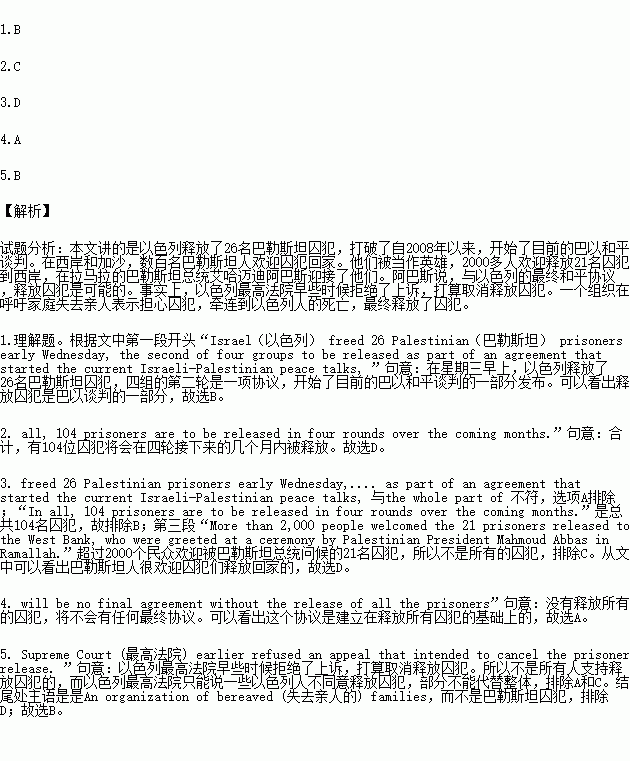
(RAMALLAH, West Bank) — Israel(以色列) freed 26 Palestinian(巴勒斯坦) prisoners early Wednesday, the second of four groups to be released as part of an agreement that started the current Israeli-Palestinian peace talks, which had broken down since 2008. In all, 104 prisoners are to be released in four rounds over the coming months.

In the West Bank and Gaza(加沙), the mood was overexcited as hundreds of Palestinians welcomed the prisoners back home, after many had spent more than 20 years behind bars.

Crowds of people rushed toward the 5 prisoners released to Gaza, raising them on their shoulders, waving Palestinian flags and dancing to music. Relatives held signs that read “we will never forget our heroes.” More than 2,000 people welcomed the 21 prisoners released to the West Bank, who were greeted at a ceremony by Palestinian President Mahmoud Abbas in Ramallah.

Hazem Shubair, thrown into prison in 1994 for the death of an Israeli according to the Israeli Prison Service, was over delighted upon his return to Gaza. “I am speechless,” he said. “Thanks to God. God is greater than the aggressors (meaning Israel)”.

Abbas said a final peace agreement with Israel was possible on the release of the prisoners. “There will be no final agreement without the release of all the prisoners,” he told the violent crowd.

Israel’s Supreme Court (最高法院) earlier refused an appeal that intended to cancel the prisoner release. An organization of bereaved (失去亲人的) families behind the appeal has said it fears the prisoners, all in connection to the deaths of Israelis, will return to violence once freed.

1.Why did Israel free 26 Palestinian prisoners early Wednesday?

A. Because they would take part in the Israeli-Palestinian peace talks.

B. Because that was part of an agreement between Israel and Palestinians.

C. Because the current Israeli-Palestinian peace talks failed.

D. Because the peace talks had broken down since 2008.

2.How many Palestinian prisoners had been released by Wednesday?

A. 21 B. 26. C. Over 26. D. 104.

3.Which of the following is true according to the passage?

A. Wednesday’s release was the whole part of the Israeli-Palestinian peace talks.

B. The other 104 Palestinian prisoners will be freed in the coming months.

C. All the Palestinian prisoners were greeted by Palestinian President Mahmoud Abbas.

D. All the Palestinian prisoners were welcomed warmly.

4.There will be no final peace agreement between Israel and Palestinians until ______.

A. all the Palestinian prisoners kept in Israeli prisons are set free

B. all the prisoners return to violence once again

C. God is greater than the aggressors

D. Palestinians welcome some prisoners back home

5.From the last paragraph we know _______.

A. Israel stopped to release the rest of the Palestinian prisoners

B. some Israelis didn’t agree to release the Palestinian prisoners

C. all the Israelis are in favor of setting the Palestinian prisoners free

D. the Palestinian prisoners will return to violence once freed
练习册系列答案
相关题目

完形填空

One day I was hanging about with several friends. Not really doing anything , just doing what teenagers do on a hot summer afternoon.

We were walking through a parking lot my younger brother, Mark, came running up to us at full . A few seconds later I saw a man running behind him. Mark was out of , so I didn't really understand what he was . The man in front of me was .for Mark. Mark moved behind me, and I realised that he was . I asked the man what the . was. The man said he wanted my little brother in a bad way. He reached for my brother again and again but I him. He then punched (拳击) me in the chest. I felt more than hurt and I had to defend myself.

did the man know that I had been training in Karate (空手道) for four years. I was .by my parents to respect all adults, this man was so terrible. He was trying to hurt my ; he turned his anger to me with a attack. But, much to his surprise, he found he was in a bit of trouble himself. So the man his attack and disappeared from my sight.

The whole thing was over a simple disagreement two children, namely Mark and the man's daughter. This man had overreacted (反应) and did things without finding out the facts. I am happy that no one was hurt badly and that worked out okay.

However, the man and I were similar in a way. We both tried to the ones we care about in the best way we could.

1.A.helpful B.necessary C.special D.useful

2.A.when B.as C.since D.why

3.A.limit B.power C.speed D.hope

4.A.control B.breath C.mind D.danger

5.A.thinking B.saying C.making D.ordering

6.A.reaching B.waiting C.caring D.leaving

7.A.surprised B.excited C.brave D.scared

8.A.difficulty B.act C.problem D.task

9.A.blocked B.defeated C.disliked D.disagreed

10.A.tired B.shocked C.moved D.bored

11.A.Little B.Much C.Many D.Few

12.A.reminded B.showed C.taught D.encouraged

13.A.and B.so C.as D.but

14.A.teacher B.father C.brother D.friend

15.A.mental B.material C.chemical D.physical

16.A.continued B.kept C.stopped D.increased

17.A.between B.across C.among D.for

18.A.naturally B.wildly C.slightly D.slowly

19.A.nothing B.anything C.something D.everything

20.A.protect B.admire C.value D.praise

Surprisingly, no one knows how many children receive education in English hospitals, still less the content or quality of that education. Proper records are just not kept. We know that more than 850,000 children go through hospital each year, and that every child of school age has a legal right to continue to receive education while in hospital. We also know there is only one hospital teacher to every 1,000 children in hospital.

Little wonder the latest survey concludes that the extent and type of hospital teaching available differ a great deal across the country. It is found that half the hospitals in England which admit children have no teacher. A further quarter have only a part-time teacher. The special children’s hospitals in major cities do best; general hospitals in the country and holiday areas are worst off. From this survey, one can estimate that fewer than one in five children have some contact with a hospital teacher—and that contact may be as little as two hours a day. Most children interviewed were surprised to find a teacher in hospital at all. They had not been prepared for it by parents or their own school. If there was a teacher they were much more likely to read books and do math or number work; without a teacher they would only play games.

Reasons for hospital teaching range from preventing a child falling behind and maintaining the habit of school to keeping a child occupied, and the latter is often all the teacher can do. The position and influence of many teachers was summed up when parents referred to them as “the library lady” or just “the helper”. Children tend to rely on concerned school friends to keep in touch with school work. Several parents spoke of requests for work being ignored or refused by the school. Once back at school children rarely get extra teaching, and are told to catch up as best as they can.

Many short-stay child-patients catch up quickly. But schools do very little to ease the anxiety about falling behind expressed by many of the children interviewed.

1.Which of the following statements is true?

A. Every child in hospital receives some teaching.

B. Not enough is known about hospital teaching.

C. Hospital teaching is of poor quality.

D. The special children's hospitals are worst off.

2.It can be inferred from the latest survey that________.

A. hospital teaching across the country is similar

B. each hospital has at least one part-time teacher

C. all hospitals surveyed offer education to children

D. only one-fourth of the hospitals have a full-time teacher

3.Hospital teachers are found________.

A. not welcomed by the children and their parents

B. necessary

C. not welcomed by the hospitals

D. capable

4.In order to catch up with their school work, children in hospital usually turn to________.

A. hospital teachers B. schoolmates

C. parents D. school teachers

5.We can conclude from the passage that the author is________.

A. unfavorable towards children receiving education in hospitals

B. in favor of the present state of teaching in hospitals

C. unsatisfied with the present state of hospital teaching

D. satisfied with the results of the latest survey

违法和不良信息举报电话:027-86699610 举报邮箱:58377363@163.com

精英家教网