题目内容

  Some building designers are thinking about building whole cities under glass domes(圆顶) in the desert. Of course, those heating and cooling systems(系统) will be necessary to control the climate in the domes. However, there will never be any rain or snow, and the temperature will always be comfortable.

  Perhaps everyone will live in high vertical(垂直) cities that are so large that they can contain all the necessities of life. Since vertical cities will use less land than horizontal(水平的) cities, and provide homes for people, they will be practical for small countries that have a large population.

  Another idea that will be helped to small countries and island countries is the floating city. Monaco has already built homes, stores, and offices on the water of the Mediterranean Sea. And a Japanese designer has suggested a plan for constructing building on bridges over Tokyo Bay(湾).

  There are some people who think we will go back to live in caves. But the caves of future will be very different from the caves of the Stone Age. Computers will control light and climate. Farms and parks will be on the land over the cave city. When people want to go to the country or a park, a short ride in a lift will take them there.

1.The text is mainly about ________.

[  ]

A.future life
B.future cities
C.building designers
D.how to save land

2.What kind of city covers less land?

[  ]

A.The city under glass domes in the desert.

B.The vertical city.

C.The city in the desert.

D.The horizontal city.

3.People living in ________ can enjoy natural climate.

[  ]

A.the cities under glass domes

B.either vertical cities or cave cities

C.both vertical cities and floating cities

D.all the above cities except the underground cities

4.Which of the drawing below gives the correct imagination that is described in the text?

A.
B.
C.
D.
答案:B;B;C;B
解析:

  解析:2.由文中第二段“Since vertical cities will use less land than horizontal cities”得知。

  4.由最后一段的第四句得知。


练习册系列答案
相关题目

阅读理解

  Good morning. I'm speaking to you today from Beijing. In just two days, I've seen some of the rich history and remarkable changes that are taking place in China, home to nearly one- quarter of the world's population.

  China is the oldest civilization on Earth. In Xi'an, on Friday, I saw the old and the new China, from magnificent Terra Cotta Warriors sculpted by artisans 2,000 years before America was founded, to the beginnings of democracy in a nearby village, where residents soon will hold elections.

  I've been touched by the warm reception given to me, my family, and the members of Congress travelling with us. Tens of thousands of Chinese families have lined the streets to greet us. For all these people, China is changing. I see cell phones, beepers, new office buildings.

  China is no longer the same country it was when president Nixon first came here 26 years ago. Never before have so many Chinese had the opportunity to start businesses, lift their families out of poverty, choose where to live, work, and travel, and enjoy the fruits of their labors.

  Today in Beijing I am meeting with China' s leaders to talk about the future of our two countries and a relationship between us that is essential to a peaceful, stable, and prosperous world in the next century. We talked about the United States and China's mutual interests ---- promoting peace in Korea, where 400,000 U.S. soldiers still risk their lives to patrol the Cold Wars last frontier; preventing a nuclear arms race between India and Pakistan; restoring economic stability in Asia; stopping the spread of unclear soldiers chemical, and biological weapons and the misspread of unclear soldiers chemical, and biological weapons and the missiles to deliver them; combating international crime and drug trafficking; preserving the environment; and opening trade.

  China is important to our future, with the largest population on Earth, a permanent seat on the United Nations Security Council, an economy increasingly connected to our own. Without China, it will be difficult to face the challenges. In dealing with China, we must stay true to a course that is both principled and pragmatic.We must continue to expand our areas of cooperation, even as we deal directly with out differences. With China, we can build a safer, more prosperous future for our children, a world of unlimited possibility in the new century

  Thanks for listening.

(1)When was the Terra Cotta in Xi'an sculpted?

[  ]

A.2,000 years ago.

B.On the beginning of the last century.

C.2,000 years before America was founded.

D.Right before Clinton's visit to China.

(2)Who traveled together with Clinton in China?

[  ]

A.His family.

B.His family and some congressmen.

C.Members of congress.

D.Reporters and bodyguards.

(3)Which of the following issue was NOT discussed by President Clinton and China's leaders during his visit in Beijing?

[  ]

A.peace in KoreA.

B.Asian economy.

C.American human rights.

D.prohibition of nuclear weapons.

(4)Which of the following impressed the president most during his visit in China?

[  ]

A.Rich history and remarkable changes of China.

B.Modern communication facilities of China.

C.Democracy progress of China.

D.Economic development of China.

(5)According to the president's address, why is China important to the U. S.?

[  ]

A.Because China has the largest population in the world.

B.Because China has a permanent seat on the United Nations Security Council.

C.Because China and the U.S. have mutual interests in the economic development.

D.All of the above.

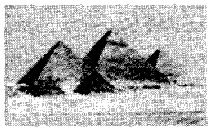
  The oldest stone buildings in the world are the pyramids. They have stood for nearly 5,000 years, and it seems likely that they will continue to stand for thousands of years yet. There are over eighty of them scattered along the banks of the Nile, some of which are different in shape from the true pyramids. The most famous of these are the “Step” pyramid and the “Bent” pyramid.

  Some of the pyramids still look as much alike as they must have been when they were built thousands of years ago. Most of the damage suffered by the others has been at the hands of men who were looking for treasure or. more often, for stone to use in modern buildings. The dry climate of Egypt has helped to keep the pyramid, in good condition, and their very shape has made them less likely to fall into ruin. These are good reasons why they can still be seen today, but perhaps the most important one is that they were planned to last forever.

  The “Step” pyramid had to be on the west side of the Nile, the side on which the sun set. This was for spiritual reasons. It also had to stand well above the level of the river to protect it against the regular floods. It could not be too far from the Nile, however, as the stones to build it needed to be carried in boats down the river to the nearest point. Water transport was, of course, much easier than land transport. The builders also had to find a rock base, which was not likely to crack under the great weight of the pyramid. Finally, it had to be near the capital, or better still, near the king's palace so that he could visit it easily to personally check the progress being made on the final resting place for his body.

1.Which of the following statements is TRUE about the “Step” pyramid?

[  ]

A.It is unlikely to fall into ruin in the near future.

B.It was built on the sands along the Nile.

C.It is the oldest building on earth.

D.It is the most famous of the true pyramids.

2.The most important reason why some pyramids remain in good condition is that ________.

[  ]

A.people have taken care of them

B.it doesn't rain often in Egypt

C.they were well designed

D.the government has protected them from damage

3.Most of the damage to the pyramids has been caused by ________.

[  ]

A.the regular floods

B.the dry climate of Egypt

C.people searching for gold

D.people in search of building materials

4.Why did the Egyptians build the pyramids along the banks of the Nile?

[  ]

A.Because they believed in their god.

B.Because it was difficult to find a large rock base far from the Nile.

C.Because the river helped a lot in the transport of building materials.

D.Because it was not easy to choose a suitable place for the pyramids.

Claude and Louris are “giraffes”.So are police officers Hankins and Pearson.These men and women don’t look like giraffes;they look like you and me.Then,why do people call them “giraffes”?

  A giraffe,they say,is an animal that sticks its necks out,can see places far away and has a large heart.It lives a quiet life and moves about in an easy and beautiful way.In the same way,a “giraffe” can be a person who likes to “stick his or her neck out” for other people,always watches for future happenings,has a warm heart for people around,and at the same time lives a quiet and beautiful life himself or herself.

  “The Giraffe Project” is a 10?year?old group which finds and honors “giraffes” in the US and in the world.The group wants to teach people to do something to build a better world.The group members believe that a person shouldn’t draw his or her head back;instead,they tell people to “stick their necks out” and help others.Claude and Louris,Hankins and Pearson are only a few of the nearly 1,000 “giraffes” that the group found and honored.

  Claude and Louris were getting old and they left their work with some money that they saved for future use.One day,however,they saw a homeless man looking for a place to keep warm and they decided that they should “stick their necks out” and give him some help.Today,they lived in Friends’ House,where they invite twelve homeless people to stay every night.

  Police officers Hankins and Pearson work in a large city.They see crimes every day and their work is sometimes dangerous.They work hard for their money.However,these two men put their savings together and even borrowed money to start an educational center to teach young people in a poor part of the city.Hankins and Pearson are certainly “giraffes”.

1.Which of the following is true?

  A.Some of the people around us look like giraffes.

  B.Giraffes are the most beautiful animal in the world.

  C.“Giraffes” is a beautiful name for those who are ready to help other people.

  D.A “giraffe” is someone who can stick his neck out and see the future.


2.“The Giraffe Project” is a group     .

  A.of police officers        B.which appeared ten years ago

  C.of ten?year?old children     D.which takes care of children


3.People call Claude and Hankins “giraffes” because they     .

  A.do what is needed for a good world

  B.are not afraid of dangerous work

  C.found a home for some homeless people

  D.made money only for other people


4.What does “The Giraffe Project” do?

  A.It tells people how to live a quiet life.

  B.It helps the homeless and teaches the young people.

  C.It tries to find 1,000 warm?hearted people in the US.

  D.It shows people what their duty is for a better world.


5.The passage mainly tries to tell us     .

  A.what giraffes are like

  B.what the Giraffe Project is

  C.why Claude,Louris,Hankins and Pearson are called “giraffes”

  D.what we should do for a better world


    In the college-admissions wars, we parents are the true fighters. We’re pushing our kids to get good grades, take SAT preparatory courses and build resumes so they can get into the college of our first choice. I’ve twice been to the wars, and as I survey the battlefield, something different is happening. We see our kids’ college background as a prize demonstrating how well we’ve raised them. But we can’t acknowledge that our obsession(痴迷) is more about us than them. So we’ve created various justifications(辩解)that turn out to be half-truths, prejudices or myths. It actually doesn’t matter much whether Aaron and Nicole go to Stanford.

We have a full-developed panic; we worry that there won’t be enough prizes to go around. Fearful parents urge their children to apply to more schools than ever. What causes the hysteria(歇斯底里) is the belief that scarce elite(精英)degrees must be highly valuable. Their graduates must enjoy more success because they get a better education and develop better contacts. All seems right but mostly wrong. We haven’t found any convincing evidence that selectivity or prestige matters. Selective schools don’t systematically employ better instructional approaches than less selective schools. On two measures—professors’ feedback and the number of essay exams selective schools do slightly worse.

By some studies, selective schools do enhance(提高) their graduates’ lifetime earnings. The gain is reckoned at 2-4% for every 100-point increase in a school’s average SAT scores. But even this advantage is probably a statistical fluke(偶然). A well-known study examined students who got into highly selective schools and then went elsewhere. They earned just as much as graduates from higher-status schools.

Kids count more than their colleges. Getting into Yale may signify intelligence, talent and ambition. But it’s not the only indicator and, surprisingly, its significance is declining. The reason: so many similar people go elsewhere. Getting into college is not life’s only competition. In the next competition—the job market and graduate school—the results may change. Princeton economist Alan Krueger studied admissions to one top Ph.D. program. High scores on the GRE helped explain who got in; degrees of famous universities didn’t.

So, parents, take it easy(lighten up). The stakes (利害关系) have been vastly exaggerated. Up to a point, we can rationalize our pushiness. America is a competitive society; our kids need to adjust to that. But too much pushiness can be destructive. The very ambition we impose on our children may get some into Harvard but may also set them up for disappointment. One study found that, other things being equal, graduates of highly selective schools experienced more job dissatisfaction. They may have been so conditioned to being on top that anything less disappoints.

1. Why does the author say that parents are the true fighters in the college-admissions wars?

         A. They have the final say in which university their children are to attend.

         B. They know best which universities are most suitable for their children.

         C. They have to carry out intensive surveys of colleges before children make an application.

         D. They care more about which college their children go to than the children themselves.

2. Why do parents urge their children to apply to more schools than ever?

         A. They want to increase their children’s chances of entering a prestigious college.

         B. They hope their children can enter a university that offers attractive scholarships.

         C. Their children will have a wider choice of which college to go to.

         D. Elite universities now enroll fewer student than they used to.

3. What does the author mean by “kids count more than their colleges” Line1, para.4?

         A. Continuing education is more important to a person’s success.

         B. A person’s happiness should be valued more than their education.

         C. Kids’ actual abilities are more important than their college background.

         D. What kids learn at college cannot keep up with job market requirements.

4. What does Krueger’s study tell us?

         A. Getting into Ph.D. programs may be more competitive than getting into college.

         B. Degrees of prestigious universities do not guarantee entry to graduate programs.

         C. Graduates from prestigious universities do not care much about their GRE scores.

         D. Connections built in prestigious universities may be kept long after graduation.

5. One possible result of pushing children into elite universities is that______

         A. they earn less than their peers from other institutions  

         B. they turn out to be less competitive in the job market

         C. they experience more job dissatisfaction after graduation 

         D. they overemphasize their qualifications in job application


Young people and older people do not always agree. They sometimes have different ideas about living, working and playing. But in one special program in New York State, adults and teenagers live together in a friendly way.

  Each summer 200 teenagers and 50 adults live together for eight weeks as members of a special work group. Everyone works several hours each day. They do so not just to keep busy but to find meaning and fun in work. Some teenagers work in the forests or on the farms near the village. Some learn to make things like tables and chairs and to build houses. The adults teach them these skills.

  There are several free hours each day. Weekends are free, too. During the free hours some of the teenagers learn photo-taking or drawing. Others sit around and talk or sing. Each teenager chooses his own way to pass his free time.

  When people live together, they should have rules. In this program the teenagers and the adults make the rules together. If someone breaks a rule, the problem goes before the whole group. They talk about it and ask, “Why did it happen? What should we do about it?”

  One of the teenagers has said something about it, “You have to stop thinking only about yourself. You learn how to think about the group.”

1. In one special program in New York State, young and older people_______.

 A. don’t work well together     B. teach each other new ways of building houses

  C. are friendly to each other D. spend eight weeks together, working as farmers

2.All the members work some time every day mainly to________.

  A. lead a busy life                    B. find useful things and pleasure in work

 C. get used to the life on the farms   D. learn new skills of farming

3.Living together, ________.

  A. the teenagers don’t have to obey the rules

 B. the members have to obey the regulations the adults make

  C. the members have no free time but on weekends

 D. the members should not break the regulations they make together

4.The best title for the passage is________.

 A. The Rules of Living Together    B. Teenagers and Adults Together

 C. Life in New York State              D. Free Hours in the Special Work Group 


违法和不良信息举报电话:027-86699610 举报邮箱:58377363@163.com

精英家教网