题目内容
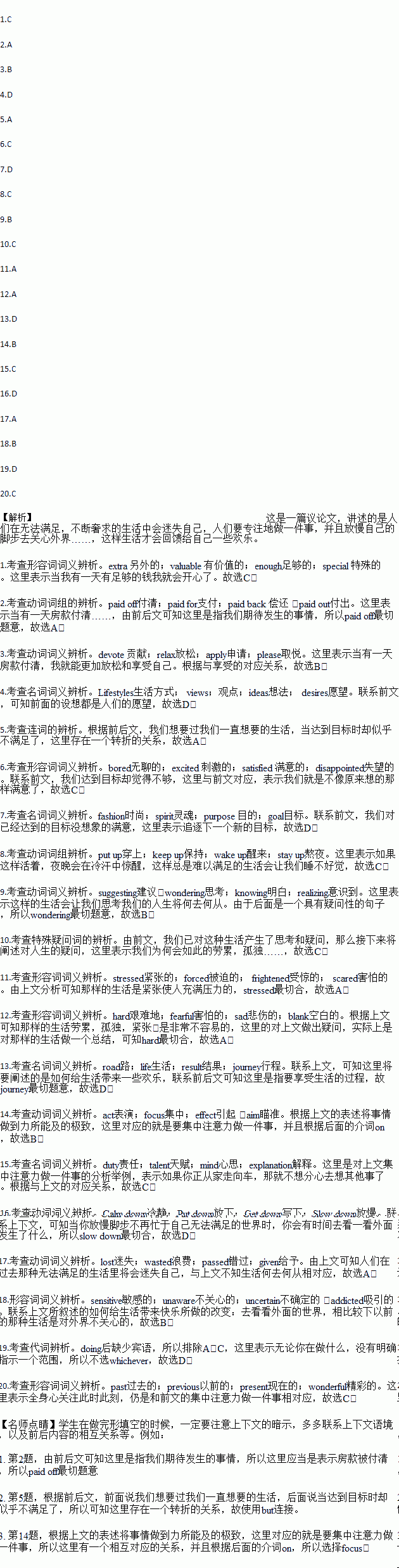
Do you spend your time working towards that “one day when...”? One day, when I have _____ money I will be happy. One day, when I have the house _______, I will be able to _______ and enjoy myself more. One day, when I get a job... These may all seem like good destinations and _______, waiting to live the life we have always wanted sometime in the future.________ when we arrive at one destination it doesn’t seem enough; somehow we are just not as _______ as we thought we would be and we start going after the next _______ .
If we live in this way, one night we will _______ in a cold sweat ______ where our life has gone--- _______ we feel so tired, lonely and _______ . Was life really meant to be ______ ?
So what can you do to bring some joy back into your life? Start enjoying the _____.No matter what you do, do it to the best of your ability with your ______ on what you are doing. If you are walking from the house to the car, don’t hurry your ______on something else. _______ down a bit, take a deep breath, look around and see what is going on in the outside world. We spend so much time ________ in our heads and we become _______ of what is going on around us.
To really start to enjoy your life now--- _______ you are doing, you need to learn slow your racing minds down and become fully aware of the ________ moment. Do yourself a favour and dedicate (奉献于) today to enjoying the journey.
1.A. extra B. valuable C. enough D. special
2.A. paid off B. paid for C. paid back D. paid out
3.A. devote B. relax C. apply D. please
4.A. lifestyles B. views C. ideas D. desires
5.A. But B. And C. Then D. So
6.A. bored B. excited C. satisfied D. disappointed
7.A. fashion B. spirit C. purpose D. goal
8.A. put up B. keep up C. wake up D. stay up
9.A. suggesting B. wondering C. knowing D. realizing
10.A. how B. that C. why D. what
11.A. stressed B. forced C. frightened D. scared
12.A. hard B. fearful C. sad D. blank
13.A. road B. life C. result D. journey
14.A. act B. focus C. effect D. aim
15.A. duty B. talent C. mind D. explanation
16.A. Calm B. Put C. Get D. Slow
17.A. lost B. wasted C. passed D. given
18.A. sensitive B. unaware C. uncertain D. addicted
19.A. however B. whichever C. wherever D. whatever
20.A. past B. previous C. present D. wonderful

How did we (38)becomea throwaway society?First of all,it is now easier to(39)replace an object than to spend time and money to repair it.(40)Thanksto modern manufacturing (制造业) and technology,companies are able to produce products quickly and inexpensively.Products are plentiful and(41)cheap.
Another cause is our(42)love of disposable (一次性的) products.As(43)brave people,we are always looking for(44)ways to save time and make our lives easier.Companies(45)produce thousands of different kinds of disposable products:paper plates,plastic cups,and cameras,to name a few.
Our appetite for new products also(46)contributes to the problem.We are(47)addictedto buying new things.Advertisements persuade us that(48)neweris better and that we will be happier with the latest products.The result is that we(49)throwaway useful possessions to make room for new ones.
All around the world,we can see the(50)consequences of this throwaway lifestyle.Mountains of rubbish just keep getting bigger.To(51)decrease the amount of rubbish and to protect theenvironment52environment,more governments are requiring people to recycle materials.(53)However,this is not enough to solve (解决) our problem.
Maybe there is another way out.We need to repair our possessions(54)insteadof throwing them away.We also need to rethink our attitudes about(55)repairing.Repairing our possessions and changing our spending habits may be the best way to reduce the amount of rubbish and take care of our environment.
| 36.A.key | B.reason | C.project | D.problem |
| 37.A.gifts | B.rubbish | C.debt | D.products |
| 38.A.face | B.become | C.observe | D.change |
| 39.A.hide | B.control | C.replace | D.withdraw |
| 40.A.Thanks to | B.As to | C.Except for | D.Regardless of |
| 41.A.safe | B.funny | C.cheap | D.powerful |
| 42.A.love | B.lack | C.prevention | D.division |
| 43.A.sensitive | B.kind | C.brave | D.busy |
| 44.A.ways | B.places | C.jobs | D.friends |
| 45.A.donate | B.receive | C.produce | D.preserve |
| 46.A.adapts | B.returns | C.responds | D.contributes |
| 47.A.tired of | B.addicted to | C.worried about | D.ashamed for |
| 48.A.newer | B.stronger | C.higher | D.larger |
| 49.A.pick up | B.pay for | C.hold onto | D.throw away |
| 50.A.advantages | B.purposes | C.functions | D.consequences |
| 51.A.show | B.record | C.decrease | D.measure |
| 52.A.technology | B.environment | C.consumers | D.brands |
| 53.A.However | B.Otherwise | C.Therefore | D.Meanwhile |
| 54.A.by | B.in favour of | C.after | D.instead of |
| 55.A.spending | B.collecting | C.repairing | D.advertising. |
-Heping Street? is where the shopping centre is.( )
| A. | Such | B. | There | C. | That | D. | This |
There can be little doubt that (4)specialclasses can help the gifted children to graduate earlier and take their place in life sooner.However,to take these (5)childrenout of the regular classes may create serious problems.
I observed a number of (6)intelligentchildren who were taken out of a special class and placed in a (7)regular class.In the special class,they showed little ability to use their own judgment,relying (8)slightly on their teachers'directions.In the regular class,having no worry about ke(http://www.unjs.com)eping up,they began to reflect (9)quicklyon many problems,some of which were not on the school program.
Many are concerned that gifted children become (10)boredand lose interest in learning.However this (11)concernis more often from parents and teachers than from students,and some of these(12)adults simply conclude that special classes should be set up for those who are(13)talented.Some top students do feel bored in class,but why they (14)feel so goes far beyond the work they have in school.Studies have shown that to be bored is to be anxious.The gifted child whop is bored is an (15)anxiouschild.
| 1.A.principle | B.theory | C.arguments | D.classification |
| 2.A.designing | B.grouping | C.learning | D.living |
| 3.A.smart | B.curious | C.mature | D.average |
| 4.A.regular | B.special | C.small | D.creative |
| 5.A.children | B.programs | C.graduates | D.designs |
| 6.A.intelligent | B.competent | C.ordinary | D.independent |
| 7.A.separate | B.regular | C.new | D.boring |
| 8.A.specially | B.slightly | C.wrongly | D.heavily |
| 9.A,directly | B.cleverly | C.voluntarily | D.quickly |
| 10.A.doubted | B.bored | C.worried | D.tired |
| 11.A.concern | B.conclusion | C.reflection | D.interest |
| 12.A.students | B.adults | C.scholars | D.teachers |
| 13.A.talented | B.worried | C.learned | D.interested |
| 14.A.believe | B.think | C.say | D.feel. |
| A. | not treated | B. | not being treated | ||
| C. | not to be treated | D. | not having been treated |