题目内容

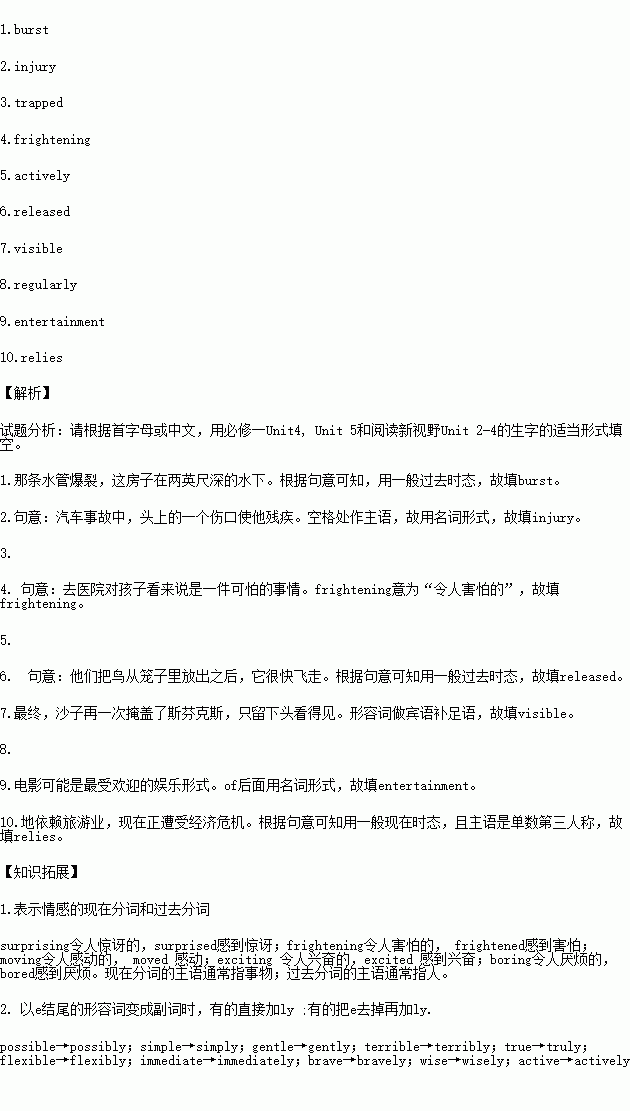
请根据首字母或中文,用必修一Unit4, Unit 5和阅读新视野Unit 2-4的生字的适当形式填空。

1.That water pipe b________ and the house was under two feet of water.

2.An i________ to the head in the car accident disabled him.

3.The miners were t________ underground. There was no way out!

4.Going to hospital can be very ________ (frighten) for children.

5.We show great respect for those who ________ (积极) take part in the sports meet.

6.The bird flew away quickly after they r________ it from the cage.

7.Eventually, the desert sand once again covered the Sphinx, leaving only the head ________ (看得见的).

8.We meet ________ (有规律地;定期地) to discuss our progress.

9.Movies are probably the most popular form of ________ (娱乐).

10.This city ________ (依赖) too much on tourism and is now suffering from an economic crisis.
练习册系列答案
相关题目

At times, our worries and anxieties can defeat us. 1. Here is a brief list of techniques that you can use to help gain a better viewpoint on things during the anxious moments.

2. A person should take a deep breath and try to find something to do for a few minutes to get their mind off the problem. A person could get some fresh air, listen to some music, or do an activity that will give them a fresh perspective on things.

Remember that our fearful thoughts are made to seem worse and can make the problem worse. 3. When unexpectedly having thoughts that make you fearful or anxious, challenge these thoughts by asking yourself positive questions that will maintain objectivity and common sense.

Be smart in how you deal with fears and anxieties. Do not try to deal with everything all at once. When facing a current or upcoming task that makes you anxious, break the task into small ones. 4.

Remember that all the worrying in the world will not change anything. Most of what you worry about never comes true. 5. Then you should leave everything else in the hands of God.

It is not easy to deal with all the fears and worries. When your fears and anxieties have the best of you, try to calm down and then get the facts of the situation. The key is to take it slow. All you can do is doing your best each day, hope for the best, and when something does happen, take it easy. Take it one step at a time and things will work out well at last.

A. When feeling anxious, stop what you are doing and try to do something relaxing.

B. This will give you the confidence to manage your anxiety.

C. Instead of worrying about something that probably won’t happen, concentrate on what you are able to do.

D. The next time you fell depressed, review your list and think about the good things that you have in your life.

E. A good way to manage your worry is to challenge your negative thinking with positive statements and realistic thinking.

F. In addition, our worries can change our understanding of what is reality and what is not.

G. Completing these smaller tasks once at a time will make the stress more manageable and increase your chances of success.

A popular saying goes, “Sticks and stones may break my bones, but words will never hurt me.” However, that’s not really true. Words have the power to build us up or tear us down. It doesn’t matter if the words come from someone else or ourselves — the positive and negative effects are just as lasting.

We all talk to ourselves sometimes. We’re usually too embarrassed to admit it, though. In fact, we really shouldn’t be because more and more experts believe talking to ourselves out loud is a healthy habit.

This “self-talk” helps us motivate ourselves, remember things, solve problems, and calm ourselves down. Be aware, though, that as much as 77% of self-talk tends to be negative. So in order to stay positive, we should only speak words of encouragement to ourselves. We should also be quick to give ourselves a pat on the back. The next time you finish a project, do well in a test, or finally clean your room, join me in saying “Good job!”

Often, words come out of our mouths without us thinking about the effect they will have. But we should be aware that our words cause certain responses in others. For example, when returning an item to a store, we might use warm, friendly language during the exchange. And the clerk will probably respond in a similar manner. Or harsh (刻薄的) and critical language will most likely cause the clerk to be defensive.

Words possess power because of their lasting effects. Many of us regret something we once said. And we remember unkind words said to us! Before speaking, we should always ask ourselves: Is it true? Is it loving? Is it needed? If what we want to say doesn’t pass this test, then it’s better left unsaid.

Words possess power: both positive and negative. Those around us receive encouragement when we speak positively. We can offer hope, build self-esteem (自尊) and motivate others to do their best. Negative words destroy all those things. Will we use our words to hurt or to heal? The choice is ours.

1.There is no need for us to feel embarrassed when we talk to ourselves because _________.

A.almost everybody has the habit of talking to themselves

B.talking to ourselves always gives us courage

C.we can benefit from talking to ourselves

D.it does no harm to have “self-talk” when we are alone

2.The underlined part in the third paragraph means that we should also timely ________.

A.remind ourselves B.praise ourselves

C.make ourselves relaxed D.give ourselves amusement

3.The author would probably hold the view that _________.

A.encouraging words are sure to lead to kind offers

B.negative words may motivate us to make more progress

C. people tend to remember friendly words

D.it is better to think twice before talking to others

4.In which column of the newspaper can you most likely read this passage?

A.News. B.Advice column. C.Health. D.Language.

Most people know that Marie Curie was the first woman to win the Nobel Prize, and the first person to win it twice. However, few people know that she was also the mother of a Nobel Prize winner.

Born in September, 1987, Irene Curie was the first of the Curies’ two daughters. Along with nine other children the parents of whom were also famous scholars, Irene studied in their own school, and her mother was one of the teachers. She finished her high school education at the College of Sévigné in Paris.

Irene entered the University of Paris in 1914 to prepare for a degree in mathematics and physics. When World War I began, Irene went to help her mother, who was using X-ray facilities (设备) to help save the lives of wounded soldiers. Irene continued the work by developing X-ray facilities in military hospitals in France and Belgium. Her services were recognised in the form of a Military’s Medal by the French government.

In 1918, Irene became her mother’s assistant at the Curie Institute. In December 1924, Frederic Joliot joined the Institute, and Irene taught him the techniques required for his work. They soon fell in love and were married in 1926. Their daughter Helene was born in 1927 and their son Pierre five years later.

Like her mother, Irene combined family and career. Like her mother, Irene was awarded a Nobel Prize, along with her husband, in 1935. Unfortunately, also like her mother, she developed leukemia because of her work with radioactivity (辐射能). Irene Joliot-Curie died from leukemia on March 17, 1956.

1.Why was Irene Curie awarded a Military Medal?

A. Because she received a degree in mathematics.

B. Because she helped to save the wounded.

C. Because she won the Nobel Prize with Frederic.

D. Because she worked as a helper to her mother.

2.Where did Irene Curie meet her husband Frederio Joliot?

A. At the Curie Institute.B. At the University of Paris.

C. At a military hospital.D. At the College of Sévigné.

3.In which of the following aspects was Irene Cuire different from her mother?

A. Irene worked with radioactivity.

B. Irene combined family and career.

C. Irene won the Nobel Prize once.

D. Irene died from leukemia.

根据短文内容, 从短文后的选项中选出能填入空白处的最佳选项。选项中有两项为多余选项。

Ebola is a dangerous virus that can cause people to get very sick and even die. The virus is causing the biggest problems in western Africa, where it has spread quickly. 1. But it can get worse and cause life-threatening symptoms(症状), such as bleeding and trouble breathing.

2.

Ebola does not spread like colds or the flu because it does not float through the air. Ebola also doesn’t spread through food or water, like some other viruses. Instead, Ebola spreads when someone touches the body fluids(液体) of a sick person.

3.

An outbreak is when many people are getting sick with the same illness around the same time. You may have heard of a flu outbreak, which is when lots of people get sick from the same types of flu virus. When an outbreak happens because of a virus, more people could get sick because there is a lot of that virus around.

Where did Ebola come from?

Scientists aren’t sure how the first person gets Ebola at the start. 4. Tropical animals in Africa believed to carry the virus include great apes, chimpanzees, gorillas, monkeys, fruit bats, porcupines, and forest antelopes.

What do kids need to do about Ebola?

Ebola is making many people sick in Africa, but no matter where you live, it’s always a good idea to wash your hands well and often. 5.

A. How do people catch Ebola?

B. But they think that people may pick up the virus by touching or eating infected animals.

C. Why do I need to wash my hands?

D. It’s very important that infected people get treatment right away.

E. Ebola symptoms can start with fever and headache, kind of like the flu.

F. What is an outbreak?

G. Keeping hands clean can help protect you from common illnesses like colds and the flu.

违法和不良信息举报电话:027-86699610 举报邮箱:58377363@163.com

精英家教网