题目内容
阅读理解。
You signed up for soccer, and played every game of the season. Sure, you're not the best player on the team, but most days you gave it your all. Do you deserve a trophy (奖杯)?

If the decision is up to Carol Dweck, the answer would likely be no. She's a psychology professor at Stanford University, California. She says a player doesn't have to be the best to get a trophy. But those who receive an award should have to work for it. She suggests trophies go to the most improved player, or the one who contributed most to the team spirit, as well as to those who play the best.
“The trophy has to stand for something,” Dweck told TFK. “If we give a trophy to everyone, then the award has no value.” Dweck argues that giving kids trophies for particular reasons, such as improving in a sport, teaches kids that adults value hard work and trying our best.
Others say that there's no harm in giving awards to all kids who play a sport, regardless of how they played or whether or not they improved.
“I think we should encourage kids' participation in sports,” says Kenneth Barish, a psychology professor at Weill Cornell Medical College, in New York City. “A trophy is one way to encourage kids' efforts.”
Barish argues that when we single_out only the best or even the most improved players with a trophy, we are teaching kids the wrong lesson. We are sending the message that winning is everything. “Winning is only part of the equation (等式),” Barish told TFK. “Playing sports also teaches kids about teamwork and the importance of exercise.”
There will be plenty of opportunities for kids to learn about competition as they get older, says Barish. They'll soon realize that only one soccer team wins the World Cup and only one football team wins the Super Bowl. For now, he thinks there's nothing wrong with letting all kids who play a sport feel like winners. That means trophies for everyone.
1.According to Carol Dweck, which player should receive a trophy?
A.Tony, the most attractive player of the soccer team.
B.David, a soccer player who is both clever and funny.
C.Peter, who is ready to help his partners to score goals.
D.Jim, a soccer player who tries his best to win the game.
2.Which of the following statements would Kenneth Barish agree with?
A.There is no sense in giving a trophy to everyone.
B.Kids fond of playing sports should be rewarded.
C.Kids should be given trophies for trying their best.
D.It is necessary to encourage kids' participation in sports.
3.The underlined phrase “single out” in Paragraph 6 probably means “________”.
A.honour B.choose
C.value D.stress
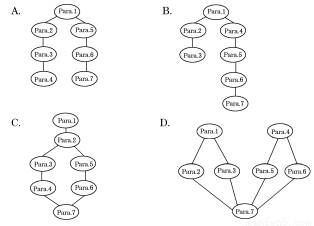
4.Which shows the correct structure of the text?


 出彩同步大试卷系列答案
Welcome to the Electronic Village to explore new ways of language teaching and learning.
Electronic Village Program (Thursday, June 18, 2015) | |
Nearpod ? 9:00 am to 10:00 am ? Room 501 Nearpod is a software program that creates a rich context (语境) for students to learn vocabulary. The presenter will show how to use it. | TEO ? 2:00 pm to 3:00 pm ? Room 502 Our students come from different backgrounds but have the same desire to learn on-line. The presenter will use examples from his first on-line class to explain how any teacher can begin teaching on-line with TEO. |
Kahoot ? 10:30 am to 11:30 am ? Room 601 Kahoot software can be used to create grammar tests which can be graded on a network. It can provide students with instant feedback (反馈), including reports about their strengths and weaknesses. | Prezi ? 3:30 pm to 4:20 pm ? Room 602 Uses of Prezi in listening and speaking courses draw students' attention to speaking more fluently. The presenter will show how students can use Prezi to confidently present on a variety of topics, including introducing family, friends, and hobbies. |
1.Nearpod can be used to ______.
A. offer grammar tests
B. teach listening on-line
C. help vocabulary learning
D. gain fluency in speaking
2.If you want to improve your speaking skills, you can go to____________.
A. Room 501 B. Room 502 C. Room 602 D. Room 601
3.A teacher who wants to learn on-line teaching is expected to arrive by ______.
A. 9:00 am B. 10:30 am C. 3:30 pm D. 2:00 pm