题目内容
【题目】假定英语课上老师要求同桌之间交换修改作文,请你修改你同学写的以下作文。文中共有10处语言错误,每句中最多有两处。错误涉及一个单词的增加、删除或修改。
增加:在缺词处加一个漏字符号(∧),并在其下面写出该加的词。
删除:把多余的词用斜线(\)划掉。
修改:在错的词下划一横线,并在该词下面写出修改后的词。
注意:1. 每处错误及其修改均仅限一词;
2. 只允许修改10处,多者(从第11处起)不计分。
A Frenchman was once visiting London. He wished to take a walk to see a city. But he was afraid he might get being lost because he knew no words of English. So before he left his hotel, he stopped on the first corner and carefully copied in his notebook the names of the street that he was staying. Then he walked on. At last, he got lost. In several hours he found a policeman. The Frenchman tried his best to explain the policeman that he didn't know the name of his hotel, however he knew the name of the street. He then showed the policeman that he copied in his notebook. It read: “Oneway street”.
【答案】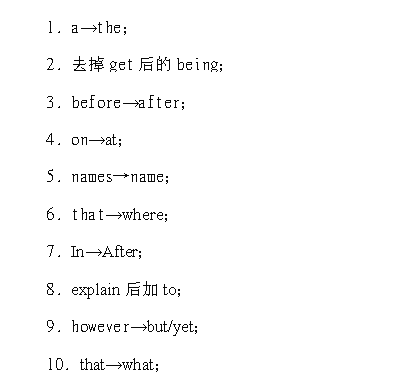
【解析】
本文是一篇记叙文。一个法国人到伦敦游玩,不懂英语,迷了路,他不知他住的旅店的名字,但他记下了旅店所在的街的名字,当他把记下的街名给警察看时,他的笔记本上记着“单行道”。看来,有时候懂外语还是很有必要的。
1. 考查冠词。该处的“city”指London为特指,故将a改为the。
2. 考查动词短语。“迷路/走丢”:get /be lost,故该处去掉being.
3. 考查连词。下文提到“他停在第一个拐角处,仔细地在他的笔记本上抄写下他住的那个街道的名字”因此可知,是在他离开旅馆之后,故将before改after。
4. 考查介词。in the corner:在里面的拐角处;在外面的拐角处,用at the corner。故将on改为at。
5. 考查名词的数。该处指的是他所暂住的这条街的名字,故用单数,故将names改为name。
6. 考查定语从句。分析句子可知, he was staying是定语从句,修饰the street,stay是不及物动词,关系词在从句中作地点状语,故将that改为where。
7. 考查介词。该处句意为:几个小时后,他找到了一个警察。In+时间段用在一般将来时中,after+时间段用一般过去时,故将In改为After。
8. 考查动词。“向某人解释某事”:explain to sb. that…,是固定用法,故应在explain后加to。
9. 考查连词。句意:法国人尽力向警察解释说,他不知道他的旅馆的名字,但他知道这条街的名字。该处上下文有转折关系,但该词后无逗号,故将however改成but/yet。
10. 考查宾语从句。分析句子结构可知,该宾语从句的连接词要在从句中做copied的宾语,指物,无范围,that引导宾语从句,无词义,不作成分。故将that改为what。

【题目】假如你是李华,你的英国笔友Peter对于中国粉丝给国外明星取昵称的行为非常感兴趣,比如说“卷福”、“霉霉”、“小李子”、“寡姐”等。请你给他写一封邮件,介绍一个你认为最喜欢的中文昵称。内容包括:1. 中文昵称的含义;2. 中英文名字在含义或发音等方面的关联;3. 粉丝起该昵称的原因。
注意:1. 该昵称可用中文或拼音表示;2. 邮件词数在80词左右。
|
|
|
|
Benedict Cumberbatch | Taylor Swift | Leonardo DiCaprio | Scarlett Johansson |
卷福 | 霉霉 | 小李子 | 寡姐 |




_____________________________________________________________________________________________________________________________________________________________________________________________________________________________________________________________________________________________________
【题目】
When you throw something in the trash, soon a garbage truck will come to take it away. Then where does it go? That depends on where you live. Different towns deal with trash in different ways. | |
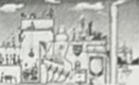
Recycling A recycling truck picks up paper, cardboard, metal, plastic and glass. These go to the recycling plant to be sorted and made into new things. |
|
Incinerator An incinerator is a huge stove that burns trash to make heat and electricity. The ash that’s left gets buried in a landfill. Trash ash can be poisonous, so it has to be stored carefully. But is takes up a lot less room than just plain trash. |
|
Compost Food waste might go to a composter. In a compost heap (堆肥堆), bacteria and worms break down dead plants and old food. They turn it in into good, rich oil. Some people keep compost heaps in their gardens. Big commercial composters handle waste from restaurants and farms. |
|
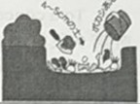
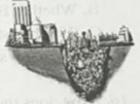
Landfills Some trash gets buried in landfills. A landfill starts as a big hole. Trucks dump trash. Big earth movers push it into place and crush it down. They cover the trash with dirt to keep scavengers (食腐动物) away. The bottom of a landfills is lined with a barrier to keep bad things from leaking into the ground. Pipes drain away liquid. When the landfill is full, it’s covered with earth. It might become a park or lawn. |
|
【1】What can we learn from the passage?
A.Recycling helps to generate energy.
B.Bacteria and worms helps handle food waste.
C.The landfill is used to drive scavengers away.
D.Trash ash is carefully handled to save room.
【2】What’s the purpose of the passage?
A.To inform us of trash treatment.
B.To appeal for trash classification.
C.To discuss solutions to trash pollution.
D.To raise awareness of the harm of trash.