题目内容

书面表达

作为一名高二学生,你或许经常跟你的父母就看电视问题闹矛盾。你的父母以学业繁重和影响视力等为由阻挠你看电视,而你又认为电视能满足你的兴趣爱好同时繁重的学业下也需要放松,最后你们之间相互妥协达成了一致意见。请你以该话题写一篇字数120左右的短文。

注意:1. 就双方的理由可以进行适当的扩充,协议自己想象。

2. 开头已写好,不计入总字数

I am a Senior 2 student. I often quarrel with my parents over whether I can watch TV after school. _______________________________________________________________

_______________________________________________________________________________
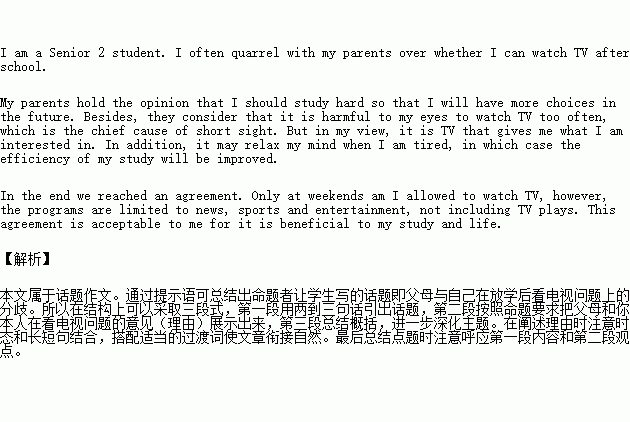
_______________________________________________________________________________

_______________________________________________________________________________

_______________________________________________________________________________

_______________________________________________________________________________

_______________________________________________________________________________

_______________________________________________________________________________

_______________________________________________________________________________

练习册系列答案
相关题目

阅读下列短文,从每题所给的四个选项A、B、C和D中,选出最佳选项。

The media provides us with the observations and experiences from which we build up our personal understanding of the world and how it works.Much of our view of reality is based on media messages.The media,to a great extent,gives us our sense of reality.

Freedom of the media carries with it certain responsibilities of honesty,fairness,accuracy and account-ability.The power of the media to create and destroy human values comes with great responsibility.

The media is powerful in the political system,having great influence on politics and on forming social change.The power is to decide who will communicate what to whom.Television can greatly influence the election of a national leader on the basis of his or her image.

Professional journalists do have a code of ethics(道德标准).Journalists make a judgment about what's safe and appropriate to report,which often involves difficult choices.German sociologist Max Weber distinguishes between“ethics of conviction”and“ethics of responsibility”.According to the latter(ethics of responsibility),journalists must take into account the foreseeable consequences of their reporting,and the impact it will have on society.The former,on the other hand,asks journalists to tell the truth,regardless of the consequences.According to Weber,both ideas of ethics should be considered.

Without doubt,information is power,and the big owners of the mass media are very powerful people.Television and radio stations,newspapers,magazines,and websites are,largely,owned and controlled by profit-making businesses.It is not strange that their ideas will get promoted at times.

It is my view that such power and responsibility should never be left in the hands of a few.I believe it is our responsibility as concerned citizens to make sure we are not merely passive viewers,readers or listeners.Together we can have a huge influence on the media by making our views known.

1.What's the first paragraph mainly about?

A.Responsibilities of the media.

B.Influence of the media.

C.History of the media.

D.Problems of the media.

2.We can learn from the third paragraph that ________.

A.the media is more interested in politics than other fields

B.forming social change is the main duty of the media

C.the great power of the media is controlled by political figures

D.the media can affect politics by forming political figures' images

3.Which of the following statements is TRUE according to the passage?

A.The mass media should be owned by the government.

B.The media industry has developed into a new age in recent years.

C.In most cases,journalists are more powerful than the owners of the media.

D.The media tends to promote the ideas of their owners sometimes.

阅读下面短文,从短文后各题所给的四个选项(A、B、C和D)中,选出可以填人空白处的最佳选项,并在答题卡上将该项涂黑。阅读下面短文,掌握其大意,然后从1--20各题所给的四个选项(A、B、C和D)中选出最佳的选项,并在答题纸上将该选项标号涂黑。

Some people are just born to be failures. That’s the way some adults look at _________ kids. Maybe you've heard the saying, “A bird with a _________ wing will never fly as high.” I'm sure that T. J. Ware was made to _________ this way almost every day. At high school, T. J. was the best-known troublemaker in his town. He was a silent boy, didn’t answer questions and often _________ .

I met T. J. for the first time at an activity aimed at getting students more involved in community charity. When I _________ , the community leaders _________ me that T.J. had the longest arrest(拘留) record in the history of town. Actually, I wasn’t the first to hear about T.J.’s darker side as the first words of _________ .

At the start of the activity, T. J. was just _________ outside the circle of students, against the back wall, with a(n) _________ look on his face. He didn’t readily join the discussion groups, and didn’t seem to have much to say. But gradually, the interactive games _________ him in. T. J. shared his great thoughts on _________ . The other students_________ his ideas and were impressed with his passion for helping those in need. _________ , they elected T. J. co-chairman of the group.

After the activity, T. J. started showing up at school and being active in class, which none of his teachers expected. More _________ , two weeks later, T. J. led a group of 70 students in a drive to collect _________. They collected a school _________ : 2,854 cans of food in just two hours, (the shortest time in the history of town) enough to take care of _________ families in the area for 75 days.

T. J. reminds us that a bird with a broken wing only needs _________. Once it has _________, it can fly higher than the rest. Now T. J. is _________ quite nicely as a chairman of a nationwide charity organization.

1.A. failed B. troublesome C. annoyed D. worried

2.A. single B. faulty C. burden D. broken

3.A. think B. walk C. feel D. struggle

4.A. fought B. drove C. challenged D. laughed

5.A. looked up B. stood up C. finished up D. turned up

6.A. warned B. suggested C. reminded D. reached

7.A. explanation B. communication C. introduction D. instruction

8.A. standing B. laughing C. hiding D. wandering

9.A. worried B. interested C. indifferent D. puzzled

10.A. allowed B. showed C. drew D. put

11.A. games B. concerns C. school D. charity

12.A. ignored B. welcomed C. doubted D. misunderstood

13.A. However B. Besides C. Anyway D. Therefore

14.A. importantly B. surprisingly C. luckily D. popularly

15.A. money B. rubbish C. cans D. food

16.A. restaurant B. record C. yard D. term

17.A. needy B. lonely C. friendly D. likely

18.A. persuading B. mending C. observing D. teaching

19.A. healed B. noticed C. appeared D. changed

20.A. behaving B. growing C. flying D. achieving

The kids in this village wear dirty, ragged clothes. They sleep beside cows and sheep in huts(小屋) made of sticks and mud. They have no school. Yet they all can chant the English alphabet(字母表), and some can make words.

The key to their success: 20 tablet computers(平板电脑) dropped off in their Ethiopian village in February by a U.S. group called One Laptop Per Child.

The goal is to find out whether kids using today’s new technology can teach themselves to read in places where no schools or teachers exist. The Massachusetts Institute of Technology researchers analyzing the project data say they’re already amazed. “What I think has already happened is that the kids have already learned more than they would have in one year of kindergarten,” said Matt Keller, who runs the Ethiopia program.

The fastest learner—and the first to turn on one of the tablets—is 8-year-old Kelbesa Negusse. The device’s camera was disabled to save memory, yet within weeks Kelbesa had figured out its workings and made the camera work. He called himself a lion, a marker of accomplishment in Ethiopia.

With his tablet, Kelbasa rearranged the letters HSROE into one of the many English animal names he knows. Then he spelled words on his own. “Seven months ago he didn’t know any English. That’s unbelievable,” said Keller.

The project aims to get kids to a stage called “deep reading,” where they can read to learn. It won’t be in Amharic, Ethiopia’s first language, but in English, which is widely seen as the ticket to higher paying jobs.

1.What can we infer from Keller’s words in Paragraph 3?

A. They need more time to analyze data.

B. More children are needed for the research.

C. He is confident about the future of the project.

D. The research should be carried out in kindergartens.

2.It amazed Keller that with the tablet Kelbesa could _______.

A. learn English words quickly

B. draw pictures of animals

C. write letters to researchers

D. make phone calls to his friends

3.How does the Ethiopia program benefit the kids in the village?

A. It trains teachers for them.

B. It contributes to their self-study.

C. It helps raise their living standards.

D. It provides funds for building schools.

4.What is the aim of the project?

A. To offer Ethiopians higher paying jobs.

B. To make Amharic widely used in the world.

C. To help Ethiopian kids read to learn in English.

D. To assist Ethiopians in learning their first language.

阅读理解。

The 2014 Nobel Prize in Literature went to the French novelist “for the art of memory” with which he has “uncovered the life?world of the occupation”.

Although the 69?year?old writer is a very popular literary figure in France, he is little known elsewhere.

So who is this Patrick Modiano, why does his memory have such an influence upon him, and what exactly has he uncovered?

Modiano was born in a suburb of Paris right after World War Ⅱ ended in Europe in July 1945.His father was a Jewish?Italian businessman who met his Belgian actress mother during the Nazi occupation of Paris.

As The New Yorker magazine put it, Europeans born in 1945 share a condition—They escaped the war, but “not the taint(污点) of the war”.

Modiano's life has been influenced by Nazi Germany's occupation during the war, and his family's connections to it.According to New York?based newspaper Forward, his father survived the war dishonorably.When Paris' Jews were brought together to be sent to concentration camps, the businessman did not join them but spent the time making money from deals with Nazis on the black market.

“The novelist has a duty to record the lives of the people who have disappeared, the people who were made to disappear,” French writer Clemence Boulouque, also an expert in Jewish studies, told The New Yorker magazine.

In his more than three dozen novels, Modiano has returned again and again to the same themes:Jewishness, the Nazi occupation, and loss of identity.His characters collect pieces of old evidence, handwriting, photographs, police files, and newspaper cuttings.

His most admired novel,Missing Person, is a good example.It's the story about a detective who has lost his memory.He tries to find out who he really is by following his own steps through history.

Although Modiano's win is a surprise outside France, people are celebrating in his home country.Modiano is the 15th French literature winner.After Le Clezio's 2008 win, it seemed unlikely that there would be another so soon.

1.The passage is mainly about ________.

A.a literary figure's personal affairs

B.a famous novelist's family background

C.a Nobel Prize winner and his literary achievement

D.European people's sufferings during World War Ⅱ

2.Which of the following statements about Patrick Modiano is TRUE according to the passage?

A.He is a survivor of World War Ⅱ.

B.He tried to find back his lost identity.

C.World War Ⅱ has an impact on his life.

D.He was world?famous before winning the Nobel Prize.

3.Modiano won the Nobel Prize because of ________.

A.his extraordinary character

B.his unique way of recording history

C.his characters' unusual experiences

D.his special connections to the war

4.It can be inferred from the passage that ________.

A.Modiano's parents were sent to the concentration camp

B.Modiano's winning the Prize was beyond expectation

C.Modiano's father had nothing to do with the Nazis

D.Clemence Boulouque is also of Jewish origin

违法和不良信息举报电话:027-86699610 举报邮箱:58377363@163.com

精英家教网