题目内容

【题目】

1The party then searched the whole cave __________________ but did not find anything except an empty tin trunk.

2It was one of the biggest buildings ___________________ and a lot of people from many countries came to see it.

3The Hubble telescope was ___________________ into space by NASA on April 20, 1990 at a cost of over a billion dollars.

4After reading an article __________________ ‘Cigarette Smoking and Your Health’ I lit a cigarette to calm my nerves.

5Heavy rain would not only ____________________ the soil but would cause serious floods as well.

6The tree was planted near the church fifty years ago, but it is only in recent years that it has gained an evil __________________.

7__________________ all that has been said, the tourists have been picking leaves and cutting their names on the tree-trunk.

8A policeman approached Jimmy and told him he ought to have gone along a side street as Jumbo was ____________________ the traffic.

9__________________ at her scornfully, he told her that the dress was sold.

10Then he had an idea and ____________________ the letters ‘SOS’ in the snow.

【答案】

1thoroughly

2of all time

3launched

4entitled

5wash away

6reputation

7In spite of

8holding up

9glancing at

10stamped out

【解析】选词填空题要先了解所给单词或短语的意思和词性,再根据句意写出所选词语的正确形式。

1thoroughly

考查副词。句意这群人彻底搜查了整个山洞,除了一个空的铁皮箱子,什么也没有找到。修饰动词searched用副词,指彻底搜查,故填thoroughly。

2of all time

考查固定短语。句意它一直以来是最大的建筑之一,许多国家的人都来参观它。表示一直,故填of all time。

3launched

考查动词。句意:哈勃望远镜于1990420日由美国宇航局发射升空,耗资10多亿美元。此处表示被发射”用过去分词。故填launched。

4entitled

考查过去分词句意:读了一篇题为《吸烟与健康》的文章后,我点燃了一支香烟,镇定神经。句中article和动词entitle是被动关系,此处是过去分词作定语,故填entitled。

5wash away

考查动词短语。句意:大雨不仅会冲走土壤,还会引起严重的洪水。此处表示冲走,情态动词would后用动词原形,故填wash away。

6reputation

考查名词。句意:这棵树是50年前栽在教堂附近的,但直到最近几年才得到了一个坏名声。前面有an evil修饰,故用名词。故填reputation。

7In spite of

考查介词短语。句意:尽管已经说了这么多,游客们还是在树干上摘树叶,把名字刻在上面。表示尽管”,故填In spite of。

8holding up

考查动词短语。句意:一个警察走过来告诉吉米,他应该沿着侧路走,因为庞然大物阻碍了交通。hold up“阻挡”,此处用进行时,故填holding up。

9glancing at

考查动词短语。句意:他轻蔑地瞥了一眼,告诉她那件衣服已经卖出去了。根据scornfully可知用glance at,与主语是主动关系,此处作状语用-ing形式,故填glancing at。

10stamped out

考查动词短语。句意:然后他想出了一个主意,在雪地上踩出了“SOS”这几个字母。根据句意可知是踩出,与所给时态一致,故填过去式stamped out。

练习册系列答案
相关题目

【题目】

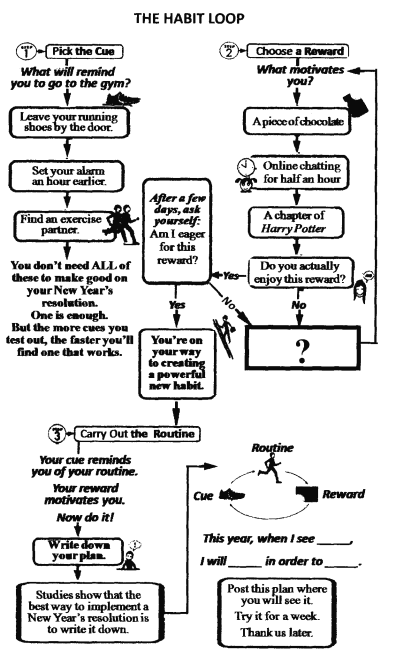
Let's say you want to hit the gym more regularly this year. How do you make that happen? Consider putting the habit loop to use.

Here's how it works:

A habit is a 3-step process. First, there's a cue, something that tells your brain to operate automatically. Then there's a routine. And finally, a reward, which helps your brain learn to desire the behavior. It's what you can use to createor break habits of your own.

Here's how to apply it:

Choose a cue, like leaving your running shoes by the door, then pick a rewardsay, a piece of chocolate when you get home from the gym. That way, the cue and the reward become interconnected. Finally, when you see the shoes, your brain will start longing for the reward, which will make it easier to work out day after day. The best part? In a couple of weeks, you won't need the chocolate at all. Your brain will come to see the workout itself as the reward. Which is the whole point, right?

【1】Which of the following best fits in the box with a “?” in THE HABIT LOOP?

A. Pick a new cue.

B. Form a new habit.

C. Choose a new reward.

D. Design a new resolution.

2】What's the purpose of putting the habit loop to use?

A. To test out different kinds of cues.

B. To do something as a habit even without rewards.

C. To work out the best New Year's resolution.

D. To motivate yourself with satisfactory rewards

3“This year when I see the Harry Potter poster, I will read 30 pages of an English novel or an English newspaper in order to watch TV for half an hour." What is the cue in this resolution?

A. The Harry Potter poster.

B. Reading 30 pages of an English novel.

C. An English newspaper.

D. Watching TV for half an hour.

【题目】阅读理解。

阅读下列短文,从每题所给的四个选项 (A 、B 、C D )中,选出最佳选项,并在题卡上将该项涂黑。

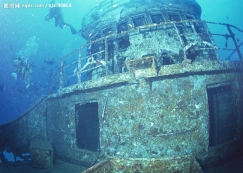
The pillage (掠夺) and destruction of ancient shipwrecks and sunken archaeological sites by treasure hunters seeking gold and other valuables may be illegal under the terms of an international treaty under discussion by UNESCOs 188 Member States.

"Protecting our underwater heritage is extremely important and increasingly urgent as no site or shipwreck is now out of bounds for treasure hunters. New technologies have made deep-water wrecks easily accessible and these technologies are getting cheaper," warns Lyndel Prott.

According to estimates by commercial salvors (寻宝者), there are some three million undiscovered shipwrecks scattered across the worlds oceans. Even the figures for the known wrecks are impressive. The Northern Shipwrecks Database for example contains 65,000 ship loss records for North America alone from 1500 AD to the present. The Dictionary of Disasters at Sea by Charles Hocking (1969) lists 12,542 sailing ships and war vessels lost between 1824 and 1962.

Then there are sunken cities such as the trading town and pirate stronghold(海盗堡垒) of Port Royal in Jamaica, which disappeared beneath the waves after an earthquake in 1692. Or the remnants of ancient civilisations, such as the Lighthouse of Alexandria in Egypt, and the Neolithic villages being discovered under the Black Sea, which some believe could help explain Noah’s great flood.

These treasures of cultural heritage are under serious threat. Technology now allows extraordinary access to the ocean depths for deermined and well-financed treasure hunters. And the potential rewards are huge. In 1985, American salvor Mel Fisher discovered the wreck of the Seora de Atocha, a Spanish ship that sank off the Florida Keys in 1622 with her cargo of gold, silver and jewellery worth an estimated US $400 million.

An archaeologist can spend ten years or more studying a ship, conserving its objects and publishing its findings. We gain an enormous amount of information and knowledge from this work. With treasure hunters, all of this is lost. This is tragic, for humanity as a whole.

【1】Why is it important and urgent to protect our underwater heritage?

A. Underwater heritage is easily accessible to treasure hunters.

B. Underwater heritage is out of reach of archaeologists.

C. New technology makes protection of underwater heritage easier.

D. There is no law to protect underwater heritage.

【2】What is the third paragraph mainly about?

A. Shipwrecks discovered by commercial salvors.

B. The main cause of shipwrecks.

C. The history of sunken ships.

D. The figures of shipwrecks around the world.

【3】What happened to Port Royal in 1692?

A. It was washed away by flood.

B. It was beneath the waves after an earthquake.

C. It was discovered under the Black Sea.

D. It was rebuilt by Noah.

【4】Why is Mel Fisher mentioned in the fifth paragraph?

A. He risked his life in treasure hunting.

B. He was one of the most successful commercial salvors.

C. He made a great discovery of shipwrecks.

D. He had no trouble in finding a shipwreck.

【题目】Want to improve your math skills without working hard? Simply zap (击打) the brain with a weak current of electricity and then, all your problems will be solved! At least that's the claim being made by a team of British scientists from London's Oxford University.

The main aim of the experiment, conducted on a group of student volunteers from Oxford University and University College London, was to test if parts of the brain could be shocked into getting it to work better with numbers.

To test this, 15 students, divided into three groups, were asked to solve the same two mathematical problems every day for a week. The problems, which involved identifying the larger of two numbers and plotting one on a number line, were made a little more challenging by replacing the numbers 19 with symbols.

However, before starting the test, two of the groups were subjected to a 20minute session of a light electric current to the parietal lobe, which the scientists believe is the brain's number cruncher (能迅速运算者). For the first group the current flow was passed right to left, while for the second it was transmitted left to right. The third group received no help at all.

The group that got zapped right to left seemed to show an amazing improvement in their math skills. However, the ones that got zapped left to right were reduced to the level of almost sixyear olds! The results for the people who got no help were somewhere in between.

While scientists are not sure why the direction of the current would make such a difference, they believe that zapping it from the right side, seemed to turn up the activity of the brain cells to math, while going the other way turned or closed them down. Luckily, the impact is expected to last for only six months!

While this is great news, do not fire your math tutor yet. That's because the research, no matter how successful, is not being done to aid lazy students, but to help people who suffer from dyscalculia (计算障碍), a disease which makes people unable to cope with simple daytoday numerical issues, like counting change or figuring out their expenses.

1In which time order was the experiment carried out?

a.Divide the students into groups.

b.Test the students with problems.

c.Give some students some electric zapping.

A. a,b,c B. a,c,b

C. b,a,c D. c,a,b

2From the passage, we can infer that ________.

A. the direction of zapping the brain is very important

B. the impact of zapping the brain will last forever

C. scientists don't know how to zap the brain correctly

D. people with dyscalculia can't recognize numbers

3What is the aim of the experiment?

A. To help students to improve their math grades.

B. To test which part of the brain controls calculation.

C. To help people who suffer from a certain disability.

D. To study whether a light electric current will damage students' brain.

4What would be the best title for the passage?

A. Dyscalculia is no longer a problem

B. A good way to improve your math skills

C. Benefit from zapping the brain

D. Improve math skills by zapping the brain

违法和不良信息举报电话:027-86699610 举报邮箱:58377363@163.com

精英家教网