题目内容
Over half of those ________ said they rarely took any exercise.
to question
questioned
questioning
to be questioned
解析:
|
句意:被询问的人中有一半以上说他们很少锻炼身体。questioned为过去分词作后置定语,表示被动。D项表示将来。 |

 口算心算速算应用题系列答案
 同步拓展阅读系列答案
My grandparents were married for over half a century, and played their own special game from the time they had met each other. The goal of their game was to write the word "shmily" in a 31 place for the other to find. They took turns leaving "shmily" around the house, and as soon as one of them 32 it, it was their turn to hide it once more.
There was no 33 to the places where "shmily" would appear. Sometimes, "Shmily" was written in the 34 left on the mirror after a hot shower, where it would reappear bath after bath. 35 , my grandmother even unrolled an entire roll of toilet paper to 36 "shmily" on the very last sheet.
It took me a long time before I was able to fully 37 my grandparents' game. It was 38 their funny little game; it was a way of life. Grandma and Grandpa held hands every chance they could. They 39 kisses as they ran into each other in their tiny kitchen. Before every meal they bowed their heads and gave their 40 : a wonderful family, good fortune, and 41 .
But there was a 42 cloud in my grandparents' life: my grandmother had breast cancer, which had first appeared ten years earlier. As always, Grandpa was with her every
43 of the way. He comforted her in their yellow room, painted that way 44____ she could always be surrounded by sunshine, even when she was too 45 to go outside. Then one day, what we all 46 finally happened. Grandma was gone.
"Shmily." It was written in yellow on the pink ribbons of my grandmother's funeral bouquet. As the crowd 47 and the last mourners (哀悼者) turned to leave, my aunts, uncles, cousins and other family members 48 and gathered around Grandma 49 . Grandpa stepped up to my grand-mother's casket and, 50 with sorrow, he began to sing to her. Through his tears and grief, the song came, a deep and throaty lullaby (摇篮曲).
SHMILY: See how much I love you.
| 【小题1】 |
| ||||
| 【小题2】 |
| ||||
| 【小题3】 |
| ||||
| 【小题4】 |
| ||||
| 【小题5】 |
| ||||
| 【小题6】 |
| ||||
| 【小题7】 |
| ||||
| 【小题8】 |
| ||||
| 【小题9】 |
| ||||
| 【小题10】 |
| ||||
| 【小题11】 |
| ||||
| 【小题12】 |
| ||||
| 【小题13】 |
| ||||
| 【小题14】 |
| ||||
| 【小题15】 |
| ||||
| 【小题16】 |
| ||||
| 【小题17】 |
| ||||
| 【小题18】 |
| ||||
| 【小题19】 |
| ||||
| 【小题20】 |
|
Many Americans are turning to Japan, they think, a country of high academic achievement and economic success, for possible answers. However, the answers provided by Japanese preschools are not the ones Americans expected to find. In most Japanese preschools, surprisingly little emphasis is put on academic instruction. In one survey, 300 Japanese and 210 American preschool teachers, child development specialists, and parents were asked about various aspects of early childhood education. Only 2 percent of the Japanese respondents (答问卷者) listed “to give children a good start academically” as one of their top three reasons for a society to have preschools. In contrast, over half the American respondents chose this as one of their top three choices. To prepare children for successful careers in first grade and beyond, Japanese preschools do not teach reading, writing, and mathematics, but rather skills such as determination, concentration, and the ability to work as a member of a group. The huge majority of young Japanese children are taught to read at home by their parents.
Like in America, there is diversity (多样性) in Japanese early childhood education. Some Japanese kindergartens have specific aims, such as early musical training or potential development. In large cities, some kindergartens are attached to universities that have elementary and secondary schools. Some Japanese parents believe that if their young children attend a university-based program, it will increase the children’s chances of eventually being admitted to top-rated(一流的) schools and universities. Several more progressive programs have introduced free play as a way out for the heavy intellectualizing (智能化) in some Japanese kindergartens.
【小题1】We learn from the first paragraph that many Americans believe .
| A.Japanese parents are more involved in preschool education than American parents |
| B.Japan’s economic success is a result of its scientific achievements |
| C.Japanese preschool education emphasizes academic instruction |
| D.Japan’s higher education is superior to theirs |
| A.preparing children academically | B.developing children’s artistic interests |
| C.developing children’s potential | D.shaping children’s character |
| A.They can do better in their future studies. |
| B.They can make more group experience grow there. |
| C.They can be self-centered when they grow up. |
| D.They can have better chances of getting a first-rate education. |
| A.broaden children’s knowledge | B.train children’s creativity |
| C.lighten children’s study load | D.enrich children’s experience |
A growing number of consumers, especially young people , are a dopting more Western habits when it comes to spending money—by favoring credit cards over savings.
A survey of 11,500 people in 18 cities by The Nielson Company found the credit card market had witnessed a major change in recent years.
“Today’s consumer is clearly not interested in saving for a rainy day, as may have been the case in the past,” Bega Ng, director of financial services research with the company said. “Consumers have been adopting Western habits and attitudes in almost every way—including saving and spending habits. Consumers in their 20s spend tomorrow’s cash to fund today’s needs.”
The report found consumers aged 18 to 24 were the most eager credit card users.
Although the report did not give the amounts credit card users in each of the 18 cities spent, it mentioned the example of Xiamen, a coastal city in Fujian Province, where consumers put an average of 50 percent of their monthly incomes into their credit card accounts to indulge(沉湎于) in cashless shopping.
Included in the survey for the first time, Xiamen is reported to have a fast growing penetration rate(渗透率) for credit cards, with four out of ten consumers now owning at least one card. With more than half of cardholders in Xiamen owning two or more cards, it is catching up with key “tier one” cities, the report said. The report did not make known the figures in major cities such as Beijing, Shanghai and Guangzhou.
Last year, the same Nielson survey showed Shanghai had the biggest population of credit card holders, with citizens owning 1.8 credit cards on average. Half of them use credit cards at least once a week, the survey said.
Yunfei, 30, from Beijing, said she spent at least 2,000 yuan a month by credit cards, most of which went on daily necessities and dining out.
【小题1】Which of the following best shows the young urbanites’ idea of consumption?
| A.Using credit cards in every way. |
| B.Spending tomorrow’s cash for today’s needs. |
| C.Owning more cards for cashless shopping. |
| D.Saving money for future use. |
| A.Forty percent of the consumers own at least one card. |
| B.Credit card users use up most of their monthly income. |
| C.The number of credit card users is larger than that in Guangzhou. |
| D.Over half of the consumers use two or more cards. |
| A.Xiamen. | B.Beijing. | C.Shanghai. | D.Guangzhou. |
| A.Most credit card users are young people aged 18 to 24. |
| B.Western habits have a big influence on the Chinese people. |
| C.The number of credit card users is growing rapidly in Chinese cities. |
| D.Chinese consumers are no more interested in saving money. |
Hungry for the brightest students, many of the country’s stronger universities are actively discounting tuition (学费).And it’s the high achievers, rather than the needy students, who are getting a good chunk of the money.The practice is remarkably widespread, reaching almost all but the 30 or so Ivy and other top colleges that forbid good grades-based financial aid.Schools are also becoming more aggressive in raising their discounts.At the DePauw University Website, enter an SAT or ACT score, grade point average and class rank, and a computer program immediately tells you what kind of "award".Only "the real unlucky" pay full price any more.
About 76% of first-year students got some form of discount this year at 331 private schools.Average award per student: $7,000.At small schools with tuition under about $20,000, the average discount is even higher, with some schools returning over half their tuition.
Carnegie Mellon even tells students it will "negotiate(讨价还价)" and perhaps match financial-aid packages if kids are offered bigger awards at other schools.Much as banks and insurers offer special rates to their best customers, schools are giving the biggest breaks to their top students.Public four-year colleges, too, are offering discounts.
The flip side of big discounts is that less money is available to improve academic programs and keep school infrastructure (基础设施) up to date.Universities that have sharply increased their tuition discount rates have seen graduation rates fall, and that’s true even among highly selective schools.They get the students in the door, but don’t have the services to keep them.
【小题1】From the first paragraph, we can judge that _______.
| A.all the universities don’t offer tuition discounts. |
| B.Ivy and other top colleges offer financial aid to the high achievers |
| C.the needy students get more money from the universities |
| D.the graduation rates of the students from highly selected schools fall |
| A.advantage | B.disadvantage | C.bad practice | D.good function |
| A.The brightest students are not at all hungry for stronger universities. |
| B.About 76% of first-year students got an award of $ 20,000 per year. |
| C.Public colleges never offer discounts to the students. |
| D.Colleges should concentrate more on the services to keep the students |
| A.the great benefit of offering lower tuition |
| B.college tuition discounts in popularity |
| C.the top students in need of tuition discounts |
| D.reducing graduation rates due to big discounts |
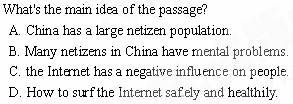
A latest national survey has found that over half of China's netizens are suffering from various mental problems although some 62 percent of them claim at the same time that they are happy on the whole anyway.
This is the result of China's first White Paper on Netizens' Health Conditions issued on Wednesday by 39.net, China's largest authoritative website on health sciences. It is the first most comprehensive health survey on netizens' health situation ever conducted in China in ten years' time. The white paper came out after two months of online and offline research that involved over 150 thousand netizens, covering topics and questions on health knowledge, mental situation, sense of health, and living habits.
According to the white paper, more than 70 percent of China's netizens say they are suffering from mental problems such as bad memory, anxiety, depression, and a lack of confidence. And a similar 72 percent of them also say they are often suffering from diseases like insomnia, dizziness, joint degeneration and achings. Meanwhile, another 53 percent of netizens believe that white collar employees who have bigger work pressures are more likely to catch mental problems.
The white paper adds, doing almost no sports and spending long time surfing online lead to the above mentioned health problems among netizens. Only 9 percent of netizens take up sports on weekends while over 40 percent stay home, surfing. And only 16 percent netizens can assure more than eight hours' sleeping daily.
At present, China has a netizen population of 162 million, with a monthly consumption of 186 yuan, or about 25 dollars, on Internet surfing.
【小题1】The national survey on netizens' health situation ________.
| A.was conducted by sohu.com | B.is conducted every year |
| C.was carried out online and offline | D.covered about half a million netizens |
| A.White clothes. | B.White offices. | C.Office workers. | D.White people. |
| A.doing no sports | B.spending long time online |
| C.heavy work pressures | D.shopping online |