题目内容
任务型阅读
请认真阅读下列短文,并根据所读内容在文章后表格中的空格里填入一个最恰当的单词。注意:每个空格只填1个单词。
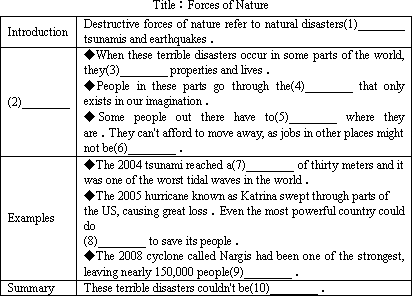
There are many destructive(破坏性的)forces when it comes to nature, which have destroyed whole cities and killed many people.They're really terrible, but they occur somewhat often, and this is why you see so many charities these days which focus their efforts on helping people who have been affected by natural disasters.
While the world is a very beautiful place to live in, there will always be parts of the world where natural disasters happen more often than in other places, where properties(财产)and lives are destroyed.Only the people who live in the country where tsunamis and earthquakes as well as other disasters occur experience these, and we can only imagine the suffering that they go through.
For some people out there, the world is cruel, but they have no choice but to stay where they are.A lot of the time people simply cannot afford to move away, as they might not be able to get a job when they leave.
In 2004, there was a tsunami in the Indian Ocean.A tsunami is a large wave that towers hundreds of feet into the air, and covers whole areas when it comes crashing(冲进)down on to dry land.This particular tsunami was caused by an earthquake that happened in the middle of the sea, shooting the water away from the ground and towards dry land.This tsunami actually reached thirty meters in height, and was one of the worst waves the world has ever seen.Over 200,000 people were hurt in the disaster.
In 2005, we also saw a hurricane happened in the United States.This hurricane was known as hurricane Katrina, and is perhaps the worst in the history of the world.It happened in 2005 and destroyed millions of properties in the area.It also took the lives of nearly 2,000 American people.It was known that for ten days, the wind swept through the area, meaning the most powerful country in the world became helpless in their attempts to save the people who were affected by the hurricane.
Finally, in 2008 we saw yet another natural disaster.This time it was a cyclone(旋风), which is similar to a hurricane but happens in a circular motion(圆周运动).This cyclone Nargis had been one of the strongest to have ever occurred, causing the death of nearly 150,000 people.All of these were terrible disasters that were unavoidable.
解析:
|
1.like 2.Consequences 3.destroy 4.suffering 5.stay/remain 6.available/found 7.height 8.nothing 9.dead 10.avoided/prevented |

 天天向上一本好卷系列答案
 小学生10分钟应用题系列答案

Task-based reading 任务型阅读
请认真阅读下面短文,并根据所读内容在文章后图表中的空格里填入最恰当的单词。注意:每空不超过1个单词。
For centuries people dreamed of going into space. This dream began to seem possible when high-flying rockets were built in the early 1900s.
In 1903 a Russian teacher named Konstantin Tsiolkovsky figured out how to use rockets for space travel. His plan was the first one in rocket science to use correct scientific calculation. About 30 years later, a U.S. scientist named Robert Goddard built the first rockets that could reach high altitudes. During World War II, German scientists built large rockets that could travel very far and carry dangerous explosives. After the war, scientists from Germany went to the United States and the Soviet Union to help those countries build space rockets.
These two countries were soon racing to get to space first. Each of these countries wanted to prove that it was stronger and more advanced than the other one. Both countries also had powerful bombs. People in the United States were worried when the Soviets were first to launch a space satellite, which was called Sputnik. The Soviets were also first to send a person into space. Yury Gagarin orbited the earth in the Vostok I spaceship in 1961.
The US government set a goal for its space program to be the first country to put a person on the Moon. The U.S. space program built a series of Apollo spaceship. These vehicles were powered by huge Saturn 5 rockets. In 1969 Apollo II took three men to the moon successfully. Nell Armstrong became the first person to walk on the Moon.
The Soviets may have lost the race to fly people to the Moon, but they built the first space station in 1971. The United States also built a space station. The space stations allowed people to live and work in space. Then the Soviet Union and the United States cooperated to hook two spaceships together in space. This action ended the "space race". Today a much larger space station, built by several countries together, orbits Earth.
Another new way to go to space is by space shuttle. A space shuttle, first made in the United States in 1981, looks like an airplane. Astronauts who fly spaceships have used shuttles to help put satellites into space.
| History of space travel | ||
| Time | Events | Information concerned |
| Early 1900s | High-flying rockets were built. | It made the ancient dream of going to space possible to come 66) ▲ |
| 1903 | Konstantin Tsiolkovsky (67) ▲ out a way to use rockets for space travel. | He planned to put correct scientific calculation to use in rocket science. |
| Around (68) ▲ | Robert Goddard built new rockets. | The rockets could fly very (69) ▲ in the sky. |
| During and after World War II | German scientists built large rockets that could travel very far and carry dangerous explosives. | Germany was ahead of all the other countries in building space rockets and later it (70) ▲ the Soviet Union and the United States |
| The Soviet Union and the United States competed to get to space first. | The Soviet Union became the (71) ▲ of the competition when it launched the first satellite and sent the first astronaut into space. | |
| 1969 | The United States was (72) ▲ in putting a person on the moon. | In one way, it (73) ▲ the Soviet Union by becoming the first country to fly people to the moon. |
| 1970s | The Soviets built the first space station and was soon followed by Americans. And they finally ended the "space race" by (74) ▲ | Astronauts can live and work in space stations. |
| 1980s-- | Space shuttles are used as new vehicles for space (75) ▲ . | Shuttles are also used to help put satellites into space. |
Task-based reading 任务型阅读
请认真阅读下面短文,并根据所读内容在文章后图表中的空格里填入最恰当的单词。注意:每空不超过1个单词。
For centuries people dreamed of going into space. This dream began to seem possible when high-flying rockets were built in the early 1900s.
In 1903 a Russian teacher named Konstantin Tsiolkovsky figured out how to use rockets for space travel. His plan was the first one in rocket science to use correct scientific calculation. About 30 years later, a U.S. scientist named Robert Goddard built the first rockets that could reach high altitudes. During World War II, German scientists built large rockets that could travel very far and carry dangerous explosives. After the war, scientists from Germany went to the United States and the Soviet Union to help those countries build space rockets.
These two countries were soon racing to get to space first. Each of these countries wanted to prove that it was stronger and more advanced than the other one. Both countries also had powerful bombs. People in the United States were worried when the Soviets were first to launch a space satellite, which was called Sputnik. The Soviets were also first to send a person into space. Yury Gagarin orbited the earth in the Vostok I spaceship in 1961.
The US government set a goal for its space program to be the first country to put a person on the Moon. The U.S. space program built a series of Apollo spaceship. These vehicles were powered by huge Saturn 5 rockets. In 1969 Apollo II took three men to the moon successfully. Nell Armstrong became the first person to walk on the Moon.
The Soviets may have lost the race to fly people to the Moon, but they built the first space station in 1971. The United States also built a space station. The space stations allowed people to live and work in space. Then the Soviet Union and the United States cooperated to hook two spaceships together in space. This action ended the "space race". Today a much larger space station, built by several countries together, orbits Earth.
Another new way to go to space is by space shuttle. A space shuttle, first made in the United States in 1981, looks like an airplane. Astronauts who fly spaceships have used shuttles to help put satellites into space.
|
History of space travel |
||
|
Time |
Events |
Information concerned |
|
Early 1900s |
High-flying rockets were built. |
It made the ancient dream of going to space possible to come 66) ▲ |
|
1903 |
Konstantin Tsiolkovsky (67) ▲ out a way to use rockets for space travel. |
He planned to put correct scientific calculation to use in rocket science. |
|
Around (68) ▲ |
Robert Goddard built new rockets. |
The rockets could fly very (69) ▲ in the sky. |
|
During and after World War II |
German scientists built large rockets that could travel very far and carry dangerous explosives. |
Germany was ahead of all the other countries in building space rockets and later it (70) ▲ the Soviet Union and the United States |
|
|
The Soviet Union and the United States competed to get to space first. |
The Soviet Union became the (71) ▲ of the competition when it launched the first satellite and sent the first astronaut into space. |
|
1969 |
The United States was (72) ▲ in putting a person on the moon. |
In one way, it (73) ▲ the Soviet Union by becoming the first country to fly people to the moon. |
|
1970s |
The Soviets built the first space station and was soon followed by Americans. And they finally ended the "space race" by (74) ▲ |
Astronauts can live and work in space stations. |
|
1980s-- |
Space shuttles are used as new vehicles for space (75) ▲ . |
Shuttles are also used to help put satellites into space. |
任务型阅读
请认真阅读下列短文,并根据所读内容在文章后表格中的空格里填入一个最恰当的单词。
注意:请将答案写在答卷上相应题号的横线上。每个空格只填1个单词。
Cross-Cultural Solutions (CCS) is a non-profit organization founded in 1995, widely known as the leading organization in the field of international volunteering, with more than 4,000 volunteers each year. CCS has a worldwide staff of more than 300 people, and operates in 12 countries, with administrative offices also located in the United States, the United Kingdom, Canada, and Australia. It offers volunteer programmes in 12 countries in Africa, Asia, Eastern Europe and Latin America.
Cross-Cultural Solutions’ volunteer programmes in China are located in Xi’an, the crossroads of Western and Eastern China, and the starting point of the Silk Road. Culturally, Xi’an is a mixture of the ancient and modern worlds. Home to the famous terracotta army, Xi’an was once the imperial capital of China. The city’s ancient history is embodied by the huge stone walls that surround the city centre, originally intended to protect the city from invasion. In the modern world, Xi’an is the largest capital city in Central and Western China. Today, with a population of approximately eight million, this modern city still reflects its rich history and culture.
China’s diverse population is well represented in Xi’an’s Han and other minorities. Volunteering in Xi’an will provide you with opportunities to connect with individuals from a variety of backgrounds, exposing you to the wide scope of Chinese culture, one of the largest and most ancient cultures in the world.
Through our cultural and learning activities in China, you will see the work of local artists, visit the site of the famous ancient terracotta army, participate in weekly Chinese classes, and engage in lively discussions on Chinese culture and society. Activities may also include cooking classes or visits from experts in the practice of traditional Chinese medicine and a local painter skilled in the unique arts of Chinese painting and calligraphy(书法). Guest speakers may also cover topics such as Chinese folklore and traditional Chinese music. Many volunteers choose to participate in regular visits to local universities to meet with students interested in English conversation and cultural exchange.
CCS offers the following programmes in Xi’an, China:
t Volunteer Abroad---- two to twelve weeks
t Intern Abroad---- three to four weeks
t Insight Abroad---- one week
| About Cross-Cultural Solutions | ||||
| l Founded in 1995, it is a (71)_______ in the field of international volunteering. l It operates and offers volunteer programmes in 12 countries. | ||||
| About Cross-Cultural Solutions’ volunteer programmes in Xi’an, China | ||||
| (72)________ | Xi’an | Past | l It was where the Silk Road (73) _______. l It used to be the imperial capital of China. | |
| Present | It has a (74)________ of about eight million, including Han and other minorities. | |||
| Conclusion | It is a city (75)_______ in history and culture. | |||
| (76) ________ | l Seeing local artists’ work l Visiting the famous terracotta army l Having Chinese classes (77) ________ a week l Discussing Chinese culture and society l Being visited by a local painter and experts in traditional Chinese medicine l Listening to (78)________about Chinese folklore and traditional Chinese music l Visiting local universities and meeting students who take interest in English conversation and cultural exchange | |||
| Benefits | Volunteers can connect with individuals from various (79)________ and understand many different aspects of Chinese culture. | |||
| (80)________of programmes | l Volunteer Abroad, which lasts two to twelve weeks l Intern Abroad, which lasts three to four weeks l Insight Abroad, which lasts one week | |||