题目内容

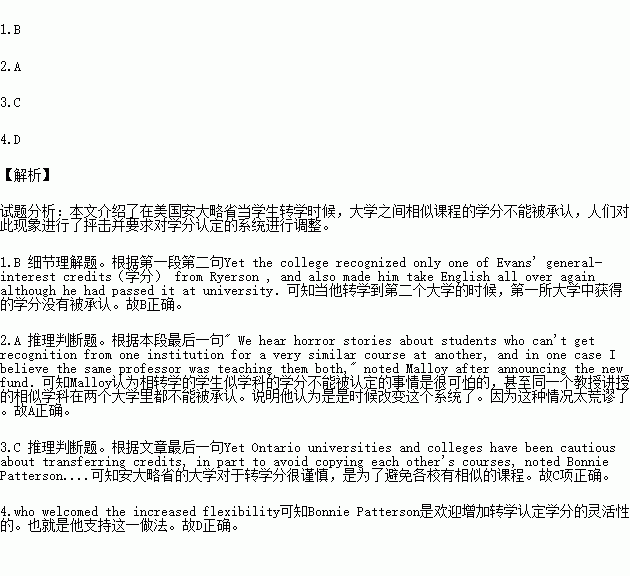
Greg Evans started to study film at Ryerson University, but had a change of heart and switched to social work at George Brown College in second year.Yet the college recognized only one of Evans' general-interest credits(学分) from Ryerson , and also made him take English all over again although he had passed it at university.

“So I spent time and money taking a course I had already taken before”, complained Evans."The system really needs to change." Evans was part of a chorus of Ontario students on Monday cheering a new $ 73.7 million five-year plan to help students switch from college to university, and from university to college.

After years' of urging from students, the Ontario government set up a new Credit Transfer Innovation loud to help students move back and forth between the more hands-on courses of community college to the often broader academic focus of a university degree." We hear horror stories about students who can't get recognition from one institution for a very similar course at another, and in one case I believe the same professor was teaching them both," noted Malloy after announcing the new fund.

Individual colleges and universities have decided on nearly 500 joint deals to honor each other's credits in certain courses.Each school is required to set targets for more credit-transfer agreements, and link these increases to provincial funding.

More than 4,000 college graduates transfer (转换) to university in Ontario every year twice as many as eight years ago, noted Justin Fox, president of the College Student Alliance.Yet Ontario universities and colleges have been cautious about transferring credits, in part to avoid copying each other's courses, noted Bonnie Patterson, president of the Council of Ontario Universities ,who welcomed the increased flexibility.

1.What happened when Greg Evans switched to social work at George Brown College?

A. He was considered to be unqualified for social work.

B. His previous credits were not all recognized.

C. He wasn't able to get enough credits.

D. His English didn't reach the required standard.

2.According to Paragraph 3, Malloy believes _____________

A. it is time that the system was changed

B. the same professor can't teach in different schools

C. students should focus on their chosen courses

D. the students' stories are horrible

3.Ontario universities and colleges have been cautious about transferring credits partly to _____________.

A. avoid accepting unqualified students

B. keep their similar courses

C. prevent courses becoming similar

D. attract famous professors

4.What attitude does Bonnie Patterson have towards the transferring system?

A. He is strongly against it

B.He is very doubtful about it

C. He thinks it is too flexible

D.He supports it for its flexibility
练习册系列答案
相关题目

Barack Obama was born on August 4, 1961 in Honolulu, Hawaii. His father came to America from Kenya, which is a country in Africa. His parents, Ann and Barack, met when they were students at the University of Hawaii. Since Barack had the same name as his father, young Barack went by the nickname “Barry”.

In 1979, after he finished high school, Barry went to Occidental College in Los Angeles, California. There, he started to learn about his African roots and decided to use his African name, Barack. After two years in L.A., he went to Columbia University in New York City to study politics.

After college, he moved to Chicago, Illinois, where he worked to help poor people in his city. He traveled to Africa to meet his grandmother and cousins for the first time. He went back many times over the years to visit with his family and learn about where he came from. At work, he met a lawyer named Michelle Robinson. They worked together in a big law firm. Then he left Chicago to go to Harvard Law School in Cambridge, Massachusetts. He did very well in law school.

After he was done with school, Barack moved back to Chicago and in 1992 he married Michelle. He worked as a lawyer, devoted to helping poor people for free who had been treated unfairly. He worked hard to get the people he helped to vote(投票).

He made many people believe that their votes were important, and helped them feel like they could make a difference.

1. Barack Obama’s father was probably born in _________.

A. Hawaii. B. California. C. Illinois. D. Kenya.

2.Which of the following is the right order according to the text?

①Getting married to Michelle.

②Travelling to Africa to meet his grandmother.

③Going to Harvard Law School.

④Going to Columbia University.

⑤Working in a big law firm.

A. ④②⑤③① B. ④③②⑤① C. ③④①⑤② D. ②①⑤④③

3. How did Obama get people to vote?

A. By cheating them to do so.

B. By making a difference to people.

C. By showing them the importance of their votes.

D. By helping poor people who treat others unfairly

4.According to the text, which of the following words can best describe Barack Obama?

A. Humorous B. Polite C. Brave D. Kind-hearted

In an ideal world,people would not test medicines on animals. Such experiments are stressful and sometimes painful for animals,and expensive and time?consuming for people. Yet animal experimentation is still needed to help bridge vast gaps in medical knowledge. That is why there are some 50 to 100 million animals used in research around the world each year.

Europe,on the whole,has the world’s most restrictive(严格的) laws on animal experiments. Even so,its scientists use some 12 million animals a year,most of them mice and rats,for medical research. Official statistics show that just 1.1 million animals are used in research in America each year. But that is misleading. The American authorities do not think mice and rats are worth counting and,as these are the most common laboratory animals,the true figure is much higher. Japan and China have even less comprehensive(全面的) data than America.

Now Europe is reforming the rules governing animal experiments by restricting the number of animals used in labs. Alternatives to animal testing,such as using human tissue or computer models,are now strongly recommended. In addition,sharing all research results freely should help to reduce the number of animals for scientific use. At present,scientists often share only the results of successful experiments. If their findings do not fit the hypothesis(假设) being tested,the work never sees the light of day. This practice means wasting time,money,and animals’ lives in endlessly repeating the failed experiments.

Animal experimentation has taught humanity a great deal and saved countless lives. It needs to continue,even if that means animals sometimes suffer. Europe’s new measures should eventually both reduce the number of animals used in experiments and improve the way in which scientific research is conducted.

1.What is the main idea of this passage?

A. The success of animal experiments should be ensured.

B. A ban on the use of animals in the lab should be enforced.

C. Greater efforts need to be taken to reduce the number of lab animals.

D. Scientists should be required to share their research results with each other.

2.Which of the following statements is true about animals used in the lab?

A. America uses only about 1.1 million lab animals per year.

B. Europe does not use mice and rats as lab animals at all.

C. Britain does not use as many lab animals as China does.

D. Japan has limited data on the number of lab animals used each year.

3.Which of the following is mentioned as an alternative to replace animal experiments?

A. Statistical studies. B. Computer models.

C. DNA planted in animals. D. Tissue from dead animals.

4.What usually happens to unsuccessful animal experiments?

A. They are not made known to the public.

B. They are made into teaching materials.

C. They are collected for future publication.

D. They are not removed from the research topic list.

违法和不良信息举报电话:027-86699610 举报邮箱:58377363@163.com

精英家教网