题目内容

About ten years ago when I was an undergraduate in college. I was working as an intern(实习生)at my University's Museum of Natural History. One day while working at the cash register in the gift shop, I saw an old couple come in with a little girl______a wheelchair.

As I looked closer at this girl, I saw that she was ______ on her chair. I then ______ she had no arms or legs, just a head, neck and ______ body. She was wearing a little white dress with red dots. As the couple ______ her up to me I was looking down at the register. I turned my head toward the girl and gave her a wink (眨眼). As I took the money from her grandparents, I looked back at the girl, who was giving me the cutest, largest smile I have ever seen.

All of a sudden her ______ was gone and all I saw was this beautiful girl, whose smile just ______ me and almost instantly gave me a completely new ______ of what life is all about. She took me from a poor, unhappy college student and brought me into her world: a world of ______, love and ______.

That was ten years ago. I'm a successful business person now and ______ I get down and think about the troubles of the world, I think about that little girl and the remarkable (非凡的)lesson about life that she ______ me.

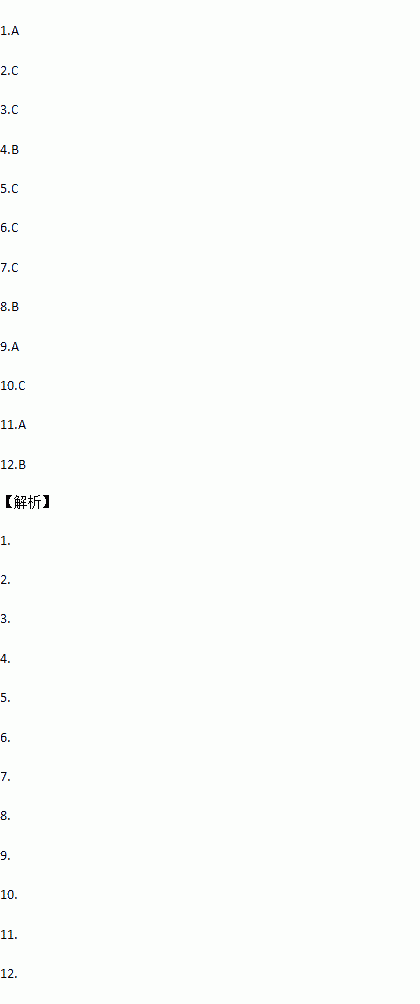
1.A. in B. on C. up D. over

2.A. lain B. remained C. set D. thrown

3.A. struck B. hit C. realized D. understood

4.A. top B. upper C. bottom D. lower

5.A. dragged B. headed C. wheeled D. approached

6.A. strength B. advantage C. disability D. happiness

7.A. affected B. infected C. melted D. frightened

8.A. command B. sense C. understand D. control

9.A. smiles B. laughter C. tears D. sweat

10.A. sorrow B. excitement C. warmth D. indifference

11.A. whenever B. whatever C. however D. whichever

12.A. offered B. taught C. gained D. drew
练习册系列答案
相关题目

Many parents have learned the hard way that what sounds like open communication is often the very thing that closes a youngster’s ears and month. One common mistake is The Lecture, the long monologue that often starts with “When I was your age….” Eighteen-year-old Kelly calls lectures “long, one-side discussions in which I don’t say much.”

Kids reflexively(条件反射地) shut down in the face of a lecture. Their eyes glaze over(呆滞), and they don’t register any incoming information. Listen to 13-year-old Sarah describe her least favorite times with her mom and dad. “First, they scream. Then comes the ‘We’re so disappointed’ speech. Then the ‘I never did that to my parents’ lecture begins. After that, even if they realize how ridiculous they sound, they never take it back.”

Lines like “When you have children of your own, you’ll understand” have been seriously said by parents since time immemorial. But many of our expert parents, like Bobby, a registered nurse and mother of three, feel that by falling back on clichés(陈词滥调) to justify our actions, we weaken our position.

Since kids are creatures of the here and now, the far-off future has no relevance to them. Therefore, good communicators like Bobby suggest, “Give specific reasons for your actions in present language: ‘I’m not letting you go to the party because I don’t think there will be enough adult supervisions(监护).’”

Betty, who lives in Missiouri, uses an indirect approach. “I find that warnings are accepted more readily if I discuss a news article on a subject I am concerned about. My husband and I talk about it while our children absorb the information. Then they never think I’m preaching.”

This really helped when Betty’s kids began driving. Instead of constantly repeating “Don’t drink; don’t speed,” she would talk about articles in the paper and express sympathy for the victims of a car crash. Betty made no special effort to draw her kids into the conversation. She depended on a teen-ager’s strong desire to put in his opinions---especially if he thinks he isn’t being asked for them.

1.The purpose of the passage is to _________.

A. compare two ways of parents` communicating with their kids

B. give parents advice on how to communicate with their kids

C. explain why kids won’t listen to their parents.

D. introduce kids` reaction to the communication between them and their parents

2.Which of the following statements is NOT right?

A. Kids won’t listen to their parents because they think what their parents say is boring.

B. Many kids think they have no right to express their own opinions.

C. Some kids think their parents should apologize when they are wrong.

D. Kids don’t like any discussion at all.

3.What does the underlined word in the first paragraph mean?

A. 独白 B. 对话

C. 插话 D. 讨论

4.Which of the following topic may appeal to kids?

A. Parents` own experience

B. Kids possible life in the future

C. Something related to kids` present life

D. What parents have done to their own parents.

5.In order to make kids follow their advice, parents should______.

A. tell their kids to listen carefully B. set out their warnings directly

C. list out as many examples as possible D. arouse kids` desire to express themselves.

Have your parents ever inspected your room to see if you cleaned it properly? Imagine having your entire houses, garage, and yard inspected at any time — with no warning. Inspections were a regular part of lighthouse (灯塔) living, and a keeper's reputation depended on results. A few times each year, an inspector arrived to look over the entire light station. The inspections were supposed to be a surprise, but keeper sometimes had advance notice.

Once lighthouses had telephones, keepers would call each other to warn that the inspector was approaching. After boats began flying special flags noting the inspector aboard, the keeper's family made it a game to see who could notice the boat first. As soon as someone spotted the boat, everyone would do last-minute tidying and change into fancy clothes. The keeper then scurried to put on his dress uniform and cap. Children of keepers remember inspectors wearing white gloves to run their fingers over door frames and windowsills looking for dust.

Despite the serious nature of inspections, they resulted in some funny moments. Betty Byrnes remembered when her mother did not have time to wash all the dishes before an inspection. At the time, people did not have dishwashers in their homes. In an effort to clean up quickly, Mrs. Byrnes tossed all the dishes into a big bread pan, covered them with a cloth and stuck them in the oven. If the inspector opened the oven door, it would look like bread was baking. He never did.

One day, Glenn Furst's mother put oil on the kitchen floor just before the inspector entered their house. Like floor wax, the oil made the floors shiny and helped protect the wood. This time, though, she used a little too much oil. When the inspector extended his hand to greet Glenn's mother, he slipped on the freshly oiled surface. "He came across that floor waving his arms like a young bird attempting its first flight," Glenn late wrote. After he steadied himself, he shook Glenn's mother's hand, and the inspection continued as though nothing had happened.

1.What does Paragraph I tell us about the inspection at the light station?

A. It was carried out once a year.

B. It was often announced in advance.

C. It was important for the keeper's fame.

D. It was focused on the garage and yard.

2.The family began making preparations immediately after ________.

A. one of the members saw the boat

B. a warning call reached the lighthouse

C. the keeper put on the dress uniform and cap

D. the inspector flew special flags in the distance

3.Mrs. Byrnes put the dishes in the oven because this would ________.

A. result in some fun

B. speed up washing them

C. make her home look tidy

D. be a demand from the inspector

4.The inspector waved his arms ________.

A. to try his best to keep steady

B. to show his satisfaction with the floor

C. to extend a warm greeting to Glenn's mother

D. to express his intention to continue the inspection

违法和不良信息举报电话:027-86699610 举报邮箱:58377363@163.com

精英家教网