题目内容

阅读下面材料,在空白处填入适当的内容(不多于3个单词)或括号内单词的正确形式。

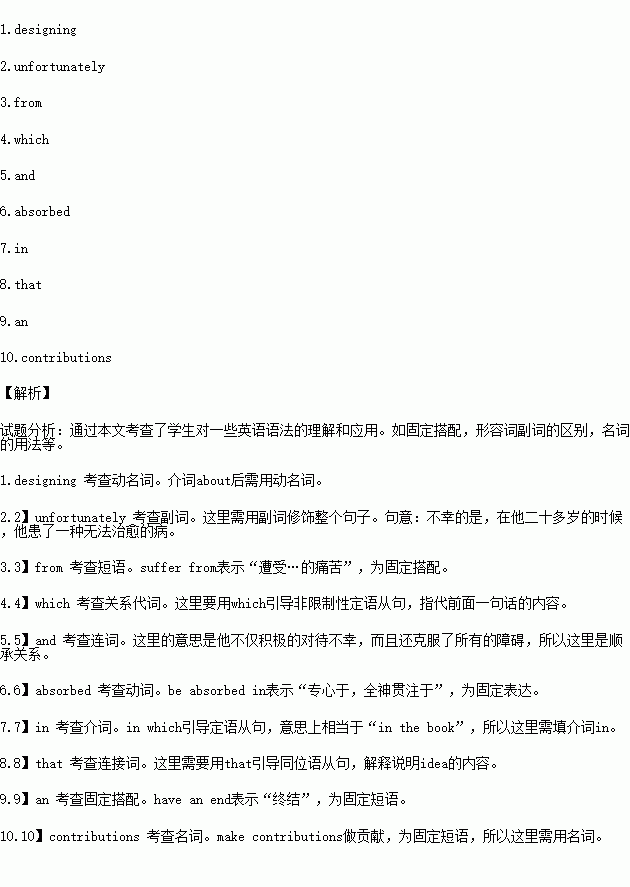
Stephen Hawking, who is the most famous physicist, was born in Britain on January 8th, 1942. As a child, he was enthusiastic about 1. (design) complicated toys but 2. (fortune), in his twenties, he suffered 3. a disease that was impossible to be cured, 4. was a great challenge for him. However, not only was he positive about the misfortunes 5. eventually he defeated all the obstacles but also he was 6. (absorb) in his research in the universe. In 1988, his best-seller A Brief History of Time was published, 7. which he put forward the idea 8. time itself has a beginning, and that it will have 9. end. In conclusion, he has made outstanding 10. (contribute) to the fields of cosmology and quantum gravity.
练习册系列答案
相关题目

“Never talk to strangers.” Many children are taught this simple rule as a precaution against abduction(诱拐). In June, 2005, an 11-year-old boy was lost in the Utah wilderness for four days. During that time, he stayed on the path. He saw people searching for him but deliberately hid from them, afraid someone might “steal” him. Eventually, the unfortunate game of hide-and-seek ended and he was found. According to the Canada Safety Council, this alarming incident shows how unwise it is to instill(灌输) a fear of strangers in children. The “stranger danger” message can prevent children from developing the social skills and judgment needed to deal effectively with real-life situations. In a difficult situation, a stranger could be their lifeline to safety.

To have a child go missing is a parent’s worst nightmare. The threat of abduction by a stranger is minimal when compared with other possible reasons for a disappearance. In 2004, there were 67,266 missing-children cases in Canada. Only 31 involved abduction; in most of those cases the abductor was a relative, friend, or person known to the family. There were 671 cases of children wandering off, and 332 cases of abductions by a parent. Almost 80 percent of all cases were runaways. These statistics cast doubt on the idea that children should never talk to strangers. Wandering off is more common — but a lost children may have to call upon a stranger for help, and must develop the ability to judge what kind of people to approach. The “never talk to strangers” rule does not protect children in the situations they are most likely to face. On top of this, it can be confusing. Adults do not model the behavior; they often talk to strangers. A child may not know how to tell who is a stranger, and who is not.

For young children, nothing replaces close supervision(监管). Pre-schoolers do not understand risk and tend to act without thinking. Children need to develop habits and attitudes that will protect them from the real threats and dangers they may face. The Canada Safety Council encourages parents to give their children age-appropriate positive messages about safety, bearing in mind how youngsters may understand their world.

1.Which of the following statements is NOT true about the 11-year-old boy?

A. He practiced the “never talk to strangers” rule.

B. He hid from the rescuers to avoid possible abduction.

C. He eventually showed up when his hide-and-seek game ended.

D. He stayed where he was, expecting the coming of familiar people.

2.Among the possible reasons for the missing-children cases in Canada, which one is the most frequent?

A. Being abducted by a parent.B. Wandering off.

C. Being abducted by strangers.D. Running away.

3.The “never talk to strangers” rule is confusing to children because __________.

A. a friendly and attractive person may be dangerous

B. adults do not act upon the rule and strangers are hard to tell

C. the rule does not protect children in the situation of abducting

D. a lost child may have difficulty in communicating with a stranger

4.Which would the author agree with about the “never talk to strangers” rule?

A. It is not well recognized by parents.

B. It is not effective in keeping kids safe.

C. It is easy enough for children to follow.

D. It is practical as a safety tip in daily life.

The cold and icy land that is the Eskimo's home is a dangerous one. The Eskimo once believed that to be safe from danger he had to obey taboos(禁忌). Taboos were rules that told him what he must do and must not do.

The Eskimo had taboos connected with almost everything he did. He had to keep them in mind at all times. He believed that to break one would bring disaster. For the Eskimo, it was taboo to store reindeer(驯鹿) and seal (海豹) meat together. He could not even eat them on the same day. He believed the Goddess Sedna had separated the land animals from the sea animals. He thought bringing them together would cause the hunting to be bad.

There were other taboos concerning animals. When a dead seal was brought into the house, the women had to stop working. They had to give its spirit a drink of water. If they did not, the spirit would be angered. It would keep other animals from being caught.

When the Eskimo broken a taboo, he believed a black cloud formed around his head. He had to tell the others in the village what he had done. He thought that if he did not tell his neighbors, they would catch the black cloud. Then the whole village would have bad luck.

1.This passage mainly tells us about ________.

A. the way the Eskimos treated their neighbours

B. the things that the Eskimos could and could not do

C. how the Eskimos store their seal meat

D. how the Eskimos got along with others

2.Why did the Eskimos separate reindeer and seal meat?

A. They went bad easily if they were kept together.

B. They thought keeping them together caused bad hunting.

C. The Eskimos did not like to eat reindeer or seal meat.

D. They did not have big enough rooms to store them.

3.From the third paragraph we can see that ________.

A. the spirit of the dead seal enjoyed drinking water

B. the spirit of the dead seal would be angry if he was not given water

C. the seal was dead, but its spirit was still alive

D. the Eskimos believed that animals had spirits

4.Which of the following is true?

A. There are many black clouds where the Eskimos live.

B. The Eskimos like land animals better than sea animals.

C. Taboos are of great importance to some people.

D. The Eskimo taboos are about everything on earth.

Planning a visit to the UK? Here we help with ways to cut your costs.

AVOID BIG EVENTS Big sporting events, concerts and exhibitions can increase the cost of accommodation and make it harder to find a room. A standard double room at the Thistle Brighton on the final Friday of the Brighton Comedy Festival (19 Oct.) cost £169.15 at Booking.com. A week later, the same room cost £118.15.

If you can be flexible and want to know dates to avoid—or you’re looking for a big event to pass your time—check out sites such as Whatsonwhen.com, which allow you to search for events in the UK by city, date and category.

STAYAWAY FROM THE STATION If traveling to your destination by train, you may want to find a good base close to the station, but you could end up paying more for the sake of convenience at the start of your holiday.

Don’t be too choosy about the part of town you stay in. Booking two months in advance, the cheapest room at Travelodge’s Central Euston hotel in London for Saturday 22 September was £95.95. A room just a tube journey away at its Covent Garden hotel was £75.75. And at Farringdon, a double room cost just £62.95.

LOOK AFTER YOURSELF Really central hotels in cities such as London, Edinburgh and Cardiff can cost a fortune, especially at weekends and during big events. As an alternative consider checking into a self-catering flat with its own kitchen. Often these flats are hidden away on the top floors of city centre buildings. A great example is the historic O’Neill Flat on Edinburgh’s Royal Mile, available for £420 for five days in late September, with room for four adults.

GET ON A BIKE London’s ‘Boris bikes’ have attracted the most attention, but other cities also have similar programmes that let you rent a bicycle and explore at your own pace, saving you on public transport or car parking costs.

Among the smaller cities with their own programmes are Newcastle (casual members pay around £1.50 for two hours) and Cardiff (free for up to 30 minutes, or £5 per day).

1.The Brighton Comedy Festival is mentioned mainly to show big events may ________.

A. help travelers pass time

B. attract lots of travelers to the UK

C. allow travelers to make flexible plans

D. cause travelers to pay more for accommodation

2.“Farringdon” in Paragraph 5 is most probably ________.

A. a hotel away from the train station

B. the tube line to Covent Garden

C. an ideal holiday destination

D. the name of a travel agency

3.The passage shows that the O’Neill Flat __________.

A. lies on the ground floor

B. is located in central London

C. provides cooking facilities for tourists

D. costs over £100 on average per day in late September

4.The main purpose of the passage is __________.

A. to tell visitors how to book in advance

B. to supply visitors with hotel information

C. to show visitors the importance of self-help

D. to offer visitors some money-saving tips

“Just ate chicken feet for lunch. ” These were the words I wrote on my blog yesterday. By the next day there were hundreds of comments from my friends. They ranged from “OH MY GOD! That is so disgusting! ” to “What were they like?” to “Why can’t you eat sandwiches like everyone else?”

To Chinese people, chicken feet are a normal snack. To my friends in Britain, the thought of eating a chicken’s foot is——well, weird (古怪的). As weird, in fact, as eating a bullfrog, scorpion(蝎子), snake, or turtle.

But if there are two things I love more than anything else in life, they are: trying new things and food.

I arrived in Beijing five months ago. Since then, I’ve searched for the “weirdest” foods so I can try them, then treat my friends to some “virtual(虚拟的)eating” on my blog.

One weekend, I went to Wangfujing, Beijing’s “snack street”. The trip gave me tons of blog material.

“I chose a stick with three live, wriggling(扭动的) scorpions on it,” I wrote. “And it was pretty good. The scorpion was warm and crispy. The legs did have a tendency to get stuck between one’s teeth, however. What’s more, I am sure scorpion number two stung me with its tail in revenge(报复).”

Next came snake: “A bit like a cross between fish and chicken, with a slightly rubbery texture and meaty taste.”

Some people were actually angry when I ate turtle soup——especially when I posted pictures showing the poor little guy’s head staring sadly up at us from the bowl. “I am never speaking to you again,” wrote one (former) friend.

Still, I will continue my culinary quest.

Next on my list is starfish, though I feel I should have some vegetables too——algae, maybe.

So what am I eating, tonight, you may ask. Pizza. Well, a girl’s gotta have a break sometimes.

1.What does the writer like most in life?

A. Trying new things and food.

B. Traveling.

C. Walking.

D. Shopping.

2.Where did the writer get her blog material?

A. From her friends.

B. From Wangfujing, Beijing’s “snack street”.

C. From Shopping.

D. From the Internet.

3.What is the writer’s friends’ attitude toward her trying “weird” foods?

A. They are satisfied.

B. They are happy.

C. They are surprised and even angry.

D. They are sorry.

4.Which of the following “weirdest” foods is the one writer hasn’t tried?

A. Chicken’s feet.B. Bullfrog.

C. Scorpion.D. Chicken’s head.

违法和不良信息举报电话:027-86699610 举报邮箱:58377363@163.com

精英家教网