题目内容

根据汉语意思,用所学的短语完成句子翻译。

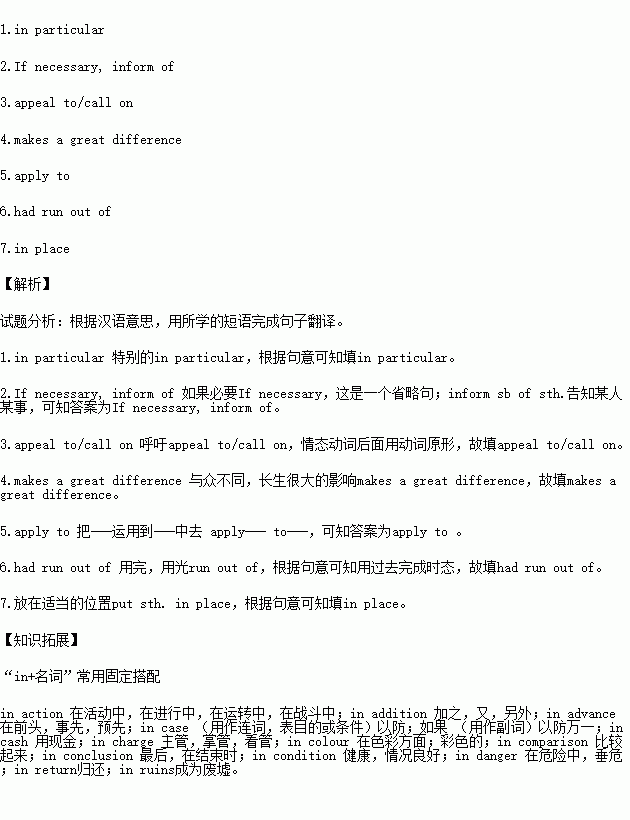
1.我在街上毫无目的地闲逛,也没想什么特别的事情。

I was wandering aimlessly in the street, thinking about nothing ______ ______.

2.如果有必要,我可以提前通知他们你到达的时间。

____ _ ______, I can _____ them ____ your arrival time in advance.

3.一方面,我们要呼吁公众去保护我们的环境。

For one thing, we should ______ _______ the public to protect our environment.

4.他早年的经历对他后来作为一名记者的生活有很大影响。

His early experience ______ ______ _______ __________ to his later life as a journalist.

5.我们应当把理论运用到实践中去,要不然这条理论是无用的。

We should ______ theory ____ practice; otherwise, it is no use.

6.事实上,Tom上周周末就已经没钱了。

As a matter of fact, Tom ______ ______ ______ ______ money by the end of last week.

7.在你离开办公室之前,所有东西都应该放在适当的位置。

Before you leave the office, everything should be put ______ ________.
练习册系列答案

相关题目

Bill Javis took over our village news-agency at a time of life when most of us only want to relax. He just thought he would like something but not too much to do, and the news-agency was ready-made. The business produced little enough for him, but Bill was a man who only wanted the simplicity and order and regularity of the job. He had been a long-serving sailor, and all his life had done everything by the clock.

Every day he opened his shop at six a.m. to catch the early trade; the papers arrived on his door-step before that. Many of Bill’s customers were city workers, and the shop was convenient for the station. Business was tailing off by 10 o’clock, so at eleven sharp Bill closed for lunch. It was hard luck on anybody who wanted a paper or magazine in the afternoon, for most likely Bill would be down on the river bank, fishing, and his nearest competitor was five kilometers away. Sometime in the afternoon, the evening paper landed on the doormat, and at 4 o’clock Bill reopened. The evening rush lasted till seven, and it was worthwhile.

He lived in a flat above the shop, alone. Except in the very bad weather, you always knew where to find him in the afternoon, as I have said. Once, on a sunny afternoon, I walked home along the river bank from a shopping trip to the village. By my watch it was three minutes past four, so I was astonished to see Bill sitting there on his little chair with a line in the water. He had had no luck, I could see, but he was making no effort to move.

“What’s wrong, Bill?” I called out from the path.

For answer, he put a hand in his jacket and took out a big, golden object. For a moment I had no idea what it could be, and then it suddenly went off with a noise like a fire engine. Stopping the bell, Bill held the thing up and called back, “Ten to four, you see, and this is dead right.”

I had never known anyone carrying a brass alarm clock round with him before.

1.Bill Javis became a news-agent when ________.

A. he needed the money.

B. he decided to take things easy

C. he was quite an old man

D. he gave up clock-repairing

2.Bill opened the shop so early in the day because ________.

A. he liked to do as much as possible before he went to work

B. the shop had to be open when the morning papers came

C. he was never sure of time

D. it was then that he did a lot of business

3.On that sunny afternoon, the writer was surprised when he saw Bill because _______.

A. he thought it was late for Bill to be still fishing

B. he thought Bill was ill, since he was not moving at all

C. Bill had not caught anything, and that seemed strange

D. Bill stayed in his flat

4.What’s the meaning of the underlined phrase in paragraph 2?

A. become noisy B. become less

C. become stronger D. become busy

Many a young person tells me he wants to be a writer. I always encourage such people, but I also explain that there's a big difference between “being a writer” and writing.

In most cases these individuals are dreaming of wealth and fame, not the long hours alone at a typewriter. “You've got to want to write,” I say to them, “not want to be a writer.”

The reality is that writing is a lonely, private and poor-paying affair. For every writer kissed by fortune there are thousands more whose longing is never rewarded. When I left a 20-year career in the U.S. Coast Guard to become a freelance writer (自由撰稿者), I had not prospects at all. What I did have was a friend who found me my room in a New York apartment building. It didn't even matter that it was cold and had no bathroom. I immediately bought a used manual typewriter and felt like a genuine writer. After a year or so, however, I still hadn’t gotten a break and began to doubt myself. It was so hard to sell a story that barely made enough to eat. But I knew I wanted to write. I had dreamed about it for years. I wasn’t going to be one of those people who die wondering. What if? I would keep putting my dream to the test even though it meant living with uncertainty and fear of failure. This is the Shadowland of hope, and anyone with a dream must learn to live there.

1.The passage is meant to ________.

A. warn young people of the hardships that a successful writer has to experience

B. advise young people to give up their idea of becoming a professional writer

C. show young people it's unrealistic for a writer to pursue wealth and fame

D. encourage young people to pursue a writing career

2.What can be concluded from the passage?

A. Genuine writers often find their work interesting and rewarding.

B. A writer's success depends on luck rather than on effort.

C. Famous writers usually live in poverty and isolation.

D. The chances for a writer to become successful are small.

3.“people who die wondering. What if?” ( Line 5, Para. 3) refers to “those ________”.

A. who think too much of the dark side of life

B. who regret giving up their career halfway

C. who think a lot without making a decision

D. who are full of imagination even upon death

4.“Shadowland” in the last sentence refers to ________.

A. the wonderland one often dreams about

B. the bright future that one is looking forward to

C. the state of uncertainty before one's final goal is reached

D. a world that exists only in one's imagination

Most people say “yes” much more readily than “no”.

A friend is moving house this weekend and would like some help, and you agree. But, what you really wanted was a couple of quiet days relaxing at home. Or a roommate spends the entire weekends playing video games and wants to borrow your homework for “reference”. But, you’ve just finished it after taking a whole day to work hard.

Many people say “yes” to those kinds of requests. They tend not to consider their own interests and feelings, and are often angry with themselves afterwards.

Saying “no” requires courage and considerable practice, in fact, according to psychologists.

“Everyone wants to be liked,” says Gabriel Steinki, a German psychologist. “Saying ‘no’ risk losing the affection of the person asking the favor or even a job.”

The result is that many people say “yes” just for keeping the peace. But experts say this is regrettable. Anyone should have the right to say “no”.

In fact, rejecting a request can even help to strengthen a relationship because it expresses a true feeling.

But, for people used to agreeing to every request, changing can be a long and uncomfortable learning process.

Most people believe that “If I say ‘no’, I’ll lose the affection of the person. But the affection is important to me.” This way of thinking can be replaced by this “If he only likes me because I always do what suits him, then the price of his affection is too high in the long term.”

Steinki says the key is talking to the other person to find a mutual(相互的) solution. “One needs to present the situation from one’s own point of view, and to suggest how the situation can be dealt with to the advantage of both parties. The other person must have the feeling that his interests are being considered.”

When the refusal is not accepted, Steinki advises giving the reasons calmly again until the person gets the message.

1. Most people say “yes” much more readily than “no” because ____________.

A. they don’t care about their own interests and feelings

B. they don’t know they will regret afterwards

C. they have already been used to saying “yes”

D. they care more about others’ affection

2. According to the writer, what should you do if you want to refuse the other person’s request?

A. Just say you can’t help him.

B. Say sorry to him.

C. Refuse him clearly.

D. Talk to the other person to find a mutual way.

3. According to the writer, what should you do if your refusal is not accepted?

A. Say yes to him.

B. Repeat your reason for his acceptance.

C. Just go away.

D. Say no to him.

4. What is the best title of the passage?

A. You Need Courage to Say “No”

B. “Yes” More than “No”

C. Nobody Has the Right to Say “No”

D. It’s Easy to Say “Yes”

Traveling in Vietnam was like visiting a mysterious neighbor. You have lived next door to each other for years but know very about what happened on side of the fence.

I travelled there last August. A(n) 180-kilometre trip from a Chinese border town to Hanoi, the capital of Vietnam, an adventurous eight hours. That’s the country still doesn’t have a modern expressway system. The major passage going through the country is only a two-way road. , many areas are mountainous.

Vietnamese drivers are and fearless. They compete with each other at full speeds no matter how scared the feel. When the bus shook us violently for the hundredth time, the driver made a to make us feel better. “See, this is just a(n) Vietnamese people give you, a free massage(按摩) service.”

It was midnight I reached that hotel. Switching on the television, I was by something: All the in the TV plays spoke in the same voice. , modern Korean plays and historical Chinese plays are with the Vietnamese. But it seemed they didn’t have enough to dub(为……配音)all these programs. So, the same boring woman appears every TV play to speak for the roles. The next morning when I opened the window, I found myself in a huge “ ”. The buildings in the streets were in all kinds of colors you can imagine. Vietnamese are allowed to their houses as they like. Each one was different. The large number of colors brought the city alive.

1.A. little B. much C. a lot D. few

2.A. another B. other C. either D. the other

3.A. long B. simple C. pleasant D. easy

4. A. took B. spent C. paid D. devoted

5.A. why B. when C. because D. where

6.A. Therefore B. However C. Also D. Otherwise[来源

7.A. wonderful B. impatient C. careful D. helpless

8.A. passengers B. policemen C. drivers D. passers-by

9.A. story B. joke C. promise D. statement

10.A. gift B. pleasure C. competition D. surprise

11.A. that B. until C. when D. while

12.A. excited B. embarrassed C. disappointed D. amazed

13.A. actresses B. actors C. characters D. channels

14.A. At present B. To be honest C. Sure enough D. Of course

15.A. satisfied B. received C. content D. popular

16.A. time B. budget C. people D. space

17.A. beside B. under C. over D. behind

18. A. film B. garden C. book D. cup

19.A. put B. set C. dressed D. filled

20.A. rent B. make C. live D. paint

违法和不良信息举报电话:027-86699610 举报邮箱:58377363@163.com

精英家教网