题目内容

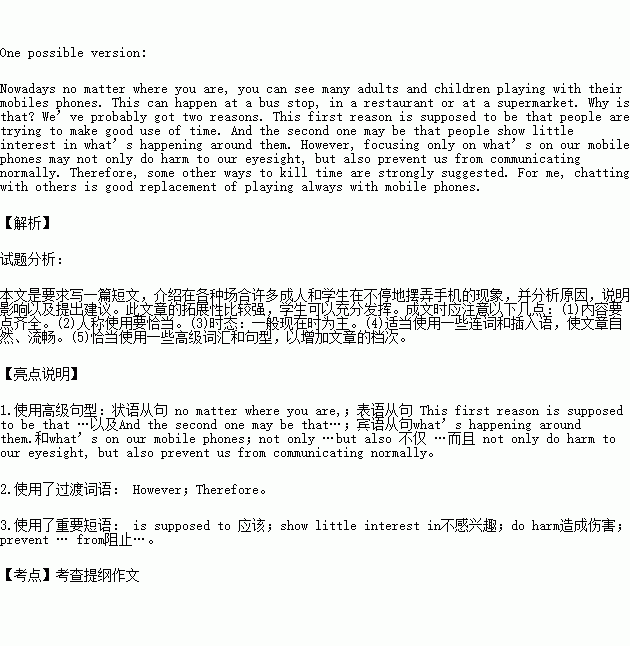
如今,在车站、餐厅、商场等公共场所都能看见许多成人和学生在不停地摆弄手机。现在,请你针对这一现象,用英语写篇短文。短文词数120字左右,要点必须包括:

1. 描述现象。 2. 分析原因(至少两条)。

3. 说明影响。 4. 提出建议。
练习册系列答案

相关题目

The day finally came, when I had to leave the warm home where I’d grown up. I ran to the back yard, as tears came up from my heart. Suddenly I __________ a hand rest on my shoulder. I looked up to __________ my grandfather. “It isn’t _________ , is it, Billy?” he said softly.

He gently _________ my hand in his, and then we walked, hand in hand, to the front yard, _________ a huge red rose-bush sat alone.

“What do you see here, Billy?” he asked. I looked at the flowers, not knowing _________ to say, and then answered, “I see something soft and _________ , Grandpa.”

He pulled me _________ . “It isn't just the roses that are beautiful, Billy. It’s that special place in your heart that makes them so.” “Billy, I _________ these roses when my first son was born. It was my _________ of saying ‘thank you’ to God. I _________ to watch him pick roses for his mother. Then, as a young man of only 20, a terrible war robbed him of his life.” Grandpa slowly stood up. “Never say good-bye, Billy. Never _________ to the sadness and the loneliness. Instead, I want you to remember the joy and the _________ when you first said hello to a friend.”

A year later, my grandpa became very _________ . Then all members of the family were _________ back, and I returned to the old house. When it came to my _________, I took his hand as _________ as he had once taken mine.

“Hello, Grandpa,” I _________ . His eyes slowly opened and said, “Hello, my friend.” With a brief (短迅的) _________ he died. Suddenly, and truly, I knew what he had _________ about never saying good-bye — about refusing to give in to sadness.

1.A. watched B. fixed C. felt D. heard

2.A. watch B. interview C. see D. discover

3.A. easy B. hard C. difficult D. comfortable

4.A. took B. made C. led D. carried

5.A. when B. where C. which D. while

6.A. whether B. how C. who D. what

7.A. beautiful B. tasty C. funny D. red

8.A. far B. hard C. close D. around

9.A. planted B. bought C. treated D. discovered

10.A. approach B. way C. method D. solution

11.A. preferred B. wanted C. used D. referred

12.A. give up B. give off C. give away D. give in

13.A. happiness B. word C. sight D. memory

14.A. weak B. ill C. old D. serious

15.A. ordered B. called C. delivered D. sent

16.A. pleasure B. duty C. wish D. turn

17.A. happily B. sadly C. gently D. carefully

18.A. laughed B. shouted C. whispered D. added

19.A. sign B. sigh C. wave D. smile

20.A. thought B. meant C. worried D. Cared

Oliver Radtke believes Chinglish mistranslations may be fun, but are not to be made fun of. “My message on Chinglish is: It should be conserved (保存). It shouldn’t be treated as a cheap joke for foreign tourists to laugh at but as a cultural treasure,” said the 32-year-old multimedia designer, who frequently visited China for almost a decade before moving to Beijing in 2007.

“I’m trying to challenge the idea that there is only one type of standard English — the English that’s spoken in America or in the British Isles — which is shortsighted, because Chinglish is already being used by millions of people to communicate with one another.”

So, since 2005, he has collected more than 5,000 examples of “the wonderful results of an English dictionary meeting Chinese grammar” on his website www.chinglish.de and has published two books on the subject.

“The two books are unique in that they talk about the academic value of Chinglish, the creative combination of English and Chinese, and why we should keep it,” Radtke said.

Patricia Schetelig, who works for the German Embassy in Beijing and regularly contributes to www.chinglish.de, said she appreciates Radtke’s approach to Chinglish.

“What’s important to me is that he’s not making fun of the way things are translated,” said she. “There are other websites doing similar things, but they’re making fun of Chinglish or saying it shouldn’t be done this way.”

Part of his mission, Radtke said, is to conserve rapidly disappearing Chinglish examples.

He was disappointed while watching the government replace Chinglish signs with standard English ones in the run-up to the Beijing Olympics. “That was a sad day for me and a sad day for Chinglish,” Radtke said.

But American David Tool, who has been closely involved in cleaning up Chinglish in Beijing since 2001, disagreed.

“Chinglish takes away from the aesthetic (美学的), educational and cultural value we want these signs to provide,” said Tool, “We get distracted when we’re trying to explain something. It’s not dealing with the issues with respect.”

1.Which of the following statements does Radtke agree with?

A. Chinglish will gradually disappear as years go by.

B. Chinglish is invented to amuse foreign tourists.

C. Chinglish will be treated as a cultural treasure.

D. Chinglish is actually a variety of English.

2.The two books are unique because it involves the following EXCEPT ________.

A. the academic value of Chinglish

B. the creativity of the Chinese people

C. the meaning of keeping Chinglish

D. the creative combination of English and Chinese

3.It can be inferred that David Tool and Radtke ________.

A. disagree on Chinglish signs

B. have both lived in China for nine years

C. once argued face to face about Chinglish

D. both have much knowledge of Chinese culture

违法和不良信息举报电话:027-86699610 举报邮箱:58377363@163.com

精英家教网