题目内容

短文改错

Dear Mary,

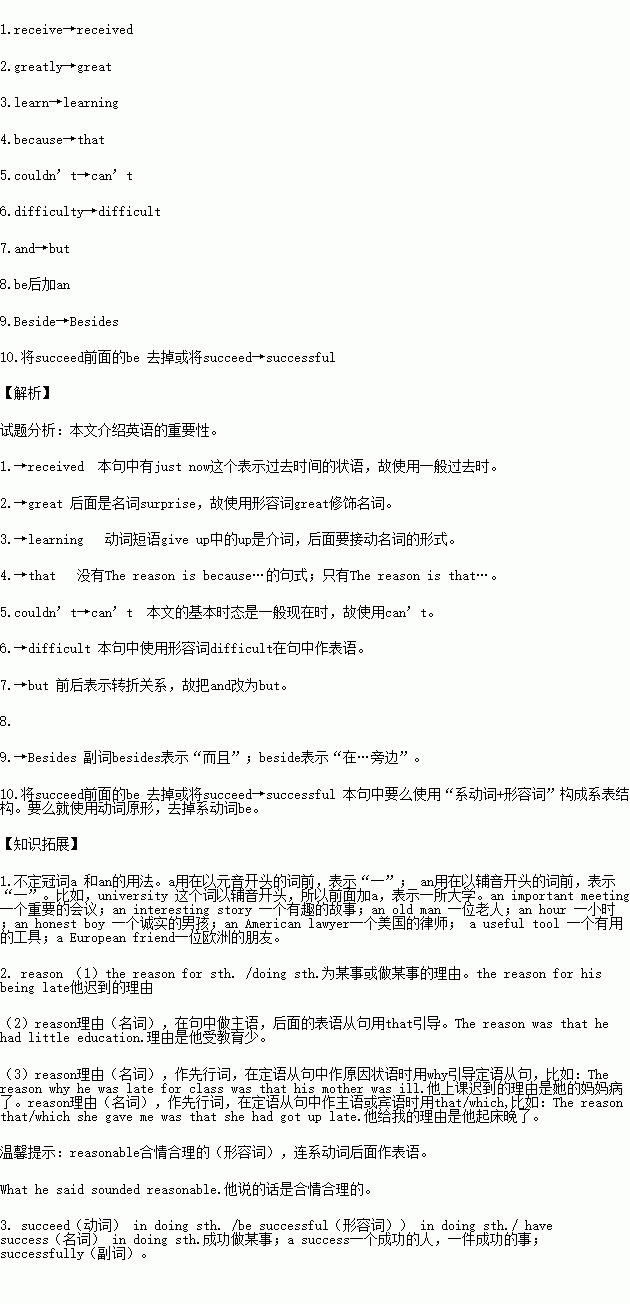
I receive your E-mail just now. Don’t worry about me. I’m getting on well with my research work in the lab. But to my greatly surprise you say you will give up learn English. The reason is because you have not done well in it recently and you have lost interests. I’m afraid I couldn’t agree with you. I know it is difficulty to learn English, and English is widely used in the world today. It will be important tool in our future work. Beside, it is becoming more and more important in our daily life. If you study hard, you will be succeed. Do remember that where there is a will, there is a way. I’ m looking forward to hearing good news from you.

Yours

Li Hua
练习册系列答案
相关题目

They wear the latest fashions with the most up-to-date accessories(配饰). Yet these are girls in their teens or twenties but women in their sixties and seventies. A generation which would once only wear old-fashioned clothes is now favoring the same high street looks worn by those half their age.

Professor Julia Twigg, a social policy expert , said ,“Women over 75 are now shopping for clothes more frequently than they did when they were young in the 1960s .In the 1960s buying a coat for a woman was a serious matter . It was an expensive item that they would purchase only every three or four years — now you can pick one up at the supermarket whosever you wish to .Fashion is a lot cheaper and people felt tired of things more quickly . ”

Fashion designer Angela Barnard ,who runs own fashion business in London ,said older women were much more affected celebrity(名流) style than in previous years .

She said, “When people see stars such as Judi Dench and Helen Mirren looking attractive and fashionable in their sixties ,they want to follow them . Older women are much more aware of celebrities .There’s also the boom in TV programs showing people how they can change their look, and many of my older customers do yoga to stay in shape well in their fifties . When I started my business a fen years ago .my older customers wended to be very rich, but now they are what I would call ordinary women .My own mother is 61 and she wears the latest fashions in a way she would call ordinary women .My own mother is 61 and she wears the latest fashions in a way she would never have done ten years ago.”

1. Professor Twigg found that ,compared with the 1960s,_______.

A. the price of clothes has generally fallen by 70%

B. the spending on clothes has increased by 5% or 6%

C. people spend 30% less than they did on clothes

D. the amount of clothes bought has risen by 5% or 6%

2. What can we learn about old women in terms of fashion?

A. They are often ignored by fashion designers .

B. They are now more easily influenced by stars .

C. They are regarded as pioneers in the latest fashion .

D. They are more interested in clothes because of their old age .

3.It can be concluded that old women tend to wear the latest fashions today mainly because.

A. they get tired of things more quickly

B.TV shows teach them how to change look

C. they are in much better shape now

D. clothes are much cheaper than before

4.Which is the best possible title of the passage ?

A. Age Is No Barrier for Fashion Fans

B. The More Fashionable ,the Less Expensive

C. Unexpected Changes in Fashion

D. Boom of the British Fashion Industry

The Internet has opened up a whole new online world for us to meet, chat and go where we’ve never been before.

But just as in face to face communication, there are some rules of behavior that should be followed when on line. 1. Imagine how you’d feel if you were in the other person’s shoes.

For anything you’re about to send: ask yourself, “Would I say this to the person’s face?” if the answer is no, rewrite and reread. 2.

If someone in the chat room is rude to you, your instinct (本能) is to fire back in the same manner. But try not to do so. 3. If it was caused by a disagreement with another member, try to fix the situation by politely discussing it. Remember to respect the beliefs and opinions of others in the chat room.

4. Offer advice when asked by newcomers, as they may not be sure what to do or how to communicate. When someone makes a mistake, whether it’s a stupid question or an unnecessarily long answer, be kind about it. If it’s a small mistake, you may not need to say anything. Even if you feel strongly about it, think twice before saying anything. Having good manners yourself doesn’t give you license to correct everyone else. 5. At the same time, if you find you are wrong, be sure to correct yourself and apologize to those that you have offended.

It is not polite to ask others personal questions such as their age, sex and income. Unless you know the person very well, and you are both comfortable with sharing personal information, don’t ask such questions.

A. It’s natural that there are some people who speak rudely or make mistakes online.

B. Repeat the process till you feel sure that you’d feel comfortable saying the words to the person’s face.

C. Everyone was new to the network once.

D. The basic rule is simple: treat others in the same way you would want to be treated.

E. When you send short messages to a person online, you must say something beautiful to hear.

F. You should either ignore the person, or use your chat software to block their messages.

G. If you do decide to tell someone about a mistake, point it out politely.

A young British woman had shortly arrived in Hongkong and had not yet 16 anything about the Chinese 17 . One day she went to the home of a Chinese friend and was 18 given a cup of Chinese tea. She was not 19 and she also found this type of tea rather 20 . However, since she had been given the tea, she felt she should drink it. Hoping to finish it 21 so that she would not feel about having to drink this tea which she did not 22 , she started to drink as much of it as she could. But as soon as her cup became half-full, the host 23 giving her more. Several times she told the host that she had had 24 , but it seemed to have no 25 . Her cup kept being 26 , and she kept on drinking. During the time of her 27 , she drank about twelve cups of tea. Later she found out that she should have just 28 the tea, and that this would have meant that she had had enough. Influenced by her 29 culture, she felt it too 30 to leave the tea and could not understand why the host took no notice of her protests(抗议) that she had had enough!

1.A. learnedB. gotC. rememberedD. taught

2.A. languageB. cultureC. habitD. food

3.A. certainlyB. hardlyC. immediatelyD. carefully

4.A. happyB. tiredC. interestedD. thirsty

5.A. sweetB. bitterC. coldD. nice

6.A. slowlyB. in timeC. quicklyD. gradually

7.A. haveB. takeC. buyD. like

8.A. stoppedB. insisted onC. practicedD. tried

9.A. someB. a littleC. allD. enough

10.A. importanceB. endC. effectD. value

11.A. filledB. changedC. movedD. emptied

12.A. visitB. talk

C. partyD. investigation

13.A. leftB. absorbedC. drunkD. filled

14.A. ancientB. modernC. easternD. western

15.A. impoliteB. politeC. easyD. uneasy

阅读下面短文,掌握其大意,然后从36—55各题所给的四个选项(A、B、C和D)中,选出最佳选项填入答题卡。

My father often works very hard. And he has___ to see a movies. Here I’ll tell you about him.

One afternoon, when he finished his work and go home, he found a film ticket under the on his desk. He thought he to have not much work to do that day and was quite wonderful to pass the at the cinema. So he came back home and finished his supper. Then he said to us and left.But to our , he came back about half an hour later, I him what was the matter. He smiled and told us about funny thing that had happened at the cinema.When my father was sitting in his seat, a came to my father’s and said that the seat was . My father was surprised. He took out the ticket looked at it carefully. It was Row17, . And then he looked at the seat. It was the same. So he asked her her ticket. She took out the ticket at once and the seat shown in it was Row 17, Seat 3.

? What’s the matter with all this? While they were wondering(想知道), suddenly the woman said, “The of the tickets are different.” So they looked at the ticket more carefully. After a while, my father said, “Oh, , I made a mistake. My ticket is for the film a month ago. Take this seat, please.” With these words, he left the cinema.

1.A. little money B. much money C. little time D. much time

2.A. a funny story B. a good story C. an old story D. a strange story

3.A. has to B. was about to C. had to D. ought

4.A. box B. book C. glass D . paper

5.A. happened B. liked C. pretended D. wanted

6.A. it B. this C. that D. which

7.A. morning B. afternoon C. day D. evening

8.A. early B. quietly C. quickly D. suddenly

9.A. hello B. good-bye C. good evening D. good night

10.A. disappointment B. joy C. sorrow D. surprise

11.A. asked B. explained C. told D. wanted

12.A. a B. one C. some D. the

13.A. man B. woman C. doctor D. nurse

14.A. hers B. his C. taken D. wrong

15.A. and B. but C. or D. so

16.A. Seat1 B. Seat2 C. Seat3 D. Seat4

17.A. it bring B. to get C. to see D. to show

18.A. Why B. How C. When D. where

19.A. designs B. days C. dates D. owners

20.A. I’m sad B. I’m sorry C. I’m wrong D. I’m worried

Japan’s youth are losing interest in science and as a result, threatening the nation’s industrial progress. According to Japan Science and Technology Agency, young Japanese are surrounded by high-tech devices(设备), but are not interested in how they work.

Japanese businesses have succeeded partly because they’ve a great many engineers. A drop in interest could lead to a decline(减少) in their numbers and quality. "In the past, the young had a big interest in science and technology," said Hirano, director of the agency’s policy department.

There are two main reasons for the problem. The first is known as "black box syndrome" of modern technology.

Electronic devices depend on tiny silicon chips(芯片), which can only be made in big factories, whose workings can’t be seen by the eyes. The devices, unlike machines of the past driven by gears and wheels, are simply boxes.

Young Japanese, brought up on video games and at home with computers, enjoy using modern technology, but this is a passive interest and different from the interest in how things work. "You need an active interest to get interested in science. This is declining in the young," said Hirano.

About two-thirds of Japanese in their 20s use PCs, twice the number of those in their 50s. But only 40% of those in their 20s say they are interested in news about science and technology, compared to 60% of the 50 to 60 year olds.

"Another reason for it is that life in modern Japan is too comfortable," he said. "A wealthy society reduces people’s desire to modernize and develop their country. To a degree, you can’t avoid this when the fruits of science and technology are fully developed." Similarly, science in Europe and the US has also suffered a lack of interest.

1.Japanese youth’s interest in science is dropping probably because ________.

A. scientists don’t make much money in Japan

B. there are too many scientists in Japan already

C. they’re not interested in how high-tech devices work

D. science is more difficult for young people to learn

2.The underlined word "their" (in Para. 2) refers to ________.

A. Japanese engineers’

B. Japanese businesses’

C. Japan’s young people’s

D. high-tech devices’

3.Why does science meet the same problem in Japan, the US and Europe?

A. People believe they don’t need to develop their science any more.

B. People are satisfied with the comfortable life high-tech devices bring to them.

C. People think high-tech devices destroy the environment.

D. People don’t want to live the modernized life.

4.Which of the following is NOT true according to the passage?

A. Older people are probably more interested in science in Japan.

B. About one-third of Japanese people in their 50s use computers.

C. Japan’s youth live too comfortably to take interest in science.

D. Electronic devices are made of parts that can not be seen at all.

违法和不良信息举报电话:027-86699610 举报邮箱:58377363@163.com

精英家教网