题目内容

【题目】You should try to be patient, Tracy. Learning a language is a slow __________. It takes time, you know.

A. system B. project

C. technology D. process

【答案】D

【解析】句意:Tracy,你应该有耐心。学习一门语言是一个很慢的过程。你知道它需要时间。system体系;project 项目;technology 技术;process 进程。

练习册系列答案
相关题目

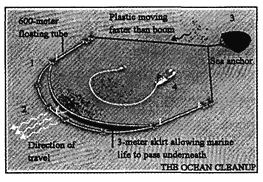
【题目】 "When I was 16 years old, I was diving in Greece, but I was disappointed because I saw more plastic bags than fish.” These are the words of Boyan Slat, an engineer who designed the world's first ocean plastic cleanup system.

Every year, more than 8 million tons of plastics end up in our oceans, according to the UN Environment Programme. It is predicted that the weight of ocean plastics will match the weight of all the fish in our oceans by 2050. To prevent this from happening, in 2013 Slat created the Ocean Cleanup, an environmental nongovernmental organization, and put his plan for an ocean cleanup device into action.

After years of research and development in the Netherlands, a device called System 001/B successfully started gathering plastics on October 2, 2019. The device uses a 600-meter-long C-shaped tube to gather all the floating rubbish. Unlike other cleanup methods, the system floats freely according to the direction of the waves, which allows waste to flow into and stay within the device. A sea anchor is attached to either end. This slows down the system as it floats through the water and allows the faster-moving rubbish, carried by the waves, to flow into its mouth. System 001/B can also collect waste below the surface using a 3-meter-deep skirt(挡板)attached to the end. After being gathered, the trash will be dragged back to shore by boat and recycled.

Right now, the system operates in the Great Pacific Garbage Patch, an area that is 3 times the size of France. Once operational, the Ocean Cleanup expects a full fleet to be able to clear 50% of the Great Pacific Garbage Patch in 5 years.

"It remains to be seen whether this dream will become a reality, but it is undeniable that humanity must work together to reduce our plastic use and repair the damage our waste has caused," Slat said. "We are starting to see a young generation that gets it and is excited about a sustainable (可持续的)future, but the question still comes down to: Are we going fast enough, and how much damage will have been done before we get there?"

1The underlined word “match” in Paragraph 2 probably means “_________”.

A.compareB.equal

C.measureD.cover

2Why did Boyan Slat create the Ocean Cleanup?

A.To collect ocean plastic waste.

B.To help to invent System 001/B.

C.To protect the living environment of fish.

D.To do research on the ocean environment.

3What can we know about System 001/B?

A.It can collect and recycle garbage at the same time.

B.It can only gather ocean waste which floats on the water.

C.It aims to clear up the Great Pacific Garbage Patch in five years.

D.It is an ocean-cleaning device which has already been put to use.

4What does Slat want to tell us according to the last paragraph?

A.Young generations care less about the environment.

B.The future ecology of the oceans is deeply worrying.

C.People should work hard to decrease plastic pollution.

D.It's quite difficult to repair the damage to the environment.

【题目】阅读理解
D
A buld-it-yourself solar still(蒸馏器) is one of the best ways to obtain drinking water in areas where the liquid is not readily available. Developed by two doctors in the U.S. Department of Agriculture, it's an excellent water collector. Unfortunately, you must carry the necessary equipment with you, since it's all but impossible to find natural substitutes. The only components required, though, are a 5' 5' sheet of clear or slightly milky plastic, six feet of plastic tube, and a container— perhaps just a drinking cup — to catch the water. These pieces can be folded into a neat little pack and fastened on your belt.
To construct a working still, use a sharp stick or rock to dig a hole four feet across and three feet deep. Try to make the hole in a damp area to increase the water catcher's productivity. Place your cup in the deepest part of the hole. Then lay the tube in place so that one end rests all the way in the cup and the rest of the line runs up — and out — the side of the hole.
Next, cover the hole with the plastic sheet, securing the edges of the plastic with dirt and weighting the sheet's center down with a rock. The plastic should now form a cone(圆锥体) with 45-degree-angled sides. The low point of the sheet must be centered directly over, and no more than three inches above, the cup.
The solar still works by creating a greenhouse under the plastic. Ground water evaporates (蒸发) and collects on the sheet until small drops of water form, run down the material and fall off into the cup. When the container is full, you can suck the refreshment out through the tube, and won't have to break down the still every time you need a drink.
(1)What do we know about the solar still equipment from the first paragraph?
A.It's delicate.
B.It's expensive.
C.It's complex.
D.It's portable
(2)What does the underlined phrase “the water catcher” in paragraph 2 refer to?
A.The tube
B.The still
C.The hole
D.The cup
(3)What's the last step of constructing a working solar still?
A.Dig a hole of a certain size
B.Put the cup in place
C.Weight the sheet's center down
D.Cover the hole with the plastic sheet
(4)When a solar still works, drops of water come into the cup form.
A.the plastic tube
B.outside the hole
C.the open air
D.beneath the sheet

违法和不良信息举报电话:027-86699610 举报邮箱:58377363@163.com

精英家教网
