题目内容

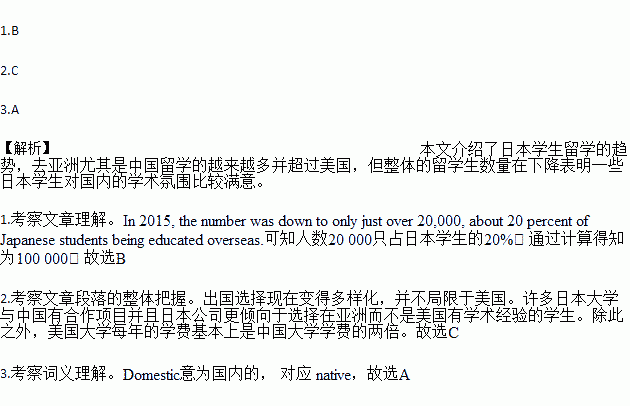
The number of Japanese students in the Chinese mainland is more than those studying in the US, according to Japan's Ministry of Education, Culture, Sports, Science and Technology, a Taiwan news outlet reported on Monday.

Japan saw the peak of studying abroad in 2010 when 124,000 sought academic careers overseas. About 61,000 Japanese studied in the US in 2010, about half the total studying abroad. But since then, the number has decreased. In 2015, the number was down to only just over 20,000, about 20 percent of Japanese students being educated overseas.

The number of Japanese going to the Chinese mainland to study has been rising since 2009 and now surpasses the US.

An official spokesman said, "Choices are various for studying abroad nowadays, not just limited to the US. Many Japanese universities have an increasing number of exchange pro-grams with Chinese universities and Japanese companies now tend to prefer people with academic experience in Asia rather than the.US or Europe as previously. Tuition fees (学费)are another reason. Annual fees in US universities are almost twice those charged by Chinese

universities.”

Some Japanese experts say the decline indicates young Japanese are satisfied with the domestic situation rather than preparing for challenges outside.

1.How many Japanese students studied abroad in 2015?

A. About 61,000. B. About 100,000.

C. About 124,000. D. About 200,000.

2.What does the fourth paragraph mainly talk about?

A. The tuition fees about studying in the US.

B. The choices for Japanese students to study abroad.

C. The reason why Japanese students go to study in China.

D. The problems that Japanese students have when studying in China.

3.The underlined word “domestic” in the last paragraph is closest in meaning to “ ”.

A. native B. previous

C. complex D. simple
练习册系列答案
相关题目

Denny Parker lived in a bad place. Because of a youth gang(帮派), he wanted to leave the area. The gang often caused trouble in the high school. As he was walking out of history class one day, Denny bumped(撞上) into another student. “Sorry,” he said, and kept walking. But he was stopped. Turning around, he found himself facing a very large, angry boy. It was Bill Douglas, a member of the gang!

“Hey,you pushed me!” Bill cried.

“Come on, Bill,” answered Denny, “I said I was sorry.”

“You're going to be sorry,” Bill said. “I will give you a lesson after school.”

“Oh, no,” thought Denny, hurrying to his next class. “I'm in trouble now.” The more he thought about it, the more fearful he became.

Then a word came to Denny's mind—courage. He decided to face it with courage. He had nothing to lose—except a few teeth. After school, many students waited on the corner. News had spread that there would be a fight. Bill Douglas and his gang were waiting, too.

“Hey, Parker,” Bill laughed as Denny walked near. “Let me teach you a lesson.”

Denny answered loudly, “Well, come on. I'm not afraid.”

There was silence. Then the students began to applaud(鼓掌).They cried, “Denny! Denny!” The noise was very loud. The gang members ran away one by one. Denny won with his courage.

1.Bill was going to _________.

A. give Denny a good beating

B. teach Denny how to fight

C. teach Denny how to be polite

D. talk about some problems with Denny

2.What decision did Denny make at last?

A. He needed to say sorry to Bill.

B. He should face Bill with courage.

C. He must tell the teacher everything.

D. He had to ask the other students for help.

3.Which of the following is NOT true?

A. The students hoped that Denny would win the fight.

B. At first, Denny was afraid that the gang members would beat him.

C. The students were unhappy when they saw the gang members run away.

D. At first, Bill thought that Denny was afraid of him.

违法和不良信息举报电话:027-86699610 举报邮箱:58377363@163.com

精英家教网