题目内容
-Is the money your parents give you enough?
-No, I have to have a part-time job to ________ my school expenses.
A.cost
B.pay
C.cover
D.offer

 千里马走向假期期末仿真试卷寒假系列答案
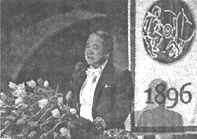
Neatly putting an emphasis on his storytelling skill is how writer Mo Yan began his Nobel Lecture in Literature speech, “Storyteller”, on Friday (Saturday, Beijing time) in Stockholm.
For 40 minutes he talked about his mother’s 36 on him as a person and a writer, his literary inspirations, and how he 37 with the controversy(争论)that followed the announcement of his Nobel victory.
He told his audience that as a boy he told stories to cheer up his mother, and 38 that poverty and loneliness fueled his imagination as a writer after he grew up. 39 , authors such as William Faulkner and Gabriel Garcia Marquez 40 him, he said, especially their bold and unlimited writing style.
“A person should be 41 in daily life, but follow one’s instinct(本能)and take control when it 42 to literary creation.”
He said the soul of 43 all of his works is the boy in Transparent Carrot who has an almost superhuman ability to bear 44 . He added that he also tried to make his hometown of Gaomi in Shandong Province a microcosm(缩影)of China and even the 45 .
His greatest challenge, he said, was writing novels that deal with 46 realities.
“In writing about the dark aspects of society there is a(n) 47 that emotions and anger allow politics to limit literature.”
He said literature must be 48 on real life but go beyond it.
He also mentioned the 49 surrounding his selection as Nobel winner, saying he was showered with many flowers. 50 he was a target for “stone throwers”.
“At first I thought I was the 51 of the controversies, but over time I’ve come to realize that the real target was a person who had 52 to do with me.”
Mo 53 his lecture by saying he was made to feel like an actor in a play with all the attention he was 54 , but he had decided that the best way to communicate his thoughts was to __55 writing.
| 【小题1】 |
|
| 【小题2】 |
|
| 【小题3】 |
|
| 【小题4】 |
|
| 【小题5】 |
|
| 【小题6】 |
|
| 【小题7】 |
|
| 【小题8】 |
|
| 【小题9】 |
|
| 【小题10】 |
|
| 【小题11】 |
|
| 【小题12】 |
|
| 【小题13】 |
|
| 【小题14】 |
|
| 【小题15】 |
|
| 【小题16】 |
|
| 【小题17】 |
|
| 【小题18】 |
|
| 【小题19】 |
|
| 【小题20】 |
|
Mo Yan, the winner of this year’s Nobel Prize for Literature, said he is not sure about whether he is happy after winning the prize.
In an interview with China Central Television broadcast on Sunday night, Mo said “I don't know,” when a reporter asked if he was happy.“Happiness means a healthy body and a total absence of mental burdens, but now I’m under high pressure and bothered by worries. Can I say that I'm happy?” he said. “But if I say I'm not happy, people will consider that I'm striking a pose. How could you be unhappy after winning the Nobel Prize?”
Mo, born into a farmer’s family in East China’s Shandong province, As a 12-year-old during the Cultural Revolution he left school to work, first in agriculture, later in a factory. In 1976 he joined the People’s Liberation Army and during this time began to study literature and write. His first short story was published in a literary journal in 1981.
“In his writing, Mo Yan draws on his youthful experiences and on settings in the province of his birth. This is apparent in his novel Hong gaoliang jiazu (1987, in English Red Sorghum 1993),” said the academy in a statement of Mo’s biography. Red Sorghum was successfully filmed in 1987, directed by famous Chinese director Zhang Yimou.
Mo won the Nobel Prize for Literature, which is worth $1.2 million, on Oct 11 for his “hallucinatory realism” which merges “folk tales, history and the contemporary”. Dozens of his works have been translated into English, French and Japanese and many other languages.
He is the first Chinese citizen to win the prize.The award sparked strong interest about contemporary Chinese literature among the public, and his books have been flying off the shelves in many bookstores across the country.
【小题1】The followings are TRUE except_____________.
| A.He has won about 8 million yuan. |
| B.His works are all about farmers. |
| C.He has a big influence on Chinese contemporary literature. |
| D.Reporters have interviewed him about his winning. |
| A.He won the prize because of his story Red Sorghum. |
| B.He wanted to become a writer when he was very young. |
| C.Mo Yan’s works have been translated into Russian. |
| D.Mo Yan was born in a farmer family. |
| A.His different work. | B.His early life. |
| C.He switched over to literature. | D.His family and hometown. |
| A.Mo Yan is very happy to win the Nobel Prize. |
| B.More and more readers are buying Mo’s books to read in China. |
| C.Winning the Nobel Prize is not easy. |
| D.Mo Yan won the prize with the help of Zhang Yimou. |
Chinese writer Mo Yan’s Nobel Prize for Literature might ignite an explosion of global interest in Chinese literature and lead to more titles translated into English, European experts say.
“Hopefully, the award means more people will read Chinese literature and more works will get translated,” says Michel Hockx, professor of the Languages and Cultures of China and Inner Asia from University of London. “Many very good Chinese writers have been accepted globally for a long time already. Mo Yan is probably the most translated Chinese writer alive, with at least five of his novels made available in English over the past 20 years.”
Jonathan Ruppin, web editor of bookseller Foyles, says Mo’s win coincides with growing interest in Chinese literature and recognizes the talents of a distinctive and visionary(富于幻想的)writer. “We are very excited by the fact that English translations of more of his books should now become available,” Ruppin says. He made the comment after Mo became the first Chinese citizen to win the Nobel Prize for Literature in its century-long history.
As East-West cultural exchange has been booming, Chinese literature has been attracting growing attention in recent years. Hockx explains, “It’s mainly because there are many more opportunities for Chinese writers to visit other countries, to publish their works outside China and to interact with readers abroad. At the same time, more and more people globally are learning Chinese and taking an interest in the Chinese language and culture.”
University of Oxford lecturer in modern Chinese literature Margaret Hillenbrand says, “The obvious reason for the growing global presence of Chinese literature is the growing global presence of China itself. People have come to realize that there is a serious knowledge deficit (缺少)between China and its international counterparts — in particular, China knows incomparably(无比地)more about Europe and America than the other way round — and reading Chinese literature is an effective, simple means of solving that gap.”
【小题1】The underlined word “ignite” in Paragraph 1 probably means “________”.
| A.start out | B.burn up | C.set off | D.appeal to |
| A.Chinese writers have been writing more and more books in English |
| B.the Chinese language has become the most widely used language in the world |
| C.the Chinese government attaches great importance to literature |
| D.the cultural communication between China and western countries has developed |
| A.Chinese literature has spread with the development of China. |
| B.The Nobel Prize for Literature has a history of hundreds of years. |
| C.In the past, no Chinese writers were accepted outside China. |
| D.Foreigners know about China mainly by reading Mo Yan’s works. |
| A.China knows more about Europe and America than before. |
| B.China knows more about Europe and America than they know about China. |
| C.China, Europe and America know one another more than before. |
| D.Compared with America, China knows more about Europe. |